


 Francais
 Deutsch
 Italiano
Refine Your Search
New Mexico United States 1946 stock footage and images
- Showing 25123 to 25128 of 30777 results more
more Hide
Hide
American Military Government commences the reconstruction of Cologne after World War II.
Reconstruction of Cologne, Germany. Aerial views of Cologne, Germany in 1930, before its destruction in World War II. Shows pre-war Cologne Cathedral and Hohenzollerm Bridge on the Rhine river. Various buildings in Cologne including train station. Scene change to Fuhrer Adolf Hitler speaking. Aerial and street views of damaged bridges and buildings in Cologne after World War II. Destroyed sewer pipes, piles of rubble in Cologne. American Military Government men, also known as "MG" lined up in streets, in uniform, wearing soldier helmets. They salute. The U.S. flag is raised. Signs behind men read, ""Militarregierungsamt" and "military government" Close up faces of MG soldiers. Large groups of civilians crossing the newly named McNair bridge. Sign reads, "Lt. Gen. Lesley J. McNair Bridge Designed by 1067 Eng. Const. Gp". A U.S. military government officer wearing a lip microphone addresses a crowd of civilians. Close-up views of German civilians as they listen. Truck equipped with horn-loaded PA speakers amplifies speech. German men, women, and children are deloused using DDT, which is sprayed in power form into their clothing. A German man with a SS blood type tattoo under his left arms is examined. The tattoo identifies him as a former Nazi German SS soldier. Germans in line to be interviewed for new military government positions. A man stopping and examining papers of a German citizen. Germans civilians at interview table being questioned. They sign the interview papers using a fingerprint. The first German police force of Cologne, Germany following World War II. They are given arm bands reading, "MG-Police." The former head of the Prussian Senate on camera, identified as one who fought the Nazis.
German troops invade Russia and Joseph Goebbels announces it on radio during World War 2.
German invasion of Russia, Soviet Union (Operation Barbarossa). Early morning in Berlin with quiet street scenes during World War II. Hands of a clock in view. A man unloads milk cans from a truck. German radio broadcasting studios. A man operates controls. View of radio tower and buildings. Men enter an office. A sign announces broadcast in progress and requests quiet and no entry. Propaganda Minister Dr Joseph Goebbels enters the room and sits on a sofa. He announces Germany has launched an offensive on the Eastern Front as Germany's actions represent declaration of war against the Soviet Union. Officers stand in the background. Several men seated in cars, listen to radio broadcast. German Foreign Minister Joachim von Ribbentrop makes the announcement to journalists at a crowded news conference. Newspapers carry the story. Cameramen take photographs. Animated map depicts the Eastern front extending more than 5 thousand kilometers from Finland in the North to Romania in the South. This is Operation Barbarossa. German troops invade Russia. A ship underway and a bridge in view. Heavy German guns bombard targets. Smoke rises up. Street signs such as "Eydtkau" are shown as evidence of advances. German troops dismantle border barriers. German tanks and artillery advancing Eastward, encountering resistance. They blow up a building.

Duke of Kent visits the Martin Aircraft production plant in Middle River, Maryland during World War 2.
Prince George, Duke of Kent, from Great Britain, arrives at Martin aircraft plant in Middle River, Maryland during World War II. Prince George is dressed in his Air Commodore uniform and is accompanied by officers. Aircraft in the background. The workers of the plant cheer. He inspects the bomber aircraft including a parked Martin B-26 Marauder bomber. The Duke of Kent tries his hand at a new jeep.
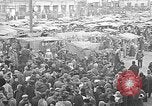
People gathered on streets and open marketplace in Moscow, Russia.
A huge crowded open-air market in Moscow, Soviet Union, seen in wintertime. Merchants' stalls are partly covered against the weather. Throngs of customers patronize the merchants. Crowds fill a space between large buildings and a river. View of fence at the river, with snow and ice below. Scene shifts to outdoor market is a more rural area. Sign above one booth advertises lighters. Back at the city market, several smiling children and two older men converse at a booth containing papers and pencils. A small girl, wearing mittens, holds a piece of bread. Adults and children stand near a hand-cranked spring driven phonograph machine playing a record. The machine uses a needle and external horn to transmit the sound. Scene shifts to a structural sign identifying the Gubrosta (Government news telegraph agency) where people read information posted there. Finally, film focuses on a monolithic memorial with a figure, near its base, that appears to by holding a globe.
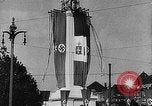
Italian fascist leader Benito Mussolini arrives by train at Munich Central Station where he is welcomed by Adolf Hitler
Italian fascist leader Benito Mussolini visits Munich, Germany. Flags of Nazi Germany and the Kingdom of Italy hang in the streets of Munich. Nazi flags hung from buildings. A Bundesadler eagle metal plate adorns a wall. Cars move along the roads. Italian leader Benito Mussolini arrives at Munich Central Station (München Hauptbahnhof, Bayerstraße 10A, 80335 München, Germany). He shakes hands with Adolf Hitler. Benito Mussolini and Adolf Hitler walk on the railway platform, the officers follow them. Military troops in formation on the platform. The two Axis leaders review formations of soldiers and sailors as military brass band plays the German and Italian national anthems (“Marcia Reale Italiana” and “Deutschlandlied”). Spectators line the streets. Benito Mussolini and Adolf Hitler enter open cars. Nazi banners and decorations adorn the Munich New Torn Hall and Marienplatz (Marienplatz 8, 80331 München, Germany). Hitler and Mussolini in Marienplatz. Crowds cheer and wave, as their cars drive down the streets of Munich, which are festooned with Nazi and Italian banners.
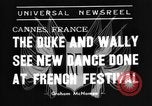
The Duke of Windsor and his wife attend a benefit French festival at Riviera Resort in Cannes, France.
The Duke of Windsor Prince Edward VIII and his wife Duchess Wallis attend a benefit French festival at Riviera Resort in Cannes, France. A huge crowd seated for the festivities. The crowd watches a new dance 'Lambeth Walk'. Other dances take place. Fire works in the sky.
CRITICALPAST.COM: About Us | Contact Us | FAQs - How to Order | License Agreement | My Account | My Lightboxes | Shopping Cart | Advanced Search | Featured Collections | Website Terms & Conditions | Privacy Policy ©2026 CriticalPast LLC.
License Agreement |
Terms & Conditions |
Privacy Policy
©2026 CriticalPast LLC.