


 Francais
 Deutsch
 Italiano
Refine Your Search
New Mexico United States 1946 stock footage and images
- Showing 25333 to 25338 of 30777 results more
more Hide
Hide
Security police checks identity papers and workers work with radioactive material in an atomic energy plant in Canada.
A film titled 'Inside the Atom' about the structure of atom and the use of radioactive isotopes in the treatment of cancer in Canada. A board on a shore reads 'Picture Taking Prohibited'. Buses drive past a sign reading 'Atomic Energy Project'. Buses are stopped at the entrance of the plant and are checked by security police. Identity cards of men are checked by the security police. Workers enter the plant. A worker walks on the plant grounds carrying a piece of a radioactive metal suspended from a rod. A minute fragment of matter is checked under a microscope. Narrator describes prospect of atomic energy to introduce a new industrial revolution, contrasting with traditional work. Scenes of Chinese or other Asian laborers at an excavation site, moving rocks and boulder by cart and wheel barrow. Men sit atop a wooden frame rig with pedals, using man power to operate a water mill. View of coal miners at work digging in a coal mine and loading coal chunks onto a moving track.
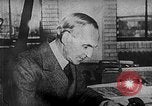
Henry Ford's work in the area of historic preservation. Construction of Ford Museum and Historical Greenfield Village
Henry Ford works on historical preservation project. McGuffey readers are seen. Sketch of Ford family farm in Springwells, Michigan. View of homestead at the farm, that Ford restores. He examines the farm's steam engine. The historic Wayside Inn, in Sudbury, Massachusetts, which Ford purchased to construct a community of historic buildings. View of the restored Botsford Inn,Detroit, Michigan, that Ford bought in 1924.View of Eagle Tavern, in Clinton, Michigan,before,and,after its purchase and restoration by Henry Ford. Concerned about need for additional buildings to house artifacts, Henry Ford consulting with Detroit architect,Robert O. Derrick (with mustache) and two other men. Derrick's plan for the Henry Ford museum is unrolled. It borrows from Independence Hall, Congress Hall, and the old City Hall in Philadelphia.Views of the Clock Tower and museum, as completed in 1929. A pictorial map of the Edison Institute Museum and Historical Greenfield Village, in Dearborn, Michigan. View of construction begun in 1927. Thomas A. Edison laboratory in Menlo Park, New Jersey, that Ford acquired for Greenfield Village. On a windy September 17, 1928, Thomas A. Edison steps from a car, and pauses before entering the doorway of his restored laboratory, in Greenfield Village. Henry and Mrs.Ford step from their car to quickly join him in the building.Edsel Ford and his wife, also follow. Inside the building, Edison officially open the site by starting a steam engine in the laboratory. Ford and Edison converse (Ford speaking close to Edison's ear, because he is hard of hearing). Later, Edison, in a cornerstone ceremony, imbeds, a shovel contributed by Luther Burbank, and then writes in cement of the cornerstone.Newspapers show coverage of the formal dedication of the museum and Greenfield village, October 21, 1929. Workers rushing the Village toward completion for that event. The Smithcreek Railroad depot is moved to the Village. Workers preparing installation of the depot.
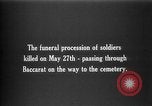
American Expeditionary Forces(A.E.F.) 42nd (Rainbow Division) bury their fallen at Baccarat, France, in World War I
A cortege of U.S. Army trucks, covered with American flags and laden with flag-covered coffins of American soldiers,who fell in combat on May 27th, 1918,proceeds through the streets of Baccarat, France, in World War 1. U.S. soldiers of the 42nd Infantry Division march as escorts, beside the trucks. Local citizens observe from the sides of the road. Scene shifts to Memorial Day (May 30, 1918), when U.S. Army Major General Charles T. Menoher and U.S. Army Colonel Douglas MacArthur,of the 42nd Infantry Division, are joined by French Generals Dupont and Penet, in decorating the graves of fallen American soldiers, during a ceremony at a rugged battlefield cemetery containing new graves marked by wooden crosses. A little French girl places a bouquet (reportedly made by Major General Menoher) upon the grave of an American soldier.She is accompanied by other French children who also place bouquets on the graves. An honor guard of American soldiers fires a salute. Scene shifts to a gathering of American soldiers at their base in Baccarat, where they surround a small outdoor stage, to watch a Miss Hart, of the YMCA theatrical Corps dance the Higland Fling. She is dressed in traditional costume of Scotland and accompanied by a violinist. A group of Army musicians, seated close to the stage, watch the performance along with the rest of the troops.

Film depicting threat of disease due to destruction of German infrastructure at end of World War 2. Populace treated with DDT.
Scenes of destruction in Germany at end of World War II, including Destroyed dwellings and rubble and rubbish-filled bomb craters. A U.S. soldier medic steps across a destroyed structure. German citizens line up to obtain water from a small tank trailer. A bucket being filled. A German civilian work crew laying new water pipes. A large trash heap displaying a sign in German reading: Drinking strictly forbidden. Danger from Typhus!(Trinken Strengstens verboten. Typhusgefahr!). Germans wearing gas masks as they lead horses drawing corpse-laden carts, along a road. Allied military spraying German civilians with DDT (Dichloro-Diphenyl-Trichloroethane) at a delousing station. They give each treated person a certificate certifying their treatment. The treated include men, women, and many mothers with their children. A nurse holds a small child as the mother is treated.

A family at home, in Chicago, Illinois, listening to their radio
A typical American family gathered around their radio, at home. This is the Springer family in Chicago, Illinois. Mr. George N. Springer and Bernadette Wiley Springer are seated on chairs in a living room with their children, George and Arthur, as they listen to their large wooden console radio. George tunes the radio. A close up of Bernadette with her child, Arthur. (This was filmed in their home on 79th Street in Chicago. George worked for the Daily News in that city.)

Vehicles drive past on a road and a puddle of water alongside the road in Vietnam.
Vehicles move on a new road from Bien Hoa to Saigon, in Vietnam. This highway was the main link between the main military airbase at Bien Hoa, and the capital, Saigon. Cars, an auto rickshaw and a van drive past on the road. A puddle of water alongside the road.Travelers ride motorbikes. Trees in the foreground. Heading towards Saigon from Bien Hoa, the South Vietnamese National Military cemetery (equivalent to U.S.Arlington cemetery) is visible, on the right hand side.
CRITICALPAST.COM: About Us | Contact Us | FAQs - How to Order | License Agreement | My Account | My Lightboxes | Shopping Cart | Advanced Search | Featured Collections | Website Terms & Conditions | Privacy Policy ©2026 CriticalPast LLC.
License Agreement |
Terms & Conditions |
Privacy Policy
©2026 CriticalPast LLC.