


 Francais
 Deutsch
 Italiano
Refine Your Search
New Mexico United States 1946 stock footage and images
- Showing 25363 to 25368 of 30777 results more
more Hide
Hide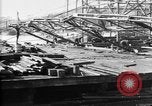
U.S. Army 106th Engineers constructing a warehouse at waterfront in Brest, France during World War I.
U.S. Army 106th Engineers in the Port de Commerce (commercial harbour) of Brest, France during World War 1. This site is adjacent to L'arsenal de Brest (Arsenal of Brest) military and naval installations on the river Penfeld. U.S. Army 106th Engineers are constructing a warehouse in the area of Basin 5. View of Engineers raising a completed section of trusswork for the warehouse, by means of cables. Engineer using power drill on sections of new trusswork being assembled on the ground. German prisoners of war using two-man saw and hammers as they cut and install wooden joists in the construction. The working prisoners are monitored by U.S Army officer. German prisoners excavating at entrance of the building. Wider view of construction site, showing rail cars nearby and construction material everywhere. A barge plying waters of River Penfeld in background, and a variety of vessels tied up in the harbor. A bridge in the backgound. Engineers tending a large steam-driven machine sheltered in a shed.
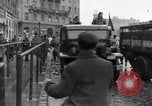
Soviet tanks and vehicles arrive at the Hungarian Parliament Building in Budapest, Hungary during the Hungarian Revolution.
Resistance fighters distribute newspapers during Hungarian Revolution of 1956. Hungarian resistance fighters loaded in a truck advance. Resistance fighters throw newspapers for civilians. Civilians gather to reads news from a newspaper. A destroyed Budapest tram on the street. Soviet vehicles advance along a street. A resistance fighter with a gun looks out from a hole in a building. Soviet tanks and army vehicles arrive at the Hungarian Parliament Building (Budapest, Kossuth Lajos tér 1-3, 1055 Hungary).

Officers addresses villagers in Vietnam during the Vietnam War.
The U.S. Army in Vietnam during the Vietnam War. Villagers gather outside a building. Captain M. Belenky addresses them. An interpretor translates what Captain Belenky is saying. The villagers applaud. A loudspeaker on the ground. A New Zealand officer speaks. A Korean officer at a microphone.
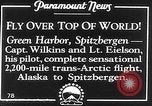
Captain Wilkins and Lt. Eielson stand near an aircraft in Spitsbergen, Svalbard after completing a trans-Arctic flight.
The history of famous airplanes. Australian polar explorer Captain Sir George Hubert Wilkins and American aviator Lieutenant Carl Benjamin Eielson in Spitsbergen, Svalbard after completing a 2,200 mile trans-Arctic flight from Alaska to Spitszbergen. Captain Wilkins in a civilian dress. An aircraft being moved out of the area. 'Detroit news, Arctic expedition' written on the side of the airplane. Captain Wilkins and Lt Eielson check over the airplane prior to a take off. Men dressed in civilian garb. The aircraft starts to taxi across the field. It is a Lockheed Vega aircraft. Animated world map shows the start of the Wilkins flight on April 15th from Point Barrow in Alaska and traces the route of the flight to Spitsbergen. The time of the flight was 20 hours, 20 minutes. They land at Green Bay in Spitsbergen.
Aviator Howard Hughes dines over lunch in Chicago and then sets speed record in flight to Los Angeles
Crew work on Howard Hughes' rented Northrop Gamma 2G (NR13761) aircraft, before his speed record setting flight from Chicago to Los Angeles in 1936. View of the Northrop Gamma 2G aircraft from tail. Scene changes to interior of a Chicago restaurant where Howard Hughes is having lunch with a friend. He stands, preparing to exit and fly, with the goal of having dinner in Los Angeles the same day. Airport terminal buildings in background as Hughes pilots the aircraft, and taxis before takeoff. View of the aircraft after take off and in flight overhead. It set a new speed record, reaching Los Angeles in 8 hours and 10 minutes, and traveling at 215 mph.
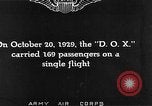
Taking off and landing of German Dornier Do X passenger aircraft at Lake Constance in Germany.
The history of aviation. German Dornier Do X passenger aircraft that carried 169 passengers on a single flight on October 10, 1929. The flying boat aircraft taxis in water at Lake Constance in Germany. The airplane is twelve-propeller driven on six engine nacelles. Interior of the aircraft shows a news cameraman taking pictures of people on the maiden flight. The take off of the DoX. The aircraft lands.
CRITICALPAST.COM: About Us | Contact Us | FAQs - How to Order | License Agreement | My Account | My Lightboxes | Shopping Cart | Advanced Search | Featured Collections | Website Terms & Conditions | Privacy Policy ©2026 CriticalPast LLC.
License Agreement |
Terms & Conditions |
Privacy Policy
©2026 CriticalPast LLC.