


 Francais
 Deutsch
 Italiano
Refine Your Search
New Mexico United States 1946 stock footage and images
- Showing 25525 to 25530 of 30777 results more
more Hide
Hide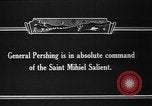
Allied soldiers during the Battle of Saint Mihiel Salient in France during World War I.
Allied troops in France during World War I. U.S. General John J. Pershing after the Battle of Saint Mihiel Salient. On September 12th Allied soldier in a field as they prepare for the Battle of Saint Mihiel Salient. Men dig trenches. Artillery being fired at the enemy position by the Allies. Allied soldiers advance. Cavalry units, infantry units and supplies loaded on to carts as they move further. Cavalry units move over wooden planks to cross a trench. Wounded being carried on litters. Artillery being fired. Soldiers on foot and a convoy of military trucks advance. Allied soldiers march forward with damaged houses in the background. An American tank crossing from a field to a lower road during battle. Smoke rises from a battlefield. Shell cases piled up as Allied soldiers load shells in an artillery piece and fire at German enemy targets. Stone concrete dug outs of Germans in Mont Sec, France being used by the Allies. Two Allied soldiers in the dugout as they look through binoculars. Views of French civilians and refugees after being freed from four years of German rule. They talk with American soldiers, smile, and relax.
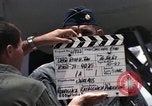
Major Mack speaks about 552nd Airborne Early Warning Control Wing's assistance to friendly areas, at Ubon Air Base in Thailand.
Major Mack at Ubon Air Base in Thailand during College Eye airborne radar surveillance mission. He talks about the 552nd Airborne Early Warning Control Wing Unit. Major Mack talks about the strike force in North Vietnam. The Radar station transmits information of target heading any friendly areas. The unit also provides MIG warning, detect friendly aircraft and provide in flight refueling. He talks about the Unit providing rescue helicopters in case of any mishap.
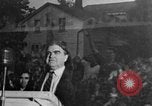
Other Labor unions support UAW-CIO strike against General Motors Company
At beginning, film shows John L. Lewis, head of the United Mine Workers, at the microphone on a podium, being applauded after pledging his union's support to the striking United Auto Workers (UAW). Slate reads: "Fisher, Flint." Scene shifts to view of a building with sign reading: "Local 581, Affiliate, UAWA. CIO." Several cars parked in front of the building suddenly start up and drive to the site of a picket line at the Fisher Body Works. They are a UAW squad of cars dispatched to prevent strike breakers from crossing the picket lines. A long line of the UAW cars, called "the flying squadron" is seen on a highway. The union strike committee is seen in a meeting. They decide to call on other union locals to join the picketing at Fisher plant No. 1. Next numerous members of other union locals are seen joining the Local 581 pickets. Among them, Leo Pritzky, of the Clothing Workers Union, is seen pledging the support of every union in the CIO (Congress of Industrial Organizations) for the UAW in its fight with the General Motors Corporation. Another slate appears reading: "Cadillac, Detroit." Glimpse of the Cadillac factory and a picket line of strikers. One sign reads: "Millions in Profits for G.M. Insecurity for their workers." African Americans marching with white coworkers on the picket line. A truck driver from another union, refuses to drive past the picket line and turns his truck around. Closeups of elderly men and some women in the picket lines. Slate reads: "Ternstedt, Detroit." Women in a picket line outside the Ternstedt Company plant (subsidiary of Fisher Body Company), to support striking Tool and Die workers. A closed panel truck is seen with large loudspeakers mounted on its roof. Across its body is painted: "West Side Local 174 United Auto Workers of America, C.I.O. Union Way Means Higher Pay." Closeup of man in the truck speaking into transmitter broadcasting through the speakers on top.
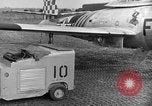
Man works on engine of F 84 in Wiesbaden, Germany
Film begins showing an auxiliary power unit under the wing of a Republic F-84 Thunderjet parked on Marsden matting at Wiesbaden Air Force Base in Germany, during Exercise Cirrus. A ground crewman uncoils the electric cable from the unit and plugs it into a receptacle under the aircraft wing. View of the man crouching below the wing. He then stands and starts the power unit. The aircraft's crew chief's name, "T/Sgt G.Cavert," is stenciled beneath the cockpit. Scene changes to an F-84 sitting alone on the airfield. Tents are seen in the background. A ground crewman approached the aircraft, climbs a ladder, opens latches securing the machine gun compartment, and raises the compartment cover forward, exposing the M3 browning machine guns inside. Closeup of the man sitting atop the open compartment.Camera focuses on his hands as he pries some cartridges from a gun and closes its cover.
Anglo French troops attack to seize the Suez Canal in Egypt.
Major events of 1956. Ships underway in Suez Canal, Egypt. President, Abdul Nasser announces the seizure of the canal. Soldiers move up in Egypt and dead Egyptian soldiers as a result of Anglo French attack. Anglo French planes bomb the canal area. Airborne troops land in the canal area. Debris due to aerial bombings spread on the street. Matter discussed at the United Nations meeting leading to a cease fire in the area. The Secretary General of the United Nations Dag Hammarskjold arrives in Egypt for negotiations. The United Nations Emergency Police forces enter a city in Egypt. People give a warm welcome to the forces.
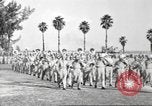
Military and civilians parade on Armistice Day in Saint Petersburg, Florida
In the opening scene, a U.S. Army Air Corps brass band leads a parade, followed by a contingent of army troops with shouldered rifles wearing steel helmets. A fairly large ship, emiting some smoke from its stack, is stationary in the background. Spectators watch from edge of the parade grounds. Palm trees dot the area. Next, a contingent of Air Corps trainees marches in formation, with a three-man color guard and the American flag behind them. The band now stands in formation off to the side as it plays. Other formations of airmen trainees march in the background. Scene shifts to downtown Saint Petersburg, where Army Air Corps officers, plus Marine and Naval officers occupy a reviewing stand with Robt. J. McCutcheon, Jr., the Mayor of Saint Petersburg. Closeup of Air Corps Colonel E. R. Householder rendering a salute. Camera pans the reviewing stand and then pans across the heads of standing spectators, to a large group of civilians occupying reserved seats. Scene shifts to the Air Corps band playing as they lead the parade down Central Avenue. The sidewalks in this business district are filled with spectators. The parade units follow in the same order as they had in earlier scenes at the parade grounds. Camera keeps pace with the unit of soldiers in steel helmets. Closeup of the soldiers executing left-shoulder arms as they march. Remaining units are seen and the color guard. Next, several formations of sailors, in whites, are seen from the rear, as they march. Camera shifts to Drum Majorette strutting between the trolley tracks on the avenue. Behind her are others in white and a contingent of sailors. A color guard of Womens Army Corps (WAC) passes the reviewing stand. Several High school cheer-leaders in white uniforms are seen next. followed by a large group High school girls, some wearing bobby socks, that seem to be marching with seniors first, trailed by successively lower classes. High School Drum majorettes in white strut ahead of their marching band. Another group of majorettes leads their band. In front of them is a drum major pushing an infant in a small stroller. He has some trouble as its wheels get caught in the trolley tracks. A group of nurses is next in the march, followed by a WAC formation in uniform. An African American marching band and majorettes is next. Their lead majorette twirls her baton. (World War II period).
CRITICALPAST.COM: About Us | Contact Us | FAQs - How to Order | License Agreement | My Account | My Lightboxes | Shopping Cart | Advanced Search | Featured Collections | Website Terms & Conditions | Privacy Policy ©2026 CriticalPast LLC.
License Agreement |
Terms & Conditions |
Privacy Policy
©2026 CriticalPast LLC.