


 Francais
 Deutsch
 Italiano
Refine Your Search
New Mexico United States 1946 stock footage and images
- Showing 25561 to 25566 of 30777 results more
more Hide
Hide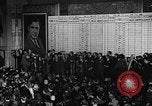
Wendell Wilkie makes an appearance at Republican election headquarters during U.S. 1940 National Elections
Republican headquarters during the 1940 U.S. National elections. Huge boards listing the 48 States and their respective voter demographics, are set up to record election returns as they are reported. Posters of Wendell Wilkie and Charles McNary flank the status boards. Newspaper and radio reporters, and Republican supporters fill the hall. Suddenly cheers erupt among the crowd as candidate wendell Wilkie enters the hall and walks to a set of microphones. The crowd chants: "We want Wilkie,"preventing him from speaking.After some call for quiet, the room settles down. Wilkie tells the crowd: "I never felt better in my life," eliciting cheers.He speaks of being part of the greatest crusade of this century. Scene shifts to volunteers resting with feet outstretched in back of the hall. (It is well past midnight, and now November 6th.) Some are sleeping.
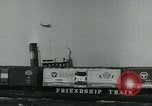
The Marshall Plan being launched to assist recovery of Europe after World War II
Rail cars on the November, 1947 "Friendship Train," at a sea port in the U.S.A. Behind it is seen the funnel of the SS Exiria, of the American Export Lines. The camera moves around to show the Exiria, displaying a large American flag and words,"Friendship Food Ship," on her hull. A steam locomotive on train in France, delivering relief supplies, displays crossed American and French flags on it. Trucks on road in France, displaying French and American flags and pictures of the Freedom Train on their sides, with words:"Ravitaillement, offert spontanment au peuple de France à partir de peuple Americain." (Refueling, spontaneously offered to the people of France from American people.) The SS Exiria docked in an Italian port. A catholic priest and several nuns with a group of boys, standing on the pier, wave American flags. Another group of American girls enthusiastically wave American flags. A large crowd waves several large Italian flags. President Harry S. Truman, at his desk on the White House, Washington, DC, signs the Economic Recovery Act of 1948 (AKA Marshall Plan). Secretary of State Marshall speaking in support of the legislation before Congress. Senator Arthur H. Vandenberg, of Michigan, speaking in support of the bill.
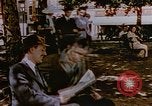
Aspects of U.S. industry including public information, agriculture, transportation, and water power.
Excerpt from film entitled "Power Behind the Nation." It opens showing glimpse of two men on a park bench, discussing a newspaper article, followed by views of men at work in a radio broadcasting studio. Next is shown a Western theme film set being constructed for a motion picture, at a Hollywood film studio back lot. Closeup of Director and crew filming a western movie with an actor on horseback as he rides up to a wooden building on the film set displaying a Dance Hall sign. Next, a director and film crew are seen working on an elaborate set with a chorus of women in white gowns. Scene shifts to film makers watching a finished movie production dealing with colonial era America (ostensibly an educational film). Another film is seen being made at a set resembling a European town. Next, views of American farms are shown with various crops under cultivation, including fruit orchards. Farm machinery is seen in use, including tractors, harvesters, and combines. Grain is shown being harvested and processed in the field, and cotton being picked. Closeup of cotton bolls on the plants. Men are shown collecting sap from sugar maple trees in the northeast U.S. for making maple syrup. In the U.S. Northwest, a flock of sheep is seen grazing in a field. A herd of cattle are shown in the Southwest, U.S. A field of grain is shown and then a section of crops irrigated by small ditches. Then a large man-made irrigation canal is seen. View of a ramshackle building and yard in a desert. Women harvesting vegetables from irrigated plants. Apples being sorted by machine. A pair of steam locomotives pulling a railroad train and a diesel locomotive pulling freight cars, all ostensibly carrying fresh produce to market. Several shots of railroad freight trains in different settings. A truck moving along a country road. A tugboat working beside a large ocean-going cargo ship on a river in the U.S. More shots of ships and inland canals. A ship passing under the Golden Gate Bridge in California. An aircraft under construction. Passengers deplaning from a Continental Airlines DC-3 passenger airplane parked on a ramp. A prototype U.S. Navy Lockheed XR6O-1 Constitution aircraft taking off. (Only two R6V aircraft were made, Bureau Numbers 85163 and 85164.) A Sikorsky helicopter in flight. Closeup of Captain in cockpit of a TWA Boeing Stratoliner airplane as it taxis out of parking place. Industrial buildings close to a river with water flowing below a dam. The Grand Coulee Dam on the Columbia River in the U.S. state of Washington.
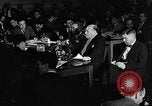
HUAC testimony of "Hollywood Ten" member Samuel Ornitz during investigations into Communist affiliations in Hollywood
Meeting of the House Un-American Activities Committee, or HUAC, in October 1947, under J. Parnell Thomas (the so-called "Thomas Hearings."). Hollywood screenwriter Samuel Ornitz is questioned and asked if he is a member of the Screen Writer's Guild. Ornitz begins his response and expresses that his response is a matter of conscience. He speaks out against the intimidation tactics of the committee chairman. The Committee members continue to cut-off the response from Ornitz and push for a rapid answer to the question. Ornitz continues to give a longer answer and states his belief that the Committee is asking him to violate the Constitution. Robert Stripling is directed to ask the next question. Ornitz is asked "are you now or have you ever been a member of the Communist Party." Ornitz continues to protest the line of questioning and likens his affiliation with any party to be like his affiliation with any religion and thus protected by the Constitution. The Committee asks if his party affiliations are directed by a foreign government. Ornitz is told to stand away and the next witness is called.
Beginnings of successful powered heavier-than-air flight. Wright Brothers flights in U.S. and Europe. General Hap Arnold
History of aviation. A balloon in flight. Historic glider such as that which interested U.S. War Department as early as 1898. In 1903, a crew of men moving a Wright Flyer into position. Two men turn over propellers on a Wright Flyer, and the engine starts. View of the Wright-designed water-cooled engine. View of Orville Wright. The famous first powered flight, at Kitty Hawk, North Carolina, with Orville Wright at controls. Animation shows that 120 foot flight juxtaposed against a B-36 wing. Wilbur Wright in Europe, in 1908, gesturing as he converses with interested parties. A gallery of spectators including the President of France, King of England, King of Spain, and King of Italy. Wilbur Wright places a wheel under the right wing of a Wright Flyer and lashes it to the strut. A team of horses pulls the plane across the field. Men maneuver the plane onto a monorail on the ground. Men pull on a heavy rope to raise a weight in a tower, for a catapult. Two men spin the propellers and the Wright Brothers airplane motor starts. Wilbur Wright and his passenger, a French journalist, board the plane. The catapult weight drops, launching the aircraft which flies low over the field. U.S. President Theodore Roosevelt speaking (He is seen on a podium campaigning for the Bull Moose Party nomination at the Kansas State Fair in Hutchinson, Kansas on September 22, 1912.) War department issues specifications for a heavier-than-air craft. Reenactment of a Wright brother signing a bid contract. A Wright Flyer airborne at Fort Myer, Virginia, as the Wrights meet the Army specifications and sell, U.S. Army airplane number 1, to the War Department, in 1908. Gold Aviator wings being pinned on the uniform of a U.S. Army pilot. Photograph of Army Air Forces Chief, General Henry (Hap) Arnold, wearing his original aviator wings on his service uniform. A Glenn Curtis training airplane starting up and taking off. View of a DH-4 airplane and a Wright Flyer taking off together.
Audio only. Executive Morton T Jones talks about his role as a businessman and his belief in God on a radio program in the U.S.
Audio only. 'This I Believe', Radio Network Program. Essay on an insurance executive, Morton T Jones. He was in the insurance business all his life. After graduating from the University of Missouri and serving in World War I, he joined his father and brothers at the RB Jones and Sons Insurance firm. He then became the managing director of the same firm. In 1929, with other businessmen he organized the Kansas City Fire and Marine Insurance Company. Morton also served as President of the Kansas City Chamber of Commerce. He talks about his role as a businessman and a church song that helps him deal with his daily problems. He states his firm belief in God and how that faith and wisdom guides him. He also talks about the importance of the human element in companies and quotes Winston Churchill.
CRITICALPAST.COM: About Us | Contact Us | FAQs - How to Order | License Agreement | My Account | My Lightboxes | Shopping Cart | Advanced Search | Featured Collections | Website Terms & Conditions | Privacy Policy ©2026 CriticalPast LLC.
License Agreement |
Terms & Conditions |
Privacy Policy
©2026 CriticalPast LLC.