


 Francais
 Deutsch
 Italiano
Refine Your Search
New Mexico United States 1946 stock footage and images
- Showing 25609 to 25614 of 30777 results more
more Hide
Hide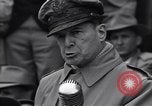
Douglas MacArthur, General of the Army, criticizes U.S. Government post-World War 2 policies, during a speech in Mississippi
General of Army, Douglas MacArthur, speaking on the steps of the Mississippi State Legislature, addresses a joint assembly of the Mississippi State Legislature, and citizens, in Jackson, Mississippi. MacArthur emphasizes that charity begins at home. He questions the merits of America spending billions to fight communism abroad. Further, he questions the commitment of European nations to fight against communism. He notes that the U.S.A. had spiritual leadership of the world, backed by the greatest military power in history, at the end of World War 2. But he claims the U.S. dissipated that power, by betraying Nationalist China; and permitting the Soviet Union to expand into Eastern European countries; while American disarmed and demobilized.
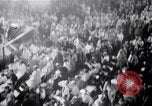
Former U.S. President Hoover arrives at the National Republican Convention, Cleveland Ohio.
Former U.S. President Herbert Hoover arrives at the National Republican Convention in Cleveland, Ohio. The President addresses Republican representatives from various states of the USA. A large number of spectators listen to his speech. Press taking photographs of the convention. The signs and banners of the states can be seen. June 1936.
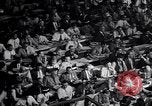
Former President Hoover addresses the Republican National Convention
The Republican National Convention of Republican representatives from various states of the USA, held in Cincinatti, Ohio. Former President Herbert Hoover addressing the large number of spectators. The hall is packed to capacity. Photographers are taking photos. The banners of the states can be seen.1936.
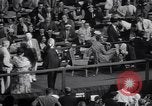
Former U.S. President Herbert Hoover waving to crowd after speaking at Republican National Convention, Cleveland Ohio.
At the Republican National Convention held at Cleveland in Chio, former U.S. President Herbert Hoover waving to a house of republican representatives from various states of USA. He waves and retreats from the podium, handing the rostrum over to the next speaker. A large number of spectators are present. People cheering for Hoover and the next speaker. A woman waving an American flag wildly. The banners of the states could be seen. June 1936.
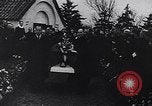
Denmark under German martial law during World War II
Film made by Danes, after increasing tensions between them and German occupation forces that invaded Denmark in 1940, boiled over in August 1943, and the Germans placed Denmark under martial law. It covers the period 1943 and 1944, after which the film was smuggled out of the country. Opening scene shows pallbearers at the funeral of Kaj Harald Leininger Munk (aka Kaj Munk) a Danish playwright and Lutheran pastor, who was assassinated by Nazi Gestapo agents, on 4 January, 1944. Narrator states that Nazi murder leagues assassinated some of Denmark's greatest leaders to intimidate the Danes and quell any rebellions. The coffin of Pastor Munk is lowered into its grave. Memorial stone and flowers are shown. Smoke rising and then a large conflagration are seen, from Danish acts of sabotage. Damaged buildings and more fires, from Danish resistance, are seen. In response, the "Schalburg Corps," a Danish volunteer branch of the Nazi SS, began counter-sabotage (called Shalbotage by the Danes). Film shows fireman on ladders at the building of the Paramount Movie Company, Ltd. where smoke is coming from the windows. (Narrator says film companies that refused every form of collaboration were blown up.) View of severely damaged Nordisk film studio at Helerup. Windows shattered in department stores and in all shops along a street. Illums Bolighus (famous store of Scandinavian design) and many others are wrecked. Camera pans up the side of damaged building with bird painted on its side and the words: "mod lysere Dage.." (Brighter Days). Views of the destroyed Royal Yacht Club pavilion, in Copenhagen harbor. Destruction in Tivoli Gardens. Its concert hall completely destroyed. Fire burning at the Syndicate, Denmark's largest armaments factory, from bombing by saboteurs, in June, 1944. Danes walking in Copenhagen, on a summer evening, flaunting the Nazi curfew from 8PM to 6AM and then lighting bonfires after dark. Abandoned wheel barrows and empty streets are shown when residents of Copenhagen all go home in a general strike. Several German soldiers are seen in otherwise empty street, as the German Commander in Chief declares the city of Copenhagen under siege. A German tank parked in the street amidst pedestrians. Barricades set up by strikers in a street. The American flag flying high over a street. The "Bulldog" a department store in flames. A car serving as an ambulance drives down a street displaying a white flag. A long line of Danes wait at a street corner shop for self-rationed food. Danes drawing fresh water from lakes to be brought to hospitals, where needed. View from above of strikers at a barricade. Narrator states that after 5 days, the Germans gave in and agreed to Danish terms. View of open area in the city, where people stand in silence to commemorate those who lost their lives in the struggle. Danish man looking through chain link fence. More scenes of continued sabotage by Danes.
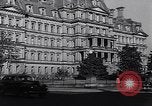
British, Soviet and U.S. officials meet and discuss industrial, agricultural and civil rebuilding of Germany after World War II.
Industrial, agricultural and civil rebuilding of Germany after World War II. State Department building in Washington DC. Secretory of States, James F. Byrnes dictates to secretary. General Luicius D Clay speaks to the members of British Occupational government. Ernest Bevin, Vyacheslav Molotov and James F. Byrnes pose for a group photograph. German farmers in an agricultural field. Men and woman plow farm by horse cart. Worker watches a factory kiln with molten metal. Cavaliers of American Military Police on horse back patrol on the streets in Germany with a destroyed cathedral in the background. They cross a bridge with sign Herkules Bridge. German workers make farm equipment and a German family with young children eats a meal.
CRITICALPAST.COM: About Us | Contact Us | FAQs - How to Order | License Agreement | My Account | My Lightboxes | Shopping Cart | Advanced Search | Featured Collections | Website Terms & Conditions | Privacy Policy ©2026 CriticalPast LLC.
License Agreement |
Terms & Conditions |
Privacy Policy
©2026 CriticalPast LLC.