


 Francais
 Deutsch
 Italiano
Refine Your Search
New Mexico United States 1946 stock footage and images
- Showing 25627 to 25632 of 30777 results more
more Hide
Hide
U.S. President Richard Nixon addresses American citizens on the nation's economy in Washington DC.
U.S. President Nixon addresses the American citizens on the nation's economy in Washington DC. The White House. The President in his office. He talks about the 3 subjects of public interest- jobs, income and cost of living. He briefly discusses the nation's problems and their causes. He introduces a program which deals with these problems. The first step involves the recognition of causes. There exists a transition between the peacetime economy and a wartime economy. Labors and the businessmen prefer the peacetime economy. He states that his government takes the responsibility to cut down the expenditure in order to strongly restrain the current economy. They have also decreased the Federal spendings. He talks about his actions against the inflation. They include- appointing the National Committee on Productivity to check how well the resources are being used, instructing the Counsel of Economic Advisor to prepare a periodic inflation alert and establishing a purchasing and review board to review all the government actions. The President briefly talks about the actions he will take and those which he would not take. He states that at this time the Congress and the President should co-operate each other on common welfare programs. He requests the Congress to help him by passing the legislation related with peoples' jobs and cost of living and to act on the one which have already been submitted by him. He asks the Congress to join him on the way of cutting down the government spendings. He also talks about the significant happenings taking place in the American economy. The President believes that in the next 5 years American consumer will be able to buy 20% more than what he does today. The White House in Washington DC.
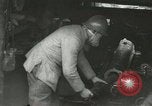
French Army troops, in Artois, France, training to use artillery against aircraft
French soldiers training in Artois, France, shortly before World War I. French artillerymen wearing gas masks, are seen inside a bunker. One loads a powder charge into a Cannon de 75 modèle 1897 field gun (So-called French 75). Slate states (in Swedish): Calculating the distance to an airship or airplane is often a very tricky task. View of French soldier, in a field, looking through a telescope, and another, nearby, looking through binoculars. The latter raises a large horn (or megaphone) and sounds it. Camera pans to two soldiers using a range finder. Closeup of aiming adjustments on a French 75 field gun. Next, gun crewmen remove shells from a protected storage caisson, buried in the side of a deep trench and other gunners load a nearby gun. Slate states that Automobile cannons constitute a very practical and effective weapon in the battle against airships. An artillery piece is shown mounted on a vehicle chassis, being maneuvered by gunners. A brief glimpse of mirror specially designed to signal to aviators.
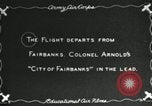
YB-10s of the U.S. Army Air Corps 1934 Alaska Flight return to Bolling Field in Washington, DC after flying more than 7000 miles.
The U.S. Army Air Corps (USAAC) Alaska Flight of 1934 departing Fairbanks Alaska on flight back to Washington, DC. Their YB-10 aircraft are seen in a line on the airfield. Spectators are at the edge of the field to see them off. Next, the aircraft are seen taxiing out for takeoff, with their Commander, Lieutenant Colonel Henry Arnold, piloting the lead aircraft, the "City of Fairbanks." Other aircraft follow in succession. Colonel Arnold's airplane takes off and proceeds in a shallow climb. Slate tells first leg is 640 miles to Juneau in 3 hours and 55 minutes. Map shows North America with outbound course to Alaska from Washington, DC, traversing the Great Lakes, Edmonton, Prince George, and White Horse, to Fairbanks. But a moving arrow shows return route via Juneau. Snow-covered mountains seen from a YB-10 on this return leg. Aerial shots of several YB-10s in formation. Slate announces next leg as 940 miles and 5 hours and 40 minutes to Seattle, Washington State. Aircraft and crews of the returning Alaska Flight, seen on a grass field in Seattle. Lieutenant Colonel Henry Arnold, expedition commander, leads his fliers across the field. Slate states remaining distance to Washington, DC, as 2700 miles and 14 hours. More shots of YB-10s in formation aloft. Shot of a YB-10 with farmland below. Ten YB-10s seen in formation, and the animated map completes the journey to Washington, DC. Aerial view from above of several YB-10s below, flying over the Potomac River, in Washington, DC, with the Lincoln Memorial, and Arlington Memorial bridge visible below. The formation of 10 planes barely visible above the Capitol building. The YB-10 named Juneau, taxiing across Bolling Field, after landing. (This segment of film is reversed, so the name and Alaska Flight logo are mirror-reversed.) The last of the 10 aircraft pulls into position on the flightline. Lieutenant Colonel Henry (Hap) Arnold stands in front of his fliers who hold a large totem pole souvenir. Secretary of War, George H. Dern, greets the returning aviators and poses next to Colonel Arnold.
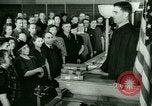
A judge administers an oath of citizenship of the U.S. to a group of people in a courtroom in Bridgeport, Connecticut.
Opening scene is in a courthouse, where a judge asks a group about taking an oath of citizenship. Members of the group raise their hands and then lower them. The judge then proceeds to have them raise their right hands and administers the oath. They repeat the words as he states them. Closeup of the judge as he administers the oath. Closeup of the persons assembled for the ceremony, raising their hands as the judge speaks, and saying "I do,"before lowering their hands. Camera in exclusive closeup of one woman as she has hand raised and states, "I Do." This last scene is repeated three times.
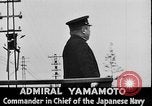
Axis powers vision for conquest at onset of World War II
Invasion plans of the Axis power in the European Theater during World War 2. Film opens, ostensibly, showing Japanese Admiral Isoroku Yamamoto speaking at a podium. (There is some question whether this is actually Yamamoto.) The U.S. Capitol and the Pennsylvania Avenue in Washington DC, with marching Axis troops superimposed as if marching in conquest. Axis troops parade in Berlin, Germany. Animated diagram shows 'divide and rule' ambitions of the Axis powers. Animation showing radio signals emanating from radio towers with propaganda and "LIES". A German speaker delivers a propaganda message from a broadcast studio in Germany. Young women are seen gathering in groups. A woman in Italy receives an award for having many sons. Group of young men and women in Italy walking arm in arm which narrator describes as an effort to boost marriages and encourage having children. Cover of "Der Hammer" magazine in which German Dr. Willband Hentschel writes: "Round up a thousand German girls. Isolate them in a camp. Then let them be joined by a hundred German men. If a hundred such camps were set up, you would have 100,000 thoroughbred children in one stroke." Next scene shows a maternity ward with many (perhaps 30 or more) newborn infants laying on a large surface and being powdered, diapered, and swaddled by a team of German nurses. Narrator states: "Of course the children from this assembly line belong to the State, to be scientifically claimed for conquest."

Dramatization depicts: Angry mob outside school waiting to attack African American children in Lamar, South Carolina USA
Excerpt from a film based on the 1970 Lamar High School Bus Attack. African-American students chatting inside a school bus. School bus passing on a road. A gathering of militant white American parents in front of Lamar High School in Lamar, South Carolina (216 N Darlington Ave, Lamar, SC 29069). One African-American student looking agitated inside the school bus. The crowd angrily talk about how letting African-Americans study in the school impedes their rights. “not here, not now, not ever!” said a woman with disgust. A sign saying “Welcome to Lamar” prompts boy to say, "do you think they mean welcome?" “He ain’t gonna be in my grandson’s class!” a man says, pertaining to the possibility of African-American students studying alongside White students. African-American students become agitated as they approach Lamar. Woman wearing a headscarf and sunglasses talks about the arrival of the African-American students with indignation. Man menacingly holds a bat and say “They’ll gonna wish they was never born”. Lamar High School with state troopers guarding the front of the school. The school bus approach. Angry mob member holding baton behind his back, another mob member holding a brick. Angry mob crowd the school bus. African American students, scared, get down on the floor to avoid being hit with projectiles and broken glass from angry mob. The angry mob breaks the school bus windows. Image of state troopers outside Lamar High School. Title sequence of “The Color of Justice” with the overturned school bus in Lamar as the background.
CRITICALPAST.COM: About Us | Contact Us | FAQs - How to Order | License Agreement | My Account | My Lightboxes | Shopping Cart | Advanced Search | Featured Collections | Website Terms & Conditions | Privacy Policy ©2026 CriticalPast LLC.
License Agreement |
Terms & Conditions |
Privacy Policy
©2026 CriticalPast LLC.