


 Francais
 Deutsch
 Italiano
Refine Your Search
New Mexico United States 1946 stock footage and images
- Showing 25729 to 25734 of 30777 results more
more Hide
Hide
German perspective on Allied attack and German defensive actions during the Allied invasion of Normandy, France.
German newsreel about the D-Day Invasion of Normandy. English narration overlaid by the U.S. Office of Strategic Services. German people read bulletin boards and newspapers describing the invasion. A map shows location of England and Germany. Information of assault broadcast in Germany by German radio stations. Announcers shown relaying information at switchboards. Alarm bells ring and German troops in bunkers grab rifles and stand ready to proceed. German antiaircraft guns and artillery fired at incoming Allied aircraft and and explosions seen at night. Allied Airborne troops incoming, according to narration, as nighttime artillery barrage continues. Naval units near mined waters. Germans soldiers in Atlantic Wall fortifications fire artillery and machine guns. Closeup views of German soldier faces, looking determined. Heavy artillery are fired at Allied troop units. Allied naval ships as seen from German perspective on shore in early morning light on D-Day. Shells are loaded into artillery and railroad guns and fired on the Allied warships from German gun emplacements and fortifications on the coast of France. British troops land on shore near the River Orne at the Normandy village of Ouistreham. Heavy bombardment from both sides. Germans examine Allied Landing Craft on the beach. Commentator says the British troops in them were annihilated or taken prisoner. Camouflaged German tanks move into position and fire on invading Allied ground troops. German forces pass wrecked gliders and an Allied parachute hung up in a tree. Allied Airborne troops are shown taken as prisoners by German forces and marched. Pan view of many Allied gliders, some crashed in a large field. British gliders seen. Close views of crashed gliders. German forces roll an intact Allied jeep out of a crashed glider and drive it away. Captured prisoner Canadian troops seen. Shoulder patch of one reads "North Nova Scotia Highlanders", and on another reads "1 Canadian Parachute Battalion Airborne". Interrogation of captured Canadian troops is seen. German holds a prisoner's "Soldier's Pay book". (World War II period).
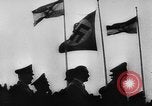
Finale of 1936 Nazi Rally at Zeppelin Field in Nuremberg, Germany. Elements of the German Army drill and perform maneuvers.
The final day of the 1936 Nazi Rally at Zeppelin Field in Nuremberg. German Chancellor Adolf Hitler, along with Hermann Goering and Rudolf Hess, stand under flags at reviewing spot. Wehrmacht Cavalry unit is introduced by a drummer riding a prancing horse. Hermann Goering, Adolf Hitler, and General Paul von Kleist, stand together. The cavalry ride across the field at a good pace. Motorized unit then performs. Soldiers in Kfz.13 armored cars perform controlled careening maneuvers on the field, followed by precise formations of armored cars in motion.Young officers have a front row seat on the ground. Horse cavalry appear again, pulling field artillery pieces. Hitler enjoys the show standing next to Cavalry Commander, General Paul von Kleist, who smiles.
British soldiers march forward for the Battle of the Somme in France during World War I
From "The Battle of the Somme." British Army at the Battle of Somme in France during World War 1. British infantry and cavalry units wait to move forward and get into trenches near Fricourt Mametz in France. At Bray platoons of Buff, Bedford, Suffolk and a battalion of Royal Welish Fusiliers lined up and march forward. Cavalry units also move forward. French farmers in fields, they tend the artillery horses and make them drink water. A General stands with a live fox in his arms (or possibly a slender dog), as soldiers stand beside and behind him in the background.
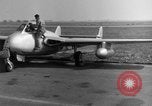
Italian pilots with Dehavilland DH-100 Vampire jet planes during Allied forces Exercise Jupiter, at Wiesbaden Air Force Base, West Germany
Exercise Jupiter, Wiesbaden West Germany, September, 1951. (This was a three-day, French-directed war game involving Allied forces in Europe. Among those on hand to observe the exercise was the SHAPE commander, Gen. Dwight D. Eisenhower.) In opening scene, an Italian pilot in flight suit, leans into the cockpit of a De Havilland DH-100 Vampire jet plane displaying number 72 on it's nose, at Wiesbaden Air Force Base. A ground crewman connects an auxiliary power unit to the aircraft, as the pilot adjusts his helmet. Closeup of the Italian pilot reaching into the cockpit. A U.S. C-47 transport plane taxis in the background. Two other Italian pilots, in flight gear, appear nearby plus a U.S. Air Force flight line tug. The other pilots stroll around the Vampire jet. Next, the tug is seen moving away as other Italian pilots gather around Vampire jets on the flight line. The tug, carrying several Italian officers, backs up to jet number 72, and hooks up and tows away the auxiliary power unit.
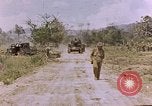
Aftermath of Japanese last desperate "banzai" attack against American forces on Saipan in World War II
Opening scene shows an M8A1 75mm Howitzer motor carriage (variant of M8, using M5A1 Stuart tank chassis). It moves slowly toward the camera along a dirt road on Saipan during World War 2. Closeup shows short gun barrel and driver in turret above, speaking on radio. Bodies of many Japanese soldiers are seen, recently killed in final attacks culminating in their organized suicide assault (AKA "the Tanapag Plain banzai attack") on July 6th and 7th, 1944. A marine throws a hand grenade at a clump of foliage. (Note: Principal American defenders included units of the 105th Infantry, that bore the brunt of the assault, together with 165th Infantry; 23rd Marines; 24th Marines; 25th Marines; 20th Marine,Engineers; and 10th Marines, plus supporting artillery units.
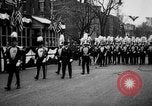
President Coolidge and Governor Byrd review a parade in Alexandria, Virginia.
U.S. President John Calvin Coolidge reviews a parade in Alexandria, Virginia. Infantry units march in the parade. People on the side of the road to watch the parade. A band marches. Cavalry units march. President Coolidge and Virginia Governor Harry Flood Byrd, Sr. review the parade from the window of a building.
CRITICALPAST.COM: About Us | Contact Us | FAQs - How to Order | License Agreement | My Account | My Lightboxes | Shopping Cart | Advanced Search | Featured Collections | Website Terms & Conditions | Privacy Policy ©2026 CriticalPast LLC.
License Agreement |
Terms & Conditions |
Privacy Policy
©2026 CriticalPast LLC.