


 Francais
 Deutsch
 Italiano
Refine Your Search
New Mexico United States 1946 stock footage and images
- Showing 2569 to 2574 of 30776 results more
more Hide
Hide
Casket of the first American Unknown Soldier placed at original Tomb of the Unknowns in Arlington National Cemetery, Virginia
Funeral and interment ceremonies for the American Unknown Soldier of World War I being interred at Arlington National Cemetery in Arlington Virginia, United States. Casket of the Unknown Soldier brought out of the new Memorial Amphitheater at Arlington National Cemetery. Soldiers carry the casket out of the amphitheater and past an honor guard of American soldiers lined up along the way and saluting. United States soldiers carry the casket past a large number of officials and military officers towards the sarcophagus of the Tomb of the Unknown Soldier. Soldiers place the casket on the sarcophagus of the Tomb of the Unknowns. Chief of the Native American Indian Crow Indian tribe, Plenty Coos, places a coup stick on the casket to pay tribute to the Unknown Soldier of World War 1, from the "first Americans."

Cotton industry and urbanization in Japan
Cotton production, transport, and urbanization in Japan. Shipment of raw cotton from the United States are unloaded from a freighter on a Japanese port. Dock worker pulls lever. The package is offloaded from the ship. Various machines process United States cotton in Japanese factories. OSK Line ship Naruto Maru sailing in New York City. The captain of the Naruto Maru stands beside the Japanese flag. The urbanization of Japanese cities. Overcrowded houses and slum areas because of industrialization in Japan. Vehicles move on the road in a Japanese city.
Japanese forces capture Corregidor, Philippines; Bataan Death March; Pacific supply lines to allies in Australia in World War II
Japanese forces fire artillery at Corregidor Island, during Japanese occupation of Philippines during World War II. Smoke rising from Corregidor under bombardment. Japanese troops land on Corregidor, the Philippines, on May 5 1942. A soldier watches enemies' action through binoculars. Soldiers fire artillery in the field. General Wainwright surrenders. He sits with other officers and Japanese officers and discusses. Japanese soldiers lower the American flag. Japanese troops Banzai cheer and celebrate their victory. They raise the Japanese flag. Captured Americans and Filipino prisoners of war departing Mariveles during the Bataan Death March, under Japanese guard. Map shows Japanese targets for invasion in other areas like Malay, Borneo, and New Guinea. Close up view of Japanese soldier's face. Briefing documents labeled Secret are opened and reviewed. Airplanes on the ground. U.S. And Australian troops march in Australia. Animated globe shows different countries. View of armament and artillery production factory operation in the United States supplying war materiel. Close up views of faces of war production workers. Animation and models show a supply line through which supplies are transferred to Australia. Lockheed P-38 Lightning wrapped in camouflage is lowered onto a transport ship deck. U.S. Army tank loaded onto ship and American troops go ashore in Australia. United States planes bomb and sink Japanese ships in the Bismarck Sea on March 2, 1943. View of American machine gunner firing machine gun from aircraft in flight toward enemy Japanese ships. Cockpit point of view shot out of American aircraft as it bombs and strafes Japanese ship. Bombs away view as U.S. aircraft release bombs. Smoke rises from the burning Japanese ships. General Douglas MacArthur and Admiral Chester W. Nimitz meet and discuss strategy and review maps. Animation shows different potential routes for American forces to return to the Philippines.
College graduation ceremony and view of Statue of Booker T Washington at Tuskegee University in Tuskegee, Alabama.
Two men on stage during graduation ceremonies of Tuskegee University (1200 W Montgomery Rd, Tuskegee, AL 36088, United States) in the United States. African American students in convocation gowns and caps. New graduates file out of the graduation ceremony, pose for pictures, and then visit with friends and family. A statue of Booker T Washington at Tuskegee University in Tuskegee, Alabama. View of stone inscription at base of the statue.
Engineers and workers from various nation work to save ancient Egyptian temples of Pharaoh Ramses II from flood of Aswan Dam.
Opening slate reads: "ANCIENT ART SAVED, Engineers To Move Treasures of the Nile." A sightseeing river boat plies waters of the Nile river approaching the Egyptian Temples of Ramses II, on its banks, in Nubia. Visitors are seen taking photographs in front of the four 65 foot statues of Ramses II in the facade of the Temple, while engineers are cutting them into pieces that will be reassembled 200 feet above the coming flood created by the new Aswan Dam in Egypt. Camera pans over smaller images and inscriptions at the site, and many embossed images cut into huge stone pillars. Statues inside the Temple tower above a man standing near them. Closeup of two of them. View of engineers making measurements on a wall filled with hieroglyphics. Four more interior statues well as the exterior statues of Ramses II are seen in stages of disassembly A worker standing beside the huge head of Ramses II statue .Camera pans over the ancient site. (Narrator states that the international effort to save and move the temple will cost 36 million dollars, with Egypt and the United States, each contributing one third, and the United Nations obtaining the rest from member nations.)
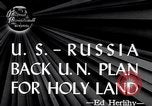
Jewish refugees from Europe reach Palestine
A newsreel titled 'US-Russia back UN plan for Holy Land' shows European Jewish refugees on board a former American vessel as they reach Haifa Palestine after traveling from a Black Sea port. Writing on ship says "Haganah Ship - Jewish State". Passengers hold up a dead infant for those on the docks to see, a victim of the overcrowded ship conditions. British forces patrol the docks before passenger disembark. Fatigued refugees, including families with small children, disembark from the ship as the injured and sick are carried away on stretchers. Passengers are sprayed with delousing agent powder to control spread of disease. Other passengers seen embarking a ship from dock for transport to Cypress detention camps, rather than facing deportation to Europe. Scene change to United Nations meeting at Lake Success New York. United States delegate, Herschel Johnson, addresses a meeting of General Assembly's Special Committee on Palestine, expressing support for proposed partition of Palestine.
CRITICALPAST.COM: About Us | Contact Us | FAQs - How to Order | License Agreement | My Account | My Lightboxes | Shopping Cart | Advanced Search | Featured Collections | Website Terms & Conditions | Privacy Policy ©2026 CriticalPast LLC.
License Agreement |
Terms & Conditions |
Privacy Policy
©2026 CriticalPast LLC.