


 Francais
 Deutsch
 Italiano
Refine Your Search
New Mexico United States 1946 stock footage and images
- Showing 25747 to 25752 of 30777 results more
more Hide
Hide
History of U.S. Army 3rd Infantry Division and its role in the Korean War.
Sergeant Stuart Queen of the U.S. Army introduces a film about the 3rd Infantry Division. He turns to Audie Murphy, the most combat decorated soldier of World War 2, seated beside him, who is now a film star, but still active as a Captain in the 36th Infantry Division of the Texas National Guard. Captain Murphy speaks about the U.S. 3rd Infantry Division. View of the Division parading for the Joint Chiefs of Staff, at Fort Benning Georgia, in Summer, 1949. Animated map shows Korea and surrounding countries of China and Japan, on June 25, 1950. View zooms in on the 38th parallel marking separation of North and South Korea. Views of North Korean troops moving against South Korea. Buildings being blown up. Armed troops of the People's Army of North Korea prodding civilians out of their homes. South Korean troops riding in an American-provided army truck, join others organizing to resist the invaders. South Korean troops in battle gear preparing to engage the North Koreans. Next, as part of United Nations response to the North Korean aggression, elements of the U.S. 3rd Infantry Division are seen arriving in November, 1950, and deploying along the East Coast of the Korean peninsula, to engage the North Korean army along its left flank. Battery of American M114 155 mm howitzers firing. American troops advancing along muddy road in snowy environment in December, 1950. Entry of Chinese forces into the conflict causes Americans to assume a defensive posture. Korean troops preparing to move elswhere.Smoke rising from battles in the background. Views of American defensive positions on the perimeter of the coastal city of Hungnam, to cover the withdrawal of units and equipment the U.S. 10th Corps, seen entering landing craft from the USS Montague (AKA-98) for evacuation from the beachhead
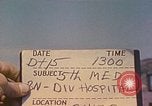
U.S. Marines carry wounded marines on stretchers towards hospital tents in Iwo Jima, Japan.
Medical units of U.S. military units in Iwo Jima, Japan during the Battle of Iwo Jima, World War II. U.S. Marines outside hospital tents. The marines with camo helmets and utilities carry a wounded marine on a stretcher. They enter a hospital tent. Other marines stand and walk in the area. A sign in the background reads: 'Officer of the day'. A wounded marine on a stretcher is unloaded from a parked vehicle in the foreground. Several marines near large tents and other small shelters in the background. A wounded marine on a stretcher is unloaded from a vehicle. Other marines walking in the area. They carry the stretcher towards a large tent.
A launcher in Iwo Jima, Japan fires bombs towards the ocean.
Medical units of U.S. military units in Iwo Jima, Japan during the Battle of Iwo Jima, World War II. A launcher on a beach. A portion of the launcher fires and a bomb explodes in the ocean. Marines arrive near the launcher and examine it. Hands point to the underside of the launcher. Projectiles in the launcher. A marine aboard a parked tank on the beach. Concertina barbed wire in the foreground. Water in the background. The launcher fires bombs which land and explode in the ocean in the background.
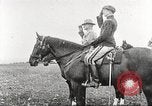
U.S. infantry of the American Expeditionary Forces march jointly with French infantry during World War I
American and French Army officers, on horseback, salute as a French and American infantry parade on a field in France during World War 1. The American and French flags are carried and various contingents of troops carry their respective identifying colors. Mounted officers accompany their units. General John J.Pershing reviews the joint French-American parade with French President Raymond Poincare and French Prime Minister Paul Painleve. French and American staff officers stand in the background. Animated map show the U.S. flag being overlayed on a smoldering Europe. A U.S. Stars & Stripes shield. (Note: Interestingly, only infantry units participate in this parade. No cavalry, or artillery are involved and rifles are the only weapons seen.)
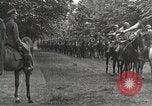
The Weimar Republic. German troops pass in review. German President Friedrich Ebert reviews honor guard and meets officers
During the period of the Weimar Republic, following World War 1, an officer on horseback reviews German soldiers on parade on a tree-lined dirt road.They are led by a brass band mounted on horseback, followed by a contingent of mounted German Lancers. A brass band stands and plays opposite the reviewing officer, as a unit of infantry with shouldered rifles and fixed bayonets marches past, led by a goosestepping unit. Numerous flags are carried by marchers at the rear. Scene shifts to a railway platform, where German Army and Navy officers accompany Friedrich Ebert, the first President of Germany, as he reviews an honor guard drawn up in precise formation. President Ebert is introduced to other German officers.
Armored vehicles and missiles on transporters move during Afghan Army parade, and King Mohammed Zahir Shah and wife in Kabul.
Afghan Army units parade in Kabul, Afghanistan. An Afghan army jeep passes on a road during the parade of the Afghan Army units at Kabul. Several people on the side of the road. Flags along the side of the road. Few army jeeps moving with army personnel. Flags on each jeep. A number of Afghan officials, guests, diplomatic corps and military attaches seated on the reviewing stand. Two SA-2 Guidelines, the Soviet designed surface-to-air missiles on transporters move along the road during the parade. A few missile containers on transporters moving on the road. A few BTR-40 armored personnel carriers with soldiers pass in the parade. BRDM-2s, armored patrol cars follow the BTR-40s. A few BTR-60s, eight-wheeled armored personnel carriers with soldiers moving on the road. A few BTR-152s, non-amphibious armored personnel carriers passing along the road with soldiers on it during the parade. Soldiers on T-54 tanks pass during the parade. A vehicle parked in front of a building. A few men outside the building. King Mohammed Zahir Shah emerges out of the building. The King and his wife Humaira Begum gets into the vehicle and the vehicle moves with other vehicles escorting. The King salutes to the officials standing along the road.
CRITICALPAST.COM: About Us | Contact Us | FAQs - How to Order | License Agreement | My Account | My Lightboxes | Shopping Cart | Advanced Search | Featured Collections | Website Terms & Conditions | Privacy Policy ©2026 CriticalPast LLC.
License Agreement |
Terms & Conditions |
Privacy Policy
©2026 CriticalPast LLC.