


 Francais
 Deutsch
 Italiano
Refine Your Search
New Mexico United States 1946 stock footage and images
- Showing 253 to 258 of 30776 results more
more Hide
Hide
United States President Herbert Hoover welcomes the Mexican President-elect Pascual Ortiz Rubio in Washington D.C.
Mexico's President-elect Pascual Ortiz Rubio visits Washington D.C., United States. United States President Herbert Hoover welcomes the Mexican President-elect. President Herbert Hoover and Pascual Ortiz Rubio exit the White House building. First Ladies Lou Henry Hoover and Josefa De Ortiz stand next to their husbands.
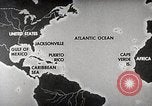
Early Warning Squadron Four take off to detect the occurrence of hurricane in the United States.
The role of Airborne Early Warning Squadron Four in the United States. Animated map depicts the regions susceptible to hurricanes including the Gulf of Mexico, Caribbean region. Hurricane Hunter aircraft in flight over an air base. Crew members gather near the aircraft. Crew members being briefed about the mission. Crew members in the cockpit of the aircraft. Weather team records meteorological data aboard an airborne aircraft. Radar team at work as they detect the chances of occurrence of a hurricane. A crew member prepares food aboard the aircraft. Crew members relax and read. A radar screen depicts the occurrence of a hurricane. Weather team checks the sighting. A barometer reading. Meteorological experts work on weather maps.

Construction of U.S. B-25 Mitchell bomber aircraft in the United States to carry out combat operations during World War II.
Film titled 'Combat Report' depicts the construction of U.S. B-25 Mitchell bomber aircraft to attack German submarine during World War II. Exteriors of U.S. War Department building in Washington D.C., United States. U.S. Assistant Secretary of War for air Robert Lovett and Under Secretary of War Robert Patterson seated at desk. U.S. officer looks at combat report at his desk. View of a oil tanker hit by torpedo as it sinks in the Gulf of Mexico. View of crewman at controls and a tower. Combat report being typed. U.S. sailors type report at typewriters. Man speaks into radio. Navy officer instructs an officer. U.S. B-25 Mitchell bomber aircraft in flight over sea. Pilot and copilot at controls in B-25. The position of attack being radioed to a U.S. B-25 Mitchell bomber aircraft in flight over sea. Interior views of cockpit of B-25 bomber, and of Instrument panel of B-25. Engine of planes. Men in war production aircraft factory at work building and assembling aircraft during World War 2. Blast furnace in factory. The airplane engines being assembled, tested and installed in B-25.
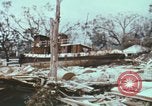
Characteristics and names by which tropical cyclones are known in different places is discussed in the United States.
A documentary in the United States on occurrence of tropical cyclones. A rubbled area after being hit by a tropical cyclone. Soldiers carrying a dead body on a stretcher. Cyclones are known by different names based on their geographical locations. Animation depicts names of cyclones in different areas with the help of a map. In the Western Pacific they are known as typhoons. They are known as Baguio in the Philippines. They are called cyclones in the Indian Ocean and the Bay of Bengal. In Australia they are called Willy-Willy. A cyclone is called a hurricane in the Eastern Pacific, the Gulf of Mexico and the Caribbean. Characteristics of tropical cyclones. Counter clockwise wind flow at the time of a cyclone. The pressure when the tropical cyclone approaches. The eye of the tropical cyclone may be very small or very large in diameter. The strongest winds around an eye average from 90-150 knots. The storm is divided into semicircles for orientation. The right semicircle is considered to be the most dangerous semicircle because of its stronger wind. The left is considered to be relatively less dangerous because of somewhat weaker winds. A demonstration is done by considering ships stuck in both the parts. The ship stuck in the right semicircle revolving in the area. The ship stuck in the left one arrives towards the end and comes out of the storm. Ships underway at sea during a storm. Clouds in the sky. Rain begins to fall. A man checking a parametric center. Animation shows a ship arriving towards the storm center. The ship's radar used to locate the ship's location.

Plan for Peace, 1947. Public information film about U.S. Army Universal Military Training Project
Firing of a V-2 rocket from White Sands, New Mexico. An XP-84 jet aircraft on a test flight in California. Scenes of devastation in Hiroshima and Nagasaki. An atomic bomb test conducted in Bikini Atoll, Marshall Islands. Large smoke cloud rises. Americans expressing disgust with war and confidence in ability to protect against it in future. Newspaper headline about Armistice ending World War I on November 11, 1918. Victory parade in New York City. Close up view of Adolf Hitler as he speaks forcefully to a German audience. V2 rocket being launched in Germany. German Messerschmitt Me 163 Komet rocket plane in flight. Map depicting uranium deposits world wide. An XB-36 bomber in flight with landing gear extended. A huge formation of various warplanes in flight, high overhead. A wartime tank assembly plant. American army troops on parade. A United Nations meeting in session. Peaceful scenes of American soldiers in Hawaii before World War II in the Pacific. Hawaiian Hula dancers. Japanese carrier-based Aichi D3A1 dive bomber in flight during attack on Pearl Harbor, December 7, 1941. Bombed U.S. warships and facilities in Pearl Harbor. American Army officer and civilian discussing wisdom of maintaing large standing army. Army recruits are seen in the U.S. Army Universal Military Training Experimental Unit at Fort Knox, in 1947. They are seen in quarters, studying; taking part in sports (baseball); and attending religious services in a base chapel. Several trainees in a field tent, working with numerous tape decks in some kind of military communications activity.

Refugees and displaced persons arriving in New York from aboard the SS Marine Flasher, arriving from Bremerhaven Germany
Arrival of displaced persons and refugees of World War 2 in New York, after the war. Men, women, and children arriving at New York City on May 20, 1946 after a voyage that departed Bremerhaven Germany on May 11, 1946. People greet relatives at the dock in New York. Two young men and a girl stand together and show the concentration camp tattoos on their arms. The tattoo numbers are A9496 on the young man with the hat, A13889 on the girl, and B3073 on the young man without a hat. The young man with tattoo B3073 is Berel Gola (later called Bernard Gola) a 20 year old Jewish man from Poland. He had been imprisoned by the Nazis at Treblinka and at the Auschwitz Concentration Camp, where he received the tattoo. A woman and a man holding a young girl stand. Women holding children stand by. A man holding a young child. People debarking from the ship. People crowd at the dock. They meet their relatives. People stand behind a fence. A woman greets her relative. An emotional woman cries when reunited with relatives.
CRITICALPAST.COM: About Us | Contact Us | FAQs - How to Order | License Agreement | My Account | My Lightboxes | Shopping Cart | Advanced Search | Featured Collections | Website Terms & Conditions | Privacy Policy ©2026 CriticalPast LLC.
License Agreement |
Terms & Conditions |
Privacy Policy
©2026 CriticalPast LLC.