


 Francais
 Deutsch
 Italiano
Refine Your Search
New Mexico United States 1946 stock footage and images
- Showing 25831 to 25836 of 30777 results more
more Hide
Hide
Airplane crash on Crystal Mountain within the Rocky Mountain range in Colorado
View of United Air Lines Flight 610 plane crash site on the slopes of Crystal Mountain west of Fort Collins, Larimer County, in Colorado. The Douglas DC-6 airliner “Mainliner Overland Trail” (N37543) was making its way towards Denver, Colorado. The engine of the crashed airplane can be seen. People at the crash site. Dead bodies are put in an ambulance. View of a rabbit killed by the crash. 50 people died in the plane crash.

Demonstration of military free fall parachuting at Marine Corps Base Camp Pendleton in California.
Recon Marines from 1st Force Reconnaissance Company Test Unit 1 demonstrate free fall parachuting. A sign identifies the Auxiliary Landing Field at Marine Corps Base, Camp Pendleton, California. (Narrator refers to the marines as para-scouts of the 1st Marine Division.) The marines, wearing back and chest parachute packs, board a U.S. Navy Grumman S2F aircraft with tail code "RZ" and number 136777. It taxis on the ramp and is next seen taking off from the runway. Two helicopters are parked on the airfield ramp. Next, viewed from the aircraft, a marine is seen in free fall. Soon he appears as only a speck , approaching the ground. Next, he is seen, from the ground, as his chute finally opens, and he lands, and begins to spill air from his billowing chute on the ground.
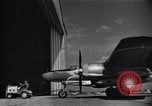
Use of artificial lightning equipment in Project Thunderstorm, and radar operations supporting project and its aircraft
Tug tows Northrop F-15 Reporter into hangar in Minneapolis, Minnesota to be instrumented for Project Thunderstorm. Various scenes of electrical equipment used in making man-made lightning, including a generator made up of hundreds of transformers, and a connected massive generator for producing high voltage. A large oscillograph is shown along with a smaller oscillograph designed for airborne use. A scientist is seen inside the giant generator. Artificial lightning tests are made on canopy of the F-15 occupied by a scientist, and the canopy remains intact following lightning strike. Lightning rods are attached to lightning-vulnerable nose, tail fin, and wing tip locations of the Project Thunderstorm aircraft. Pilot climbs into canopy of F-15. Airborne F-15 project aircraft seen in flight headed toward area of dark clouds. In Ohio at Clinton County Army Air Field, a project officer (AAF Captain) describes how search procedures of the pilot, weather observer, and radar observer are coordinated and key locations of radar and cooperating facilities at Jamestown and the Clinton County Army Airfield. Large radar antenna revolving on top of large tower, scanning for signs of thunderstorms. Radar antenna scanning vertically, near Quonset huts. Command center inside a quonset hut with project personnel at radar scopes and thunderstorm and aircraft positions plotted on large plexiglass screens. Technician adjust motion picture camera that photographs radar scopes every four seconds. Operator at vertical measuring instrument, showing reflected returns from targets, on July 18, 1947. View of operator at plan position indicator radar scope showing weather returns on June 6, 1947. Ground Control Approach (GCA) truck located near end of airfield to guide landings of Thunderstorm aircraft. Radio operators sitting at radar scopes inside the GCA unit. P-61 makes GCA approach and landing in good weather, to maintain skills needed when weather is bad. Briefing officer at blackboard cites radio channels to be used for various purposes. View of AAF aircrews in audience.
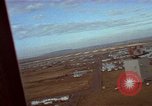
Commander, staff, and missile combat officers of the 341st Strategic Missile Wing begin their day with briefings during Cold War
View from Helicopter cleared to land at Malmstrom Air Force Base in Montana. Boys running across a field of tall grass past radar antenna at the base. A boy on a bicycle rides past a Strategic Air Command sign at the base reading "Peace is our Profession." Interior of a command center. An Air Force Senior Master Sergeant working with airmen to maintain status of the 341st Strategic Missile Wing's Minuteman missiles and coordinating their servicing and maintenance. Staff in the unit's command center is called to attention as their Commander, Colonel Rex Dowtin, enters. Colonel Dowtin and his staff officers take seats and listen to their morning briefing, beginning with a report from their weather officer about local conditions. This is followed by reports from other officers, including an African American officer, about the status of matters in their respective areas of responsibility. Meanwhile at another location, white-clad missile combat officer crews (Captains and Lieutenants) are being briefed by a Lieutenant Colonel who tells them the defense condition (DEFCON) is "4" and issues instructions for the day as they prepare to manage various missile silos and installations.
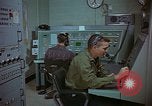
NASA Project Mercury spacecraft tracking facility at Eglin AFB
Operators at work in NASA Project Mercury tracking facility at Eglin Air Force Base, Florida. An FPS-16 operator at control console.Other equipment seen include time signal receiver and time standard equipment. Several technicians are seen, some performing diagnostic testing of equipment.. (Note: The FPS-16 units originally planned for the Project Mercury tracking network did not have adequate displays and controls to reliably acquire the spacecraft during orbit. So NASA had them modified to double their range and also incorporated data-handling equipment to facilitate transmissions from all sites to the Mercury Project computers.)
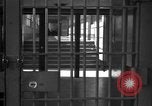
Buildings of Stateville Correctional Center; Prisoners are released from their cells in groups and move about the facility.
Stateville Correctional Center buildings and prisoners, in Crest Hill, Illinois, near Chicago. Prisoners come out of their prison cells, as they are unlocked sequentially in tiers starting with the upper and working down the cellblock of the penetentiary. Prisoners moving about the prison facility, along an external hallway and into landscaped area of lawn, flowers, and hedges. View inside a large roundhouse circular cellblock. Several prisoners are escorted singly to their cells. The center of the unit appears to be a large atrium. Overview of the entire facility shows several circular cellblocks and other buildings.
CRITICALPAST.COM: About Us | Contact Us | FAQs - How to Order | License Agreement | My Account | My Lightboxes | Shopping Cart | Advanced Search | Featured Collections | Website Terms & Conditions | Privacy Policy ©2026 CriticalPast LLC.
License Agreement |
Terms & Conditions |
Privacy Policy
©2026 CriticalPast LLC.