


 Francais
 Deutsch
 Italiano
Refine Your Search
New Mexico United States 1946 stock footage and images
- Showing 26011 to 26016 of 30777 results more
more Hide
Hide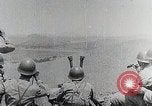
Role of metals in Japanese war against China during 2nd Sino-Japanese Conflict
Scenes of Second Sino-Japanese War, circa 1938. Japanese soldiers observing battlefield from a ridge. Japanese artillerymen firing field pieces. Flight of two Mitsubishi Ki-15-1 light bombers in formation, later called "Babs" by the Allies and known as a C5M in Japanese Navy usage. Aerial view of Japanese bombs falling on Chinese cities. Chinese citizens, including an injured woman, seeking shelter from bombing. Aerial view of Chinese ship being strafed by Japanese aircraft. The ship explodes. Downed Japanese warplanes burning. Scenes of destruction from bombing of oil facilities. Iron ore being moved in Japanese rail cars. Steel plants around Yawata, Japan. Numerous containers of molten steel inside a steel plant. Hot Steel ingots being moved. Animated map shows locations of iron ore deposits in Japan. Scrap steel being imported that, narrator states, helped boost Japanese wartime production to 12 million ingot tons in the Sino-Japanese war. More views of open rail cars moving alloying elements to a steel mill. Open mining using explosives. Mining operations for copper and bauxite (aluminum ore). Japanese miners shoveling ore by hand into open rail cars. Open rail cars moving in both directions on parallel tracks. (Note: Although some narration refers to 1941 Japanese production, the images are from earlier period.)
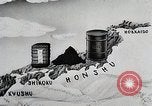
Japanese natural resources related to Second Sino-Japanese war and World War II
Animated map illustrating shortage of indigenous raw materials in Japan. As stockpiles vanish during Second Sino-Japanese war, Japan's domestic sources supply only 10% of the nation's needs for war. Animated sequence shows lack of steel, aluminum, copper, and power generation for the conduct of war. But one of the nation's greatest resources is the population of skilled Japanese workers, who are shown at various high tech jobs, as well as on the farms and in the fishing industry. Japanese workers are seen who work for the Zaibatsu (four ruling families of Japan). Banks of Japanese women typists and women in a factory. Young women painting faces on a "Kewpie doll." A Japanese family at dinner time. Women engaged in fabric spinning. Animated graphic illustrates Japan's war-related resources for World War 2, by showing a Japanese soldier standing astride map of Japan with lines extending to sources of needed raw materials from Japanese possessions in Korea, Manchuria,Formosa, China,Indochina,Malaya, and its network of Pacific Islands. Final scene displays copy of Los Angeles Times newspaper with headline reading: "Jap Supply Lines Blasted." It also features a story that appears to refer to the U.S. 6th Army invasion of Leyte in the Philippines, in October, 1944 (when General MacArthur waded ashore and stated,"I have returned"). (Note: Although produced during World War 2, this film shows prewar scenes of Japan. The animated illustrations and maps and, of course, the newspaper shown at the end, date from World War II.)
U.S. Lieutenant General Daniel Sultan explains Japanese aggression in China and need for troops in India and Burma during WW2
World War II film about the China, Burma, India (CBI) Theater of Operations. A soldier is seen filling out a form seeking information about him and inviting him to write in questions about anything he hadn't learned through normal information channels. Scene shifts to Information and Education Department of the Burma-India Command, where it is being processed by a soldier. Lieutenant General Dan I. Sultan, commander of Burma-India Theater, is seen next, seated at a desk, with wall map of the region behind him. He is appearing in an information film intended to inform troops under his command. He notes that more than half the troops who filled out the information form, asked why American troops were stationed in India and Burma. He refers to the recent recall of General Stillwell and the splitting of CBI into two theaters (China and India/Burma). He states that the purpose is a path toward Japan. An animated map shows China (that narrator notes has been fighting Japan since 1937). Animation shows Japan walling off China from the outside world, by seizing her ports, and then concentrating its grip on the Eastern part of the country. Without access by sea, the allies had only one option to assist China in the fight against Japan. That was to open the Burma Road. Film shifts to scenes of Japanese bombing of Shanghai and Chinese civilians abandoning the city in 1937 during Second Sino-Japanese War. Wounded and injured Chinese fighting fires while tending casualties in an open area. Glimpse of Chinese soldiers near one of their few large artillery pieces. A gun crew manning one of her few antiaircraft guns. Chinese jam road in trek to the unoccupied provinces of the country. Chinese carrying casualties on stretchers, making do without ambulances. Chinese coping in the face of all kinds of shortages. In contrast, well supplied Japanese troops are shown in formation. Japanese troops, military vehicles and equipment are seen. Japanese firing machine guns and heavy artillery against Chinese positions. Japanese armor and long lines of troops engaged against the Chinese, who continue to resist in spite of shortages and hardship. Chinese soldiers without shoes, marching in a column.
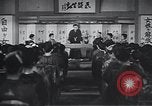
Documentary on status of women in Japan. Contrasts progressive efforts to past practices affecting lives of women.
Documentary on the status of women in Japan. It begins with a group of "progressive" women working to improve women's lot. Images of Meiji statesmen Fukuzawa Yukichi and Mori Arinori are shown with comment that they recognized the importance of women and worked towards their equality. The narrator states that in spite of their efforts, attitudes towards women were slow to change. The narrator cites centuries of repression of women as a reason for this. (In the Nara period, however, songs from the anthology called the Manyoshu, indicate men and women had a more equal relationship, which is illustrated by a couple relaxing in a park, while girls dance in the background.) With that exception, women are shown to have had generally difficult lives in the past. scenes of women being supressed are reenacted, such as one where a man eats dinner while his wife sits quietly behind him. Another shows a woman being scolded by her husband. A woman pulling a heavily laden cart up a hill. Women bowing low while a Samurai passes them.
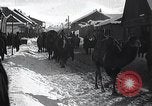
Russian troops moving supplies on camels during the Caucasus Campaign of World War I
Slate states: "Transportation difficulties are solved by Bactrian camels as they withstand the intense cold remarkably well. " Russian Army camel caravan moving supplies through a snow-covered village during the battle of the Caucasus, in World War 1. Later, they are seen moving across deserted field of snow, with partially pine-covered mountain in background.
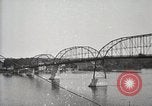
U.S. Army Transcontinental Motor Convoy crosses Mississippi River on the Lyons-Fulton Bridge from Illinois to Iowa
The 1919 Motor Transport Corps convoy en route from Washington, D.C., to San Francisco, California. The Convoy of U.S. Army trucks is seen moving slowly, over the Lyons-Fulton Bridge across the Mississippi River at Clinton, Iowa. While crossing the bridge, the convoy is led by an open car displaying an American flag, followed by a bicyclist. Pedestrians walk along side walkway crossing the bridge in the opposite direction. The convoy of Army trucks driving along a highway after crossing the Mississippi. Sign at side of road reads: "Bay State." Sign on one truck reads: "Frisco." Trucks display logo of U.S. Army Corps of engineers. The convoy driving along a road parallel to a railroad line. Next sequence shows one truck attempting to pull another that has been mired down in mud, in Nebraska. After some effort, the truck is successfully pulled out of the mud.
CRITICALPAST.COM: About Us | Contact Us | FAQs - How to Order | License Agreement | My Account | My Lightboxes | Shopping Cart | Advanced Search | Featured Collections | Website Terms & Conditions | Privacy Policy ©2026 CriticalPast LLC.
License Agreement |
Terms & Conditions |
Privacy Policy
©2026 CriticalPast LLC.