


 Francais
 Deutsch
 Italiano
Refine Your Search
New Mexico United States 1946 stock footage and images
- Showing 2599 to 2604 of 30776 results more
more Hide
Hide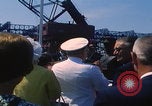
Navy Chaplain Sargent performs a benediction during the keel laying of USS Nimitz
The keel laying of supercarrier USS Nimitz (CVAN-68) at the Newport News Ship Building & Drydock in Newport News, Virginia, USA. United States Navy Chaplain Captain G.H. Sargent speaks on the microphone while giving the benediction. Crowd departing the area. The bust of Fleet Admiral Chester W. Nimitz is seen. A blonde woman smiles while standing in group chatting. Some of the crowd leaving after the ceremony has ended.
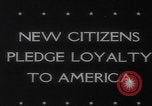
Newly naturalized Americans recite the Pledge of Allegiance during the 1944 “I Am An American Day” (WWII)
More than a million people attend the “I Am An American Day” citizenship ceremony in Central Park in New York City, during World War 2. Over 150,000 people attended the ceremony as newly naturalized American citizens. Native American Indians in traditional dress and women and men in military uniform attend the ceremony. Flags of various nations are flown. Wounded Army soldiers and wounded Navy sailors arrive as guests of honor. New York City Mayor Fiorello LaGuardia shakes hands with servicemen, giving tribute to their heroism during World War II. Immigrants stand up to recite the Pledge of Allegiance to the United States of America as part of the naturalization ceremony. Speaker recites the Pledge of Allegiance, which predates the inclusion of "under God" which was added later in the 1950s.
U.S. President Franklin Roosevelt inspects one of the government's rural settlement communities in Arthurdale, West Virginia.
U.S. President Franklin Delano Roosevelt arrives in Arthurdale, West Virginia. View of new houses in the area built through US government New Deal programs. Roosevelt seated with other officials in a car. He arrives to inspect one of the government's new rural settlement communities. People gather on a road of the rural town. Roosevelt seated in his car and talking to people who have gathered around, including men, women, and children. A boy nearby wearing a Boy Scout uniform. President Roosevelt makes a joke as he pets the nose of a steer, saying that "it's what people call a West Virginia moose." A family poses for the camera on a porch. The people laugh. Scene changes to Roosevelt addressing people in a hall, as the graduation speaker for the local high school in Arthurdale. He speaks about the new tax bill (the Revenue Act of 1938), saying "At midnight tonight, this new tax bill automatically will become law. But it will become law without my signature or my approval." Scene changes to a dance. The First Lady of the United States, Anna Eleanor Roosevelt enjoys a square dance in a dance hall. Men playing musical instruments including guitar and banjo, and a caller calls out the changing moves of the dance as Mrs. Roosevelt and others dance.
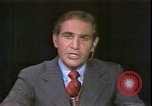
Irving R Levine and Paul Duke report and discuss the proposals stated by U.S. President on economic problems.
News analysis following Richard Nixon's speech on economy crisis from Washington DC, United States. Reporter discusses the speech with journalists Irving R. Levine and Paul Duke. Group reviews the proposal of President Nixon to end unemployment and economy crisis. The proposals to end unemployment by Nixon are 90 day wage-price freeze, additional action on wages and prices, temporary suspension of full convertibility of dollar into gold (later called the "Nixon shock"), investment of tax credit, temporary surcharge of 10% imports, repeal of excise tax on automobiles, speeding of personal tax exemption to get more money in pocket and reduction of federal expenditure. Journalists Irving and Paul Duke also question why the President made the proposal now when the graph of dollar and unemployment begins to fall after sitting on President's seat for two years.
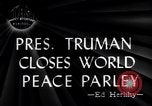
U.S. President Harry S. Truman closes the San Francisco Conference leading to founding of the United Nations.
U.S. President Harry S. Truman greeted at San Francisco Airport by U.S. Secretary of State Edward Stettinius before a parade through streets. President witnesses the voting, as fifty nations agree to the new United Nations Charter. First to sign is China followed by Russia, Great Britain and France. Then Mr. Stettinius affixes his signature. A close view of signed charter is shown. President then addresses the Conference.
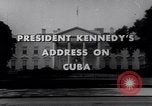
President John F. Kennedy address from White House about Cuban build up of nuclear ballistic missiles.
President John F Kennedy addresses the people of United States about recent events in Cuba during the Cuban Missile Crisis. Cameras and press in front of Kennedy in the White House. President Kennedy sits at table with flags in the background. Kennedy tells about the news of Soviet nuclear weapons being stockpiled by the Cuban Government. The U.S. government has evaluated the threat and now Kennedy gives details about both medium and intermediate range ballistic missiles seen in Cuba. Kennedy lists some areas within America that are in range of Cuban missiles He also notes that the Cubans are preparing jet bombers. Kennedy makes note of a 1947 pact with the Soviets, and notes also some personal talks with the Soviets in September. He notes his talks with Russian Foreign Minister Andrei Gromyko as well. He states that use of nuclear weapons is a threat to peace. He notes that the U.S. has no desire to dominate any country but declares Cubans action to be provocative.
CRITICALPAST.COM: About Us | Contact Us | FAQs - How to Order | License Agreement | My Account | My Lightboxes | Shopping Cart | Advanced Search | Featured Collections | Website Terms & Conditions | Privacy Policy ©2026 CriticalPast LLC.
License Agreement |
Terms & Conditions |
Privacy Policy
©2026 CriticalPast LLC.