


 Francais
 Deutsch
 Italiano
Refine Your Search
New Mexico United States 1946 stock footage and images
- Showing 26197 to 26202 of 30777 results more
more Hide
Hide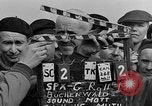
Kurt Gatner, an Austrian internee at Buchenwald concentration camp in Germany.
Internees at a concentration camp in Buchenwald, Germany. Kurt Gatner, a former Chief of Prime Minister Schuschingg's body guard from Vienna, Austria. He says that he was arrested in 1938 soon after the occupation of Austria by Germans. He states how he was badly treated at various concentration camps. He talks about the harsh punishments being given at these camps. He thanks the American and other Allied forces for liberating him and many others from the camp. Other internees in the background. (World War II period).
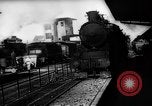
Croatian officers receive a warm welcome after they return to Zagreb, Yugoslavia.
Croatian officers return to Zagreb, Yugoslavia from Germany. A train pulls up at a station in Zagreb, Yugoslavia. Croatian officers get off the train as a jubilant crowd cheers and welcomes them in a warm manner. Officers review troops, hear a speech by an officer. Officer shakes hands with the soldiers. Soldiers march on the street as people cheer them. Officers parade with the Chief of State Ante Pavelic. (World War II period).
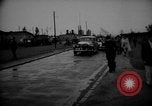
In Germany, displaced Jewish people in cars and buses readying for trip to newly founded Israel
Jews in Germany 4 years after the end of World War II. Cars carrying Jewish people move along a street to railway station as they leave for the newly founded state of Israel. The Israeli flag on a car. Men on bicycles. Men loaded onto a bus. Private cars decorated with branches move towards railway station. People gathered at the station. A man salutes.
Displaced persons (mostly Russian) carry Russian flags and celebrate victory over Germany in Wiesbaden
A victory celebration in Wiesbaden Germany near the end of World War 2 in Europe. Mostly Russian Displaced Persons (DPs) carrying Russian flags gather in a street in Wiesbaden, Germany to celebrate the Allied victory over Germany. A band plays at the center of the people as men stand around. Russian women march. (See also prior clip clarifying April date, despite slate in this clip stating February.)
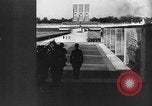
Nazi Party ceremonial grandeur is contrasted to the horrors perpetrated under the 3rd Reich
6th Nazi Party Congress at Nuremberg, in 1934, featuring a "Totenehrung" ceremony, honouring dead. Nazi SA ( Sturmabteilung) and SS (Schutzstaffel) troops in precise formations fill the Zeppelin Field Luitpold Arena, leaving only a wide pathway to the Ehrenhalle war memorial. View from behind honor guard standing at the Ahrenhalle, as Adolf Hitler, flanked by SS leader, Heinrich Himmler (in Black) and Viktor Lutze, head of the Sturmabteilung (SA), approach. Three huge banners with swastikas are seen in the far background. Scene shifts to 1945. American troops are now assembled at the main grandstand (Ehrentribüne) of Zeppelin Field. The American flag covers the wreathed swastika sculpture at the top of the Grandstand. View of German soldiers, who have been mustered out, mingling with civilians in a town. Some speak with an American soldier, who is part of the U.S. occupying force. Scene shifts to the Yalta conference in February, 1945. Winston Churchill, Franklin D. Roosevelt, and Joseph Stalin are seen seated while their most senior military staff members stand in the background. Allied leaders sit around a large conference table. U.S. Secretary of State James F. Byrnes, sits near Prime Minister Winston Churchill. Scene shifts back to Nazi era. Joseph Goebbels, Reichminister of Propaganda is speaking and haranguing a crowd. In contrast, German soldiers are seen conversing with occupying American soldiers. This is contrasted with more scenes of Nazi leaders giving impassioned speeches to a hall filled with Nazi faithful. German soldiers, prisoners of war are seen directed by U.S. military police, behind a barbed wire enclosure. Large numbers of German prisoners of war in an open holding area. Closeups of some. Bucolic scenes of farmers working in fields and herds of sheep and cattle. Hitler speaking in a forceful, animated way and haranguing an audience of rapt listeners. German civilians standing quietly in a group. (Narrator refers them being the people of Beethoven, Goethe, and Martin Luther, as statues of those iconic Germans are shown.) In dramatic contrast, numerous dead bodies of victims are being shown to German citizens by American troops, at Nordhausen, Buchenwald, and Bergen-Belsen concentration camps. This is contrasted against views of German people folk dancing in traditional costumes, German contributions to science (view of Albert Einstein speaking) and industry (view of professional glass blowers at work). Glaring contrast shows German civilians moving the body of a concentration camp victim; several civilians being shot dead by a firing squad (unseen); Rudolf Himmler; and an image Germany being destroyed, as result of the Nazis. American soldiers are loosely assembled in an open field. by the Elbe River at Torgau, Germany on 26 April 1945. American and Russian officers greet each other at the site, where their armies have met in World War 2. American and Russian soldiers mingle and greet one another. Views of Allied forces entering Germany. Another scene of victims' bodies stacked at a concentration camp. French soldiers examine stake where prisoners were tied and executed in the Gestapo headquarters on Paris France. Other views of the Gestapo prison, where victims were buried. Examples of torture devices used to coerce information from prisoners. More views of stacked bodies of victims. Germans carrying bodies from a concentration camp. General Dwight Eisenhower and General George Patton visiting the Ohrdruf Concentration Camp. Burned remains of victims. Closeup of General Patton. German officials and citizens confronting horror as they are compelled to walk through the camp. A huge wagon loaded with bodies of the dead. German women appalled and repelled by the sights. Countless numbers of dead victims covering a large courtyard. German citizens compelled to carry body of a victim from the yard. Others carrying bodies of victims. Large numbers of German citizens, seemingly shamed and remorseful at the revelations. A group of German men carrying shovels and others carrying crosses to commence burying the victims appropriately. Men carrying victims bodies in open wooden caskets along a road lined with spectators. Coffins of victims laid out in a cemetery. (Narrator alludes to them never forgetting.) German men gently place covered coffins in a long mass grave.
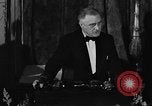
U.S.President Franklin D. Roosevelt castigates the Supreme Court at Democratic Party Victory Dinner in Washington, D.C.
President Franklin D. Roosevelt, standing at podium, speaking after Democratic Victory Dinner, in the Willard Hotel, Washington, DC, on March 4, 1937. He castigates the Supreme Court for issuing what he describes as a "pronunciamento," the Court's decision that neither the Federal Government nor the States may legally address issues of hours and wages. Roosevelt says it defines a "No man's land of final futility." The audience applauds. He goes on to speak to various problems with the Supreme Court. He speaks of freeing progressive actions of the Democratic Party from legal doubt. He calls for courage and wisdom. He notes that "here is one third of a nation, ill nourished;ill clad;ill housed." The President mentions farmers burdened by mortgage interest, and people laboring for inadequate wages. He decries the fact that thousands of children who should be in school, are, instead, working in mines and mills. The audience responds with enthusiastic applause.
CRITICALPAST.COM: About Us | Contact Us | FAQs - How to Order | License Agreement | My Account | My Lightboxes | Shopping Cart | Advanced Search | Featured Collections | Website Terms & Conditions | Privacy Policy ©2026 CriticalPast LLC.
License Agreement |
Terms & Conditions |
Privacy Policy
©2026 CriticalPast LLC.