


 Francais
 Deutsch
 Italiano
Refine Your Search
New Mexico United States 1946 stock footage and images
- Showing 2635 to 2640 of 30776 results more
more Hide
Hide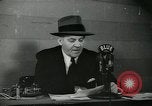
Walter Winchell 's radio broadcast about Nazi German atrocities (WW2)
Newspaper columnist and broadcaster, Walter Winchell, is filmed making a radio broadcast in New York City, United States, during World War II. He talks about the hard facts of war. He also states that any American who feels that America is being cruel to Nazi Germany should visit the American Military hospitals. He talks about the hardships and starvation suffered by women and children under German leader Adolf Hitler. There are several takes during this filming.
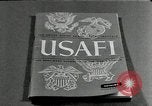
Soldiers attend special classes at the United States Armed Forces Institute in the United States.
A film shows veteran soldiers enrolling at the United States Armed Forces Institute in the United States. A book on the desk reads 'USAFI'. A hand opens the book. A boy seated on a desk fills the form and puts it in an envelop. The USAFI '(United States Armed Forces Institute )building. A sign reads 'War and Navy Departments, United States Armed Forces Institute'. A woman works at a typewriter. Another woman takes out the students list. People make bundles of the books for first course. A man and a woman seated at a desk check the enrollment forms. The University building. A woman checks the papers. A woman enters the building. Women seated on a desk work on a paper. A man seated on a desk looks into the papers. A man and a woman pack the text material to be mailed to students. A boy lying in his bed as he reads a book. An officer writes on a blackboard and students seated in a classroom. A certificate from the USAFI. A woman works on a typewriter. The University campus. Students in a class. A man at a blackboard. A student holds the degree and stands. Another student wearing gown and a hat.
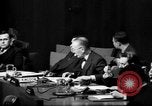
At a UN Security Council session held in Lake Success, Alexander Cadogan speaks about a truce between Palestine and Britain.
A United Nations Security Council session held in Lake Success, New York during the Cold War. Representatives of different nations are seated. Britain's representative to the UN Alexander Cadogan speaks about a truce between Palestine and Britain after the formation of the state of Israel. He speaks about withdrawal of British troops from Palestine. Soviet Union's representative on the United Nations Security Council Andrei Gromyko sitting next to Cadogan.
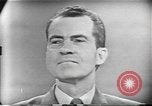
During a presidential election debate in Chicago Richard M. Nixon talks about the reasons for the financing of schools.
The first Kennedy-Nixon Presidential Debate in Chicago, Illinois. Sander Vanocur from NBC News asks Republican candidate U.S. Vice President Richard M. Nixon whether the financing of the schools and hospitals was provided by the Eisenhower Administration or by the local school districts. Nixon answers and states that they only think about the work of the federal government. Instead they should consider the joint effort by the federal, state, local government and individual enterprise. The reason the Eisenhower Administration has supported the funds to build schools, hospitals and highways is because this administration has encouraged individual enterprise. Another reason is the greatest expansion of the private sector of the economy and the overall growth of our country. Democratic candidate Senator John F Kennedy presents his views and states that the reason for the construction of schools is because of the willingness of the local school districts to increase property taxes. And also because the United States is a powerful country. He compares the country's progress with that of their adversaries and hopes an overall progress in the field of education, in health, in buildings, in homes and in economic strength.
Montage of scenes depicting America in World War I, from 1917 to 1919.
U.S. President Thomas Woodrow Wilson signs the declaration of war during World War I. U.S. ships sink after torpedo attacks. United States troops aboard a troop carrier ship bound tor France. Assistant Secretary of the Navy, Franklin D. Roosevelt. U.S. troops disembarking on docks in France. Navy ships being built in U.S. shipyard. Allied troops attack across no man's land. Allied rail gun firing. U.S.Soldiers fire howitzers. Smoke pours out of Allied biplane aircraft after being shot down. German troops fighting in trenches. A horse falls into a trench after being shot. Tanks in action. Tanks advance and fire. German machine gunners. German prisoners walk in a line. American troops in France celebrate the end of hostilities with the Armistice on the 11th hour of 11th day of 11th month, 1918. The American flag flies on a pole as a symbol of victory. Huge crowds of Americans celebrate in Manhattan, New York city, waving newspapers with headlines announcing German surrender. In 1919, President Wilson and General John (Black Jack) Pershing review victorious American troops marching in Chaumont, France (Pershing's headquarters). Franklin D. Roosevelt, Assistant Secretary of the Navy with Secretary of the Navy, Daniels, in France. U.S. troops board transport ships to return home after war. Returning U.S. Armies hold a victory parade in Manhattan, New York City, where they parade through a temporary Victory Arch constructed expressly for the purpose in Madison Square. Hydrogen balloons decorate the Arch. New York City mounted police monitor the crowds.
Joe E Brown entertains troops; Red Ruffing and Joseph DiMaggio participate in a baseball game in WW2
A United States aircraft in flight. Comedian Joseph Evans Brown (Joe E Brown) arrives in South Pacific and is seen on stage putting on a show to entertain U.S. Army soldiers and sailors. Joe E Brown organizes a baseball game fundraiser in Hollywood, California, raising money for recreational equipment for the troops during the war. It features active duty military members who were recent former professional baseball players playing the game. Charlie Stevens of the Saint Louis Browns warming up at bat. Froilan "Nanny" Fernandez, formerly of the Boston Braves, warms up at bat. Walt Judnich, former outfielder for the St Louis Browns, warming up at bat. Next Joe DiMaggio, formerly of the New York Yankees, is seen batting. He is followed by Max West, formerly of the Boston Braves, at bat; next seen is former catcher from the New York Giants, Harry Danning. Next seen is Dario Lodigiani, formerly of the Chicago White Sox; and finally Charles Herbert 'Red' Ruffing of the New York Yankees. Joe E Brown and baseball player Joe DiMaggio participate in a baseball game along with servicemen and other dignitaries, during World War 2. Fans seated in the spectator area. Baseball game in progress. Spectators and fans in the stands cheer. Joe E. Brown talks to Joe DiMaggio and Red Ruffing on the sidelines.
CRITICALPAST.COM: About Us | Contact Us | FAQs - How to Order | License Agreement | My Account | My Lightboxes | Shopping Cart | Advanced Search | Featured Collections | Website Terms & Conditions | Privacy Policy ©2026 CriticalPast LLC.
License Agreement |
Terms & Conditions |
Privacy Policy
©2026 CriticalPast LLC.