


 Francais
 Deutsch
 Italiano
Refine Your Search
New Mexico United States 1946 stock footage and images
- Showing 26509 to 26514 of 30777 results more
more Hide
Hide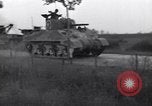
U.S. Army soldiers riding M-4 tanks and firing 105mm Howitzer from camouflaged M-7 tanks near Salerno Italy.
U.S. Army units of the 753rd Tank Battalion, 645th Tank Destroyer Battalion, and 179th Infantry Regiment, advancing at Ponte Barizzo, Salerno, Italy, during World War 2. M-4 tanks moving past abandoned German Pz.III tank. Soldiers in M-4 tanks moving through the dusty and rough roads along the fields. Smoke rising from far distances. Soldiers loading and firing rounds from a 105mm Howitzer on a camouflaged M-7 tank motor carriage. Several soldiers near the camouflaged M-7 tanks preparing for the attack. (Note: the location is at the intersection of SP11a and SP 278 east of the Sele River.)
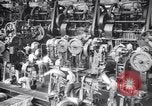
Ford automobile assembly line, pressing body tops for cars at River Rouge plant
Ford River Rogue plant in Dearborn, Michigan. Interior views of production unit and workers operating heavy pressing machines, body shaping machines, and placing component parts for body tops on assembly line.
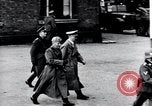
Adolf Hitler and Benito Mussolini review troops in Munich, Germany.
Fuhrer Adolf Hitler and Italian Prime Minister Benito Mussolini in Germany. Hitler and Mussolini walk rapidly across a courtyard, enter an open car, and ride along a road. (Hitler has chin strap down on his hat to keep it in place.) A small observation aircraft in flight. Glimpses of Italian troops deployed in a campaign and German troops marching in close formation. Mussolini conversing with Hermann Goering. The Winged Victory Column in Berlin. Hitler and Mussolini reviewing German Army troops, from in a car, in Munich. Civilians on either side of the streets. An Italian Fascist Group displays a banner from the sidewalk. The leaders wave and salute to the crowd. Hitler and Mussolini surrounded by high ranking German military officers, on a reviewing stand, as German military units parade past.
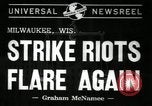
Strike breaks out at the Allis Chalmers factory and the CIO workers protest during strikes in Milwaukee, Wisconsin
Strike at the Allis Chalmers factory in Milwaukee, Wisconsin. The United Auto Workers (UAW), a labor union-Congress of industrial Organizations(CIO) workers carry flags of America and of CIO as they move in huge crowd. Views of the Allis Chalmers plant and smoke comes out of the smoke stack. The crowd advances and a car being driven amidst the crowd. Horse driven carriage carry people. Governor of Wisconsin Julius Peter Heil walks from the crowd. He calls for help and closes the plant. Rear of a car having a spoiled glass from paint being thrown on it. Police force controls the crowd. Police sprays water on the protesting workers from fire hoses . Crowd runs all around the area. Tear gas is used to break up the crowd. A damaged police vehicle. Worker throw stones at the vehicles. (World War II period).
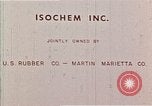
Donald G. Williams speaks about private industry diversification programs and the activities of the people in Richland, Washington.
Activities of the Atomic Energy Commission on the Hanford Project in Richland, Washington. An animation depicts : a plant set up for radioactive material recovery from storage by Isochem Inc. An electronic assembly plant by International Telephone and Telegraph Corporation. A plant for the use of nuclear power in the space by Douglas United Nuclear . The Battelle Memorial Institute scientists work in a laboratory. Computer Sciences Corporation employees work on machines in a Univac computer room, processing data transferred through telephone lines. Workers of the U.S. Casting Company work on machines. Meters and other equipment. Donald G William, the manager of the AEC Richland, speaks about various other organizations involved in the segmentation and diversification program. Various scientists and workers at work in the plant. A barge in a river. The center for graduate study. Visitors at the science center in the Richland administration building. A child stands. Houses and trees in the foreground. Building of the dental center. People on a street in Richland Washington, and view of 1950s and 1960s cars and various automobiles. Homes along streets in suburban neighborhoods of the Richland Washington area. People passing time at a local lake swimming area, with boy and girl children and families enjoying the water. A boat in water. Men water skiing. A U-37 Tri-Cities speed boat leaving dock area and speedboats in a race. An aerial view of the city. Vehicles on a road.
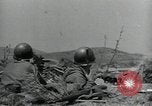
U.S. Army Medical Service at work during the Korean War.
The role of the American Army Medical Service during the Korean war. U.S. Army Captain Carl Zimmerman introduces Major General George E. Armstrong, Surgeon General of the U.S. Army who speaks from Washington, DC, about the work of the medical service. Scenes from the Korean War. U.S. troops rushed from japan, in July 1950 after a Chinese offensive at the 38th Parallel. Troops disembarking from ship and unloading artillery. Medical personnel offloading from assault boats, including doctors, medics, ambulances and drivers. A crane offloads medical equipment and supplies from a ship. Nurses with a mobile surgical hospital unit. Medics remove a casualty from an ambulance, on a stretcher. U.S. infantry slogging through difficult terrain. An ambulance driven on a mud road. Korean refugee families. Children sit and eat. People walk. An old Korean man is helped into a car. U.S. C-54 transport aircraft unloading supplies and evacuating wounded on stretchers. Medical supplies being unloaded from an aircraft and loaded into a truck. Surgeons in a tent hospital. A doctor treats a patient who is receiving blood plasma in an IV. Medics moving with tanks and infantry. Walking wounded being assisted. U.S. wounded lying on the ground, attended by medics. The U.S. medics treat injured soldiers during a tank battle. Soldiers on tanks. Thousands of paratroopers jumping from aircraft, their parachutes filling the skies. U.S. Army wounded being treated on stretchers around the Yalu River. Tenth Corps Troops in long winter withdrawal. U.S. Marine aircraft evacuating wounded. Troops withdrawing by sea in Landing Ships.
CRITICALPAST.COM: About Us | Contact Us | FAQs - How to Order | License Agreement | My Account | My Lightboxes | Shopping Cart | Advanced Search | Featured Collections | Website Terms & Conditions | Privacy Policy ©2026 CriticalPast LLC.
License Agreement |
Terms & Conditions |
Privacy Policy
©2026 CriticalPast LLC.