


 Francais
 Deutsch
 Italiano
Refine Your Search
New Mexico United States 1946 stock footage and images
- Showing 26629 to 26634 of 30777 results more
more Hide
Hide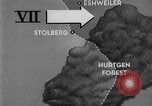
U.S. 4th and 8th infantry divisions enter Hurtgen Forest and 5th and 8th Inf. divs enter into Kleinhau to attack in Germany.
Activities of American first Army in Germany, advancing eastward in late 1944 during World War 2. Animated map shows: 4th and 8th infantry division move out from Stolberg and enter into Hurtgen Forest . U.S. 4th Infantry attack with field guns and artillery. Field gun amidst pile of shells fires toward Hurtgen Forest. 4th Infantry Division troops crawl up a hill in the Hurtgen Forest, sometimes pinned down under enemy German fire. Armor comes to their aid and casualties are treated by medical corps personnel. U.S. Army tanks arrive to support the infantry and they continue forward, where footage shows U.S. mortars and artillery bombing Grosshau, and point of view shot of a U.S. Army machine gun firing at a target in the town of Grosshau. Animated map shows: 5th and 8th Inf. Divisions enter into Kleinhau. Kleinhau is bombarded by a heavy volley of U.S. Army rockets and artillery from units of the 5th and 8th Infantry Divisions. Allied fighter bombers in flight over the area. Artillery is loaded and fired at close-range on target of Kleinhau which was then captured. U.S. Army Soldiers around the ruined buildings of Hurtgen, eating and drinking during a break. Infantry division move towards another towns. U.S. Army soldiers take a moment to relax during the long drive eastward. U.S. soldiers fire mortars from positions along the west bank of the Ruhr.

Robot bomb damage in England; launching sites and wide gauge tracks for transporting bombs in Cherbourg, France (WWII)
U.S. Army 9th Air Force North American P-51 Mustang fighters in flight and tracking a V-1 Flying bomb to shoot it down over Southern England, United Kingdom, during World War II. Crowds inspect damage caused by V1 flying bombs and V2 rockets, also known as “robot bombs.” A crater formed by a German robot bomb. A U.S. Army soldier collects fragments while inspecting the bottom of the bomb crater. British and American soldiers and British civilians inspect the damage. Aerial and ground views of an unfinished German V-1 and V-2 launch site on the Cherbourg Peninsula in Normandy, France after its capture by Allied forces. The main rocket ramp is seen on the launch site. A crane at the unfinished launch site. A concrete strip under construction. An unfinished section at the Cherbourg rocket launch site. The rich concrete mixture used in the construction of the massive installation is reinforced by lattice-type steel rods (half inch thick woven in squares). Unfinished and destroyed platforms from 29 rocket launch installations made by German forces at Cherbourg before the Normandy landings. Large solid underground structures intended as showrooms for shells and equipment. Unfinished or damaged narrow-gauge railroad used for supplies and construction. Carts are seen on the railroad. Netting laced with metal leaves to prevent fading is used for camouflage. A soldier arranges green coverings outside a bunker. A man stands on a crater. Wide gauge tracks to bring bombs to the platform. Some parts of the installation are bombed by Allied bombers.
Battle of the Ardennes and Battle of the Bulge, in World War II
Film starts showing silhouettes of British tanks on the move, including one with a bulldozer blade. View from Allied warplane as bombs explode on the ground below. In November, 1944, infantry of the First Canadian Army, with Polish and British units fire Bren guns as they advance in Belgium and secure the Scheldt Estuary, to open a shipping route to Antwerp for the Allies. They traverse a river and cross rail lines while advancing. View of destroyed steel bridge across the Maas (Meuse) river with several British troops wading in water nearby. Silhouettes of German prisoners of war marching single file. View from rear of German prisoners walking under guard with hands resting on their heads. British troops running beside the Scheldt river at Antwerp on September 4, 1944, as huge explosions occur in the river behind them. A column of British troops, marching on tree-lined road, enters outskirts of Antwerp, as local people cheer them. Views of the troops being greeted in the city itself. Columns of Belgian refugees are seen returning to their homes. One,injured, is carried by friends in a wooden cart. A contingent of British troops marching in the city. Glimpses of derricks in the Antwerp port and a ship under construction in a shipyard. An animated map shows German counter offensive through Belgium and Luxemburg on September 4, 1944. Refugees leaving again, ahead of the returning German forces. View of a road sign reading: "Bastogne." American military police checking credentials of some refugees as they leave. American soldiers jammed together atop a Sherman tank parked at a checkpoint. After delaying further German advance, through the Ardennes, on September 16th, American troops are forced back and seen leaving , in trucks and Sherman tanks, from Bastogne, past a road leading to Martelange. As weather cleared on September 22nd, a formation of British Hawker Typhoon ground attack aircraft are seen in flight and diving to attack lines of communication with machine gun fire and rockets. Several different views of the aircraft firing and smoke rising from the ground. Animated map of German advance depicts the so-called "Bulge" extending 60 miles into Allied territory. Captured German films show German troops,one carrying a rifle and another a Sig 44 machine gun, as they pass columns of burning Allied trucks, other vehicles and armor. Closeup of German soldier waving to others to follow him, as he runs ahead past burning Allied equipment. Several German soldiers hunker under a knocked out Allied tank, as a German Jagdpanzer 38(t) Hetzer light tank destroyer passes their position. Closeup of German soldier smoking captured American cigarette. German infantry, walk past barrel of destroyed Allied tank. Several gather and smoke American cigarettes. One of them, with a belt of ammunition around his neck, is Hans Tragarsky aka Walter Armbrusch, of German Kampfgruppe Hansen, a battle group formed during the Battle of the Bulge from SS-Panzergrenadierdivision Regiment 2, an infantry regiment of SS Pz Rgt 2 "Das Reich". (This image is well known but his identity is subject to debate.) Glimpse of German officer walking with a soldier at the front, with background engulfed in flames.. Scene shifts to a formation of U.S. Army Air Forces C-47 transport planes seen, in flight, dropping food and ammunition to beleaguered American troops caught in the Battle of the Bulge. Change of scene to German Jagdpanzer IV tank destroyer moving; Panzer IV tanks firing 7.5 cm KwK 37 L/24 guns; and troops riding on a Tiger tank ( Panzerkampfwagen Tiger Ausf. B). German soldiers riding in a streamlined Volkswagen Kübelwagen. German soldier in an open single seat courier car spattered with mud. Close-ups of him smoking a cigar. German soldiers looking at formation of American C-47 aircraft overhead. A U.S. Army Air Corps B-25 bomber in flight. View from Allied bomber dropping bombs that strike ground with many explosions. View from above of a B-24 Liberator bomber in flight. View on ground of shells and bombs exploding in wooded area and low level black flak clouds. Captured 88mm gun being fired by Allied forces. British soldiers in a Landing Vehicle Tracked, cross a stream and climb up a steep bank. View from British "Wasp" flame-throwing Bren-gun carrier, as it fires and resulting inferno of fires. Views from a long distance of other flame-throwers firing across the stream. Closeup view of one firing with fires burning on the opposite shore.
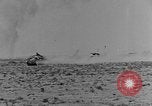
Tanks and trucks of British 8th Army move across a desert in North Africa.
British 8th Army advances in North Africa. Tanks and trucks move across a desert. Explosions in the background. A van of the medical unit moves across the desert. Smoke rises from explosions. Several British infantry soldiers walk across the desert.
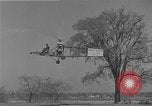
Igor Sikorsky at the controls of the VS-300A helicopter during a free flight. It rises and then settles back to the ground.
The VS-300A helicopter, built by the Vought-Sikorsky Division of United Aircraft Corporation,Stratford, Connecticut. Demonstration free flight without cables attached to ground. A slight improvement on the VS-300, the sign on side of helicopter reads, 'VOUGHT-SIKORSKY VS-300A' This is an early 300A with two tail rotors. Inventor and Engineering manager of the company, Igor Sikorsky, is at the controls. The helicopter ascends and then descends and lands.
Story of the U.S. Navy Seabees (Fighting construction men). History, recruitment, training, and deployment of the Seabees.
History and story of the Seabees. Admiral Moreell, chief of the U.S. Navy's Bureau of Yards and Docks speaks in his office in Washington, DC. A view of the U.S. Capitol building through his window. He gives a brief history of the Seabees and introduces the film. Retrospective footage shows a formation of Japanese warplanes. Views of Honolulu, Hawaii, Midway, Taviti, and Wake Islands. U.S. civilian construction workers. Hickam and Wheeler fields, in Hawaii, being bombed by Japanese airplanes during attack on December 7, 1941. U.S. Navy ships in Pearl Harbor burning. U.S. casualties on stretchers. American soldiers raising the flag with fire and smoke behind them. Seebee recruitment poster. Volunteers going to enlist. Navy Seabee trainees learning military and construction skills. Practicing methods of rapid construction for combat zones. Trainees negotiating obstacle courses. Amphibious assault training. Seabee units parading in dress whites, followed by Seabees in some of their combat vehicles: DUKWs, construction graders, and bulldozers. U.S. Navy sailors loading onto railroad train cars as a newly trained battalion of Seabees leaving training camp by train. A band plays seeing them off. Seabees loading up at a port of embarkation. A troop ship seen. The troop ship moving away from the wharf, with help from tugboat. (World War II period).
CRITICALPAST.COM: About Us | Contact Us | FAQs - How to Order | License Agreement | My Account | My Lightboxes | Shopping Cart | Advanced Search | Featured Collections | Website Terms & Conditions | Privacy Policy ©2026 CriticalPast LLC.
License Agreement |
Terms & Conditions |
Privacy Policy
©2026 CriticalPast LLC.