


 Francais
 Deutsch
 Italiano
Refine Your Search
New Mexico United States 1946 stock footage and images
- Showing 2671 to 2676 of 30776 results more
more Hide
Hide
Ford Motor Company promotional film showing Niagara Falls and Ford Motor car plant in Dearborn, Michigan
Animated sequence shows wheel of a Ford car traversing map from Manhattan, New York, to the Niagara Falls on the Canadian border. Extensive views of the falls. A honeymooning couple sitting in a Ford convertible auto with top down. The woman doesn't appreciate Niagara Falls. Guided by their "V8" hood ornament (where the "8" in the "V8" transformed into an animated Ford character, that narrates the activities) they motor across Canada and back into the United States, to the Ford Motor Company Rouge Works in Dearborn, Michigan. Views of the sprawling Ford Motor Company factories at the Rouge Works. Contrasting view of the original Ford shop where he made his first automobile. Mr. Henry Ford steps out of the shop and looks at that first Ford car. He doffs his hat, examines a tire, and walks past the camera while waving his hand. Suddenly a new 1935 Ford car appears where the original first car stood. Narrator comments that a million of these could not be built in the humble first Ford shop. Accordingly, scene shifts to views of the vast Ford Rouge plant. Numerous buildings, bridges,conveyer systems, pipes, and smoke stacks are seen (a cluster of 8 appear in one view). Molten steel being poured into crucibles, as the honeymoon couple watch from their car. Glowing hot ingots slide in troughs into a rolling mill, where they are reduced. Parts being forged by a power hammer. Engine blocks moving on a conveyer. Molten iron being poured into a mold to form an engine block.Coking ovens discharging their product. Ford ships in a port. Iron ore being unloaded from ships.
Road testing of 1951 Ford cars in Dearborn, Michigan and American Southwest.
New 1951 Ford test car comes over the crest of a hill, being driven through deep mud, in deep water, and over cobble stones, on the Ford Dearborn Michigan test track. View of test driver at the wheel. Test car hits hard bumps. View of Ford's 'Automatic Ride Control' suspension on test track and in the Ford laboratory. View of suspension attached to drive train in laboratory with view of suspension spring. 1951 Ford being tested over desert road in Southwest United States. New 1951 Ford convertible in showroom.
Chicago city views; representatives arrive and attend Democratic National Convention of 1968 held at International Amphitheater in Chicago.
Daytime view of Chicago landmarks, including Buckingham Fountain in Grant Park in Chicago. Exterior view of Chicago Sun Times and Chicago Daily News newspaper building. Cars, traffic, and pedestrians on sidewalks along streets of Chicago, including Michigan Avenue, with Prudential Building rising in background. Democratic National Convention of 1968: Democratic representatives from all states descend from a parked United passenger airplane at airport outside Chicago. They greet and shake hands with each other. Cars on roads approaching city of Chicago. Posters in the city welcoming the democrats including one on a highway overpass that reads, "Welcome Delegates. Democratic National convention." Another, smaller fountain in a city park of Chicago and view of buildings along street. Convention attendees inside International Amphitheater hallways, moving from room to room and registering. An African American boy wearing a hat with a "McGovern" sticker hands out stickers endorsing George McGovern. The boy shakes hands with a delegate and smiles. Delegates in conversation together. Staff assisting delegates, man typing at typewriter, monitoring television feeds. Men journalists in a room working at typewriters (has appearance of a newspaper or journalist news room also.) Several African American women typing.
Allied D-Day preparations and invasion of Normandy, France during World War 2
General Dwight D Eisenhower, General Spaatz and Air Marshal Mallory discuss the plan for invading Normandy, France during World War II. Supplies are massed in England for the invasion. British soldiers and U.S. Army soldiers preparing for invasion and boarding ships for the voyage across the English Channel. Some British troops carry bicycles on board. U.S. soldiers marching toward landing craft and boarding landing craft. United States bomber aircraft fly and bombard coastal defenses in France. Aerial camera view from inside allied aircraft as it flies low over German Atlantic Wall defenses and fires rockets at the coastal defenses. Aerial view of beaches of Normandy in the days soon after the D-Day invasion of France. Allied troops landing and bringing supplies ashore. Groups of German soldier prisoners of war lined up under Allied guard. General Montgomery visits Normandy, arriving and jumping down to the beach from a DUKW amphibious vehicle. People in England receive news about the invasion through newspapers. British citizens holding the Evening Standard newspaper with headline reading "The Invasion of Europe Begins." British civilians buying newspapers and reading the news. A busy street in England and a queue of people buying newspapers at a newsstand. View of Allied aircraft flying in formation and closeup views of faces of British civilians looking up at the sky.
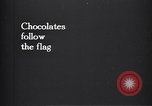
Scenes of American forces in France at conclusion of World War I, Christmas gifts, and immediate postwar period
Several u.S. Army soldiers of the American Expeditionary Forces (AEF) stand near three French children, outside a church building in France, during World War 1. A large relief of Christ on crucifix is displayed on the wall behind them. One soldier kneels down next to the children and gives them some chocolates. He talks with them. Closeup of the children eating their candy. A boy wipes his hands on his sweater. The children make circles on their tummies, indicating that the food tasted good. New sequence shows American Army of occupation troops celebrating Christmas, 1918, at Montabaur, Germany. They are assembled at a hillside, around a platform holding a monument and statue. A large decorated Christmas tree is set up on one side of the monument, and an Army brass band stands on the other side. Captain William A. Turner, of the Salvation Army, dressed as Santa Claus, hands out gifts to some of the soldiers, assembled in the foreground. There also appear to be some local German people gathered to the far right, of the brass band. Next, "Santa Claus" is seen throwing gifts out to the gathered soldiers. Scene shifts, again, this time to several U.S. Navy dreadnought battleships that might be returning troops from Europe back to the United States. The first seen is a two-stacker, Florida-class; the second is the USS Pennsylvania (BB-38) and the third is the two-stacker USS New York (BB-34). Final sequence shows U.S. Secretary of the Navy, Josephus Daniels, and Secretary of War, Newton D. Baker, in top hats, stand on deck of a ship with with its Captain (a U.S. Navy Commander) to review U.S. Battleships returning from service with the British fleet in World War 1. The dim image of a battleship is seen in the background. (World War I; World War 1; WWI; WW1)
Events in career of Chester W. Nimitz. Japanese Attack on Pearl Harbor. Admiral takes command of U.S. Pacific Fleet
Japanese flag on a Japanese aircraft carrier. Japanese aircraft take off to attack Pearl Harbor. Squadron of Japanese aircraft in flight, and dropping bombs over Pearl Harbor. U.S. Navy ships being destroyed by Japanese bombing at Pearl Harbor. Chester W Nimitz gives a brief speech when he takes command of the U.S. Pacific Fleet. He shakes hand with his senior officers. Animated map depicts the Japanese and American bases. Sweeping elevated view of an American ship building dock area as many workers build new warships for World War 2. Close-up views of war production workers building ships. New ships being launched including an aircraft carrier and also the Liberty Ship SS Richard Bassett. View of interior of a U.S. Navy submarine. Officer with cigar in mouth viewing target through periscope. Shot of torpedo being fired from submarine and then view through periscope as a target ship is hit and explodes. Dramatic shot of a U.S. Navy submarine surfacing. The submarine breaks the surface and its bow shoots high into the air as it breaches and then settles to complete surfacing. Scene of United States warships firing at Japanese enemy ships, and U.S. Navy aircraft taking off for attack from aircraft carrier. Narrator indicates it is for Battle of the Coral Sea and Battle of Midway. Scene from deck of U.S. Navy ship of sky filled with flak and fire as American ships work to down a Japanese airplane. Fire on deck of a U.S. Navy aircraft carrier after attack by a Japanese aircraft. Burning wreckage of Japanese aircraft in water close to an American Navy ship. Scenes of U.S. Navy ship guns firing and hitting Japanese aircraft that crashes into the sea. An aerial view of a Japanese airplane hit by an attacking U.S. aircraft, as seen from the American aircraft gun camera.
CRITICALPAST.COM: About Us | Contact Us | FAQs - How to Order | License Agreement | My Account | My Lightboxes | Shopping Cart | Advanced Search | Featured Collections | Website Terms & Conditions | Privacy Policy ©2026 CriticalPast LLC.
License Agreement |
Terms & Conditions |
Privacy Policy
©2026 CriticalPast LLC.