


 Francais
 Deutsch
 Italiano
Refine Your Search
New Mexico United States 1946 stock footage and images
- Showing 2701 to 2706 of 30776 results more
more Hide
Hide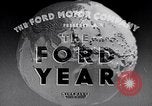
Ford promotional film about progress made by Ford in 1934 and prospects for 1935 during Great Depression
Ford promotional film. Man talks about the progress made by Ford in 1934. Views of Ford's Administration Building in United States. Henry Ford in conference with two other men. Reporter talks over prospects for 1935. Henry Ford says, "As far as we're concerned, the Depression is over....we'll build a million cars next year." Interviewer says, "Well that will do a lot to pull the country out of the Depression." Ford answers, "Well maybe we'll do better." Newspaper plant with newspaper printing presses rolling new edition. Views of several processes in printing newspaper. Headlines reads, 'Ford Will Build Million Cars in 1935', 'End of Depression seen in Ford Plant'.
Men and women sailors join and serve in the U.S. Coast Guard, and citations for those who gave up their lives in battle.
'Battle Stations' depicts life as a United States Coast Guard. Medals lie on citations for gallantry in action during the landing on Tulagi Island. Images of U.S. Coast Guard cutters at sea and soldiers in battle as the citations are read out. U.S. CG troops during a parade. Sailors with rifles. They march with the U.S. flag. CG cutters in heavy seas. Sailor watches through binoculars. A sailor at the deck gun, another sends a semaphore signal. The Congressional Medal of Honor lies on a citation for heroism and gallantry in action during the evacuation of a battalion on Guadalcanal. Bodies of U.S. Coast Guard sailors wrapped in U.S. flags. Sailors salute as bodies are loaded. Women take the oath as they join the U.S. Coast Guard as U.S. Coast Guard SPARS (US CG Women's Reserve). Training Station: New SPARS recruits arrive as graduates leave the station. Recruits on bunk beds, during training, getting uniforms, on bicycles, and attending classes. Class of SPARS graduates receiving diplomas. Narration by Ginger Rogers and James Cagney.
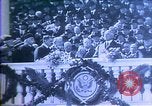
Warren Harding assumes office of the President and changes in the life of American people from the early to modern times.
The life of people during 1920s in the United States. Sketch of Warren Gamaliel Harding taking oath of office of the President of U.S. Sketches of the U.S. President Warren G. Harding. People in the factories. Sketches of the people in the various towns of America. The President addresses the people. Horse drawn wagons on the streets. Modern cars on the street. Women in houses as they perform various activities. Sketches depict the revolution brought about due to the invention of cars. People enjoy at various occasions in a car. Cars on streets. People listen to radio. Sketches depicts the motion pictures of the times. A family posing for a picture, each with one leg kicked out. Sketches of American writers like Fitzgerald and Hemingway who chose to live abroad. Footage of Moulin Rouge night club in Paris France and neon lights of other Paris night clubs seen at night. Women dance on a Paris night club stage. Sketches of famous writers and their view of modern America. Brief scene of people at Coney Island Amusement Park in New York sliding down a slide and riding on the "Human Pool Table" ride.
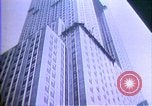
Various changes being brought about in U.S. in areas of sports, aviation and politics after World War I.
Leisure activities in the United States after World War I. A high rise skyscraper building in America. People enjoy thrilling sports. Flagpole sitting. New sports figures like George Herman Ruth (Babe Ruth), baseball player, and Jack Dempsey, a boxer. Charles Lindbergh, an American aviator is seen and gets into a plane. He addresses the people. People welcome the return of Lindbergh after a successful flight. A parade during the Presidential elections. Police men control the crowd. Sketch depicts Herbert Clark Hoover as one of the candidates for the Presidential election . Sketch of Herbert Clark Hoover with his wife. Sketches of the catholic candidate in the election Alfred Emanuel Smith. Sketches show people at coastal places, destruction of booze barrels during prohibition, and men drinking alcohol. Picture of Alphonse Gabriel Capone (Al Capone), a mafia gangster in America.
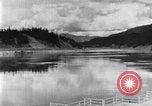
Film about the role of American hydroelectric power in World War II
Film opens with montage of rapid images illustrating the outbreak of World War 2 in Europe. Appeals from the Allied powers are described. Shown is a field full of American Martin B-26 bombers ready for shipment abroad. View of men working in a construction site. Towers holding high tension electric supply lines are seen. Products needing electric power for production, such as aluminum and magnesium are shown as ingots in production facilities. View of the Columbia River waters surging along its course. Views of the Bonneville Dam and power plant, and the Grand Coulee Dam. Giant electric generators operating in the hydroelectric plants. Technicians in power plant control rooms, and views of transmission lines and switch yards outside a power plant. A ship under construction at a wartime shipyard. Workers using electric arc welders during ship construction. View of the SS Mormacwren launched 22 May 1942 at the Consolidated Steel Corporation's Wilmington, California yard. Launch on May 22, 1942, of the ship, Irving S. Olds, a Bulk Freighter built by the American Ship Building Co., Lorain, Ohio. (Her launch was coordinated with those of numerous other ocean cargo vessels in yards around the United States, to bolster the national morale, when German submarines were sinking many ships in the Atlantic.) Next, a ladle of molten aluminum, to be used in aircraft manufacture, is seen pouring its contents into ingot molds. Workers dislodge the ingots after cooling. Inside an aircraft plant, men assemble aircraft parts from aluminum. A partially completed medium bomber is towed outside the plant. View of Grand Coulee Dam and of many electrical distribution facilities. Herds of sheep moving across the Grand Coulee Dam to new pastures.
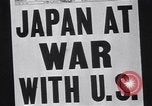
Various newspaper headlines announce war with Japan, guns mounted, airplanes parked in line during World War II.
Newspaper headlines announce U.S. declaration of war on Japan in World War 2, such as 'Japan at war with US'. Supplies moved along a conveyor belt to waiting ships. Arms buildup in the United States as the U.S. enters World War II. Stockpiles of new tanks, Army trucks, and fighter airplanes lined up as U.S. war production increases.
CRITICALPAST.COM: About Us | Contact Us | FAQs - How to Order | License Agreement | My Account | My Lightboxes | Shopping Cart | Advanced Search | Featured Collections | Website Terms & Conditions | Privacy Policy ©2026 CriticalPast LLC.
License Agreement |
Terms & Conditions |
Privacy Policy
©2026 CriticalPast LLC.