


 Francais
 Deutsch
 Italiano
Refine Your Search
New Mexico United States 1946 stock footage and images
- Showing 27973 to 27978 of 30777 results more
more Hide
Hide
Audio only. Mathematician Fred Hoyle gives his opinion on morality and war, on a radio program in the U.S.
Audio only. 'This I Believe' Radio Network Program hosted by Edward R Murrow. Essay on an English mathematician Fred Hoyle. He has taught in Saint John's College of Cambridge University and conducted series of lectures on nature of universe in past. He speaks about visiting church when First World War ended and receiving a sermon telling him to pray to God in thankfulness that the right side had won. But he realized in school that Germans claim the same. Every nation has its own rules of behavior. If a particular action happens to fit in with the rules of society, people describe it as a right or a moral or a just action. Fred Hoyle adds that he personally doesn't believe that the present world can be run successfully on moral principals. He further speaks that people that outgrows its natural resources becomes both a nuisance and a danger because an over-swollen society sooner or later will try to grab the resources that belong to someone else, which of course must lead to trouble and possibly to war. He says that we are so with self-satisfaction at our righteousness that we are failing to appreciate the really important issues.

Audio only. Chairman of Columbia University Robert M Maciver speaks about his beliefs and memories on a radio program in the US
Audio only. 'This I Believe' radio network program episode. Essay on Chairman of Columbia University, Sociology Department, Robert M Maciver. He speaks about his ways of observing things when he was young. He further explains that we never learn things and the causes of things. We learn more about things and the things change amazingly as we learn but we never learn to explain their being. We discover the atom and it becomes another form of energy. It’s hard to explain the form of energy. If someday energy turns out to be something else again, we are no nearer explaining than before. He says that everything belongs forever with other things, but how it belongs and will belong he cannot comprehend. He speaks that we have something in common, the common pulse, the common life, a common destiny. He adds that the wonder is within him, encompasses him and lies forever beyond. Knowing no name for it, he calls it God.

The operation of an 18th century manual printing press is compared to the making a magazine in a modern printing press.
Making of magazine in modern printing press. Portrait of Benjamin Franklin with his introduction. Dramatization shows a man in Franklin costume, others in 18th century work costumes in print shop. Workers operate manual printing press. Franklin examines a copy. View of Butler Gazette and County Journal of August 10, 1772. A modern printing plant shows machinery and workers in printing plant. View of 'The Dearborn Independent' for July 31, 1926. Editors work in an office. President Calvin Coolidge delivers an address at battery of microphones. Crowd listens to the President. Deck view on sailing vessel 'Irene and May'. Wild geese in a field and in flight. Four women swimmers posed on side of a boat. They dive into water. Detroit Tigers baseball game in progress. Tennis game in progress. Spectators applaud. Football game in progress.
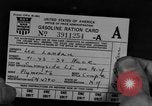
View of Gasoline ration cards, and people stand on long line for rationed goods at stores in U.S. during World War II.
Close up views of a World War 2 Gasoline Ration Card, and of the application to apply for the card. A late 1930's car driving up to a gasoline service station in Washington DC with the dome of the U.S. Capitol building visible in the background. People stand in a long line in front of stores in a busy city, waiting to obtain a rationed good.
Series of test in which automatic detonator 'mole' is tested for effectiveness in disabling railroad trains.
A research film in which 'mole', an automatic detonator, is tested for effectiveness in disabling railroad trains when a train suddenly enters darkness as in a tunnel. Railroad train approaching camera position near track. Point of view shot from left side of railroad locomotive train as it approaches and enters a tunnel. A train passes through tunnel. Working and components of mole explained. Components include photoelectric cell, amplifier and a detonator. Working of mole explains where to place explosive, why and how to prepare it. Charge is placed on a railroad car. This car is attached at the end of train. A train moves. Train car damaged after detonating mole. Men at railroad car examine. Charge placed by men on train. Explosion and reaction of train is tested. Damage is examined. Next test shows 'linear shaped charge' with explosive and bracket to hold it, demonstrates how to secure charge to bracket, bracket to train car and where to place components of mole. Explosion on train. Damage in detail is examined. World War 2 period.

Private Snafu gets captured by German soldier as he neglected to care for his weapons and equipment.
Animated film of Private Snafu explains to take care of the weapons. A headline reads 'US soldiers best armed in world'. U.S. weapons unbeatable if taken care off. The cartoon character sits in a tent with a newspaper. He does not take care of his weapons. A Nazi soldier arrives. Private Snafu comes out of the tent and tries to kill him with his weapons. But the weapons do not work as the weapons were neglected. Nazi soldier comes with knife and captures Private Snafu. He tries to escape in his jeep but the steering wheel of the jeep comes out. Private Snafu in a jail. (World War II period).
CRITICALPAST.COM: About Us | Contact Us | FAQs - How to Order | License Agreement | My Account | My Lightboxes | Shopping Cart | Advanced Search | Featured Collections | Website Terms & Conditions | Privacy Policy ©2026 CriticalPast LLC.
License Agreement |
Terms & Conditions |
Privacy Policy
©2026 CriticalPast LLC.