


 Francais
 Deutsch
 Italiano
Refine Your Search
New Mexico United States 1946 stock footage and images
- Showing 28183 to 28188 of 30777 results more
more Hide
Hide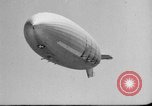
A sailor hanging on a cable attached to USS Akron in flight over Camp Kearny, San Diego, California.
The U.S. Navy Zeppelin, USS Akron (ZRS-4)in flight over Camp Kearny, San Diego, California. she drops mooring cable to crew of about 100 sailors on the ground. Part of the cable breaks, and three sailors are left dangling on the remaining cable. They are pulled up as the Akron rises and two of the sailors fall to their deaths. One sailor (Navy Apprentice Seaman, C.M. Cowart) remains secure on the cable and is reeled into the airship. Captain of the airship, Lieutenant Commander, Charles Emery Rosendahl, gives a public statement following the accident.
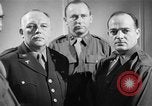
World War 2 Combat Exhaustion patients undergo personality tests, receive sleep therapy and various treatment in the U.S.
Treatment for combat exhaustion cases among U.S. soldiers following combat in World War II. U.S. officers talk about operation plan of a hospital and speak about three sections including admission, treatment and rehabilitation. A patient undergoes a physical examination. A dental survey and necessary laboratory studies. Doctors seated at table to perform an intelligence tests and mental examination. Psychiatric and other personality tests and intelligence test are administered including Rorschach test and Kohs block design test. The doctors check the psychiatric and physical report of the patient by looking at an X-ray. Patients receive sleep therapy: A nurse and an army doctor give narcosis therapy (continuous sleep treatment), by administering barbituates that keep a patient asleep for 18-20 hours per day for several days. Insulin is used on "loss of weight" cases: Combat exhausted soldiers lying on beds and receiving insulin before breakfast by nurses to stimulate their appetite. A nurse checks the weight of a patient during treatment. A nurse checks the diet which will be given to the patients in a kitchen. A patient receives an electric shock therapy treatment. A doctor injects a medicine into a patient. The patients go through physical exercises to maintain physical fitness. The patients are reeducated to know the causes of diseases. (Note: Clips deals with treatment for Combat Exhaustion, also later termed Post-traumatic Stress Disorder or PTSD.)
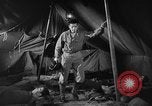
U.S. Army soldiers suffering Combat Exhaustion are asked about their health after treatment at a field hospital
Reenactment of combat exhaustion treatment for World War II U.S. Army soldier. A patient is asked about his health after treatment. The patient and a Red Cross soldier move out of a tent and talk. A Red Cross soldier and patients stand near a truck. The Red Cross soldier goes towards a patient whom he has treated. He asks him about his health. He tells about the problem in his hand and a medic discusses the impact of fear and exhaustion in the soldier's condition. Soldiers talk about exhaustion cases. (Note: Clips deals with treatment for Combat Exahaustion, also later termed Post-traumatic Stress Disorder or PTSD)
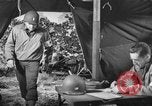
A U.S. Army psychiatric officer tries to detect signs of combat exhaustion and advises ways to prevent them
Reenactment of handling and treatment for U.S. Army World War 2 soldiers suffering combat exhaustion. A soldier gives answers to a psychiatric officer. The psychiatric officer tries to detect signs of combat exhaustion (modern equivalent Post Traumatic Stress Disorder or PTSD) like lack of physical coordination, slowing mental processes, excessive reaction off noise and inability to rest. Soldiers adjust position of artillery. The soldiers are directed to take proper meals and get sound sleep to prevent combat exhaustion and fight stress.
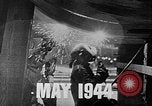
USS Wakefield is rebuilt, soldiers attend religious services and are issued rations aboard the ship in the Atlantic Ocean.
Activities of U.S. ship yard workers and soldiers aboard USS Wakefield in the Atlantic Ocean during World War II. Scenes in May 1944 as ship yard workers repair the fire damaged ship. Workers weld parts of the ship. A stern view of the ship. The ship at sea carrying thousands of troops. Bags hanging in the quarters of the troops. Soldiers rest in their quarters. Men look through binoculars and see an aircraft. Mounted guns aboard the ship. The troops standing near railings wave at the aircraft. The soldiers aboard the ship attend religious services. Ration is issued to the soldiers. The ship is underway at sea. A Coast Guard officer makes an announcement for all army personnel. The army personnel seated and resting on the deck listen to the announcement.
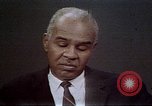
Roy Wilkins condemns looting following the death of Martin Luther King Jr.
Civil Rights leader Roy Wilkins condemns the looting and stealing taking place during the riots following Martin Luther King, Jr. He notes that this behavior "desecrates" the memory of Dr. King.
CRITICALPAST.COM: About Us | Contact Us | FAQs - How to Order | License Agreement | My Account | My Lightboxes | Shopping Cart | Advanced Search | Featured Collections | Website Terms & Conditions | Privacy Policy ©2026 CriticalPast LLC.
License Agreement |
Terms & Conditions |
Privacy Policy
©2026 CriticalPast LLC.