


 Francais
 Deutsch
 Italiano
Refine Your Search
New Mexico United States 1946 stock footage and images
- Showing 2851 to 2856 of 30775 results more
more Hide
Hide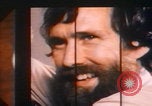
View of Thomas Alva Edison’s West Orange factory; various inventions by Edison
An Edison phonograph playing a record. American inventor Thomas Alva Edison and his wife Mina Miller Edison at the porch of a house. Edison taking his hat off. Edison punching his timecard in timeclock as he arrives in his office. View of Thomas Edison’s West Orange Laboratory (211 Main St, West Orange, NJ 07052, United States) in New Jersey. Thomas Edison shakes hands with an employee inside his factory. Edison watches his employees working. A hole being drilled. A lathe machine scrapes a block of metal. Wheels of belt driven machines moving inside a factory. Cylinder phonograph playing ‘Mary had a Little Lamb’. Illustration depicting Thomas Edison with gramophone by Poyet. A wax cylinder phonograph playing music. Still image of a male opera singer and an orchestra perform in a recording studio. A glowing lightbulb.
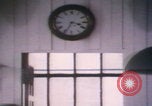
Early filmmaking in Thomas Alva Edison’s Black Maria studio; Edison showing lightbulbs
A wall clock hanging on top of a window. Camera shows American inventor Thomas Alva Edison’s laboratory. Glass laboratory bottles and tubes on display. Footage circa 1920 of Thomas Alva Edison showing early lightbulbs to colleagues. A carbon filament light bulb lights up. Camera moves closer to show the glowing carbon filament inside the lamp. Early filmmaking in the United States. A man cranks a Kinetograph, the first movie camera invented by Edison. A belly dancer performs in one of Edison’s early films. A film rolling. A boxing match filmed by Thomas Edison. A cameraman records the boxing match inside Edison’s Black Maria film studio in West Orange, New Jersey. Exteriors of the Black Maria studio showing the turntable and wheels underneath. 19th century women wearing summer dresses strolling in film captured by Edison. Cameramen sent by Edison films people on the beach and in amusement park rides. Edison having lunch with other inventors Henry Ford Sr., Harvey Firestone Sr., and Alexander Graham Bell. View of Edison’s study. A light bulb is turned off.

Miguel Aleman succeeds President Camacho in Mexico.
Miguel Aleman takes over as President in Mexico. Mexican people on road. Cars parked on road. Arrival of President Miguel Aleman , Camacho and other dignitaries. Dignitaries and Soldiers on stage. President Miguel Aleman takes an oath. People stand and listen. President Miguel takes the seat of President Camacho. People clap and cheer in the hall. Civilians of Mexico perform dance for him. Soldiers do march past. The President and other dignitaries salute. President Miguel waves.

Neon signs on the streets of Mexico City, Mexico.
Several glowing neon advertisement signs of leading companies at night time on the streets of Mexico City. Some of the signs seen include 'Wells Fargo & Co. Express' , 'Pan American Airways', 'Vogue', 'Philips Radio', 'Bette Davis en Jezabel', 'Westinghouse Casa Edison', 'Remington Rand', 'Agencia Philco', 'Sunshine Special Missouri Pacific Lines', 'La Opera Hennessey', 'Ladies' Entrance Bar', 'Old Schenley', 'Sparton', 'Articulos Electrico Universal', 'Ford', 'Frigidaire General Motors', and 'Entrada Gratis Concurso Nestle'
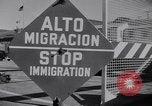
Mexican General Juan Felipe Islaz receives American General John L DeWitt at US-Mexico border during his visit to Mexico.
American Army General John L DeWitt's visit to Mexico. Mexican General Juan Felipe Islaz receives General DeWitt at the US-Mexican border. Bi-lingual sign board 'Alto Migration/ Stop Immigration' at the international border. General John L DeWitt and Mexican General Juan Felipe Islaz shake hands with each other as other officials surround them and watch. Both Generals talk to each other, shake hands and pose for a photograph.
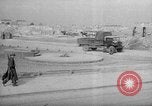
Ruined buildings outside Warsaw, and the first memorial to the Warsaw Ghetto uprising in Poland
Scenes shortly after the end of World War 2. View of the mostly cleared rubble and ruins in Warsaw, Poland, near the intersection of Anielewicza Street, Karmelicka Street, Lewartowskiego Street and Zamenhofa Street in the devastated Warsaw Ghetto district of Muranów, near where the first armed clash of the uprising occurred. Two soldiers walk by on a sidewalk beside the round memorial on the street corner. A truck is parked on an intersecting street. There are mostly open sight lines into the distance with all buildings having been destroyed. A horse cart moves along the road. A jeep with soldiers pass along the road. Closer views of the first memorial to the Warsaw Ghetto Uprising (also later called the Monument to the Ghetto Heroes), designed by Leon Suzin. Views of the inscription on the stone memorial, dated April 19,1946, and commemorating Polish Jews who fought against German military forces in World War 2. Translated, it reads, "To those who fell in an unprecedented and heroic struggle for the dignity and freedom of the Jewish people, for a free Poland, and for the liberation of mankind. Polish Jews." Some flowers laying at the memorial site. (The round 1946 memorial tablet, with its shape symbolizing the underground manholes used during the uprising, was later incorporated into the larger Monument to the Ghetto Heroes, sculpted by Nathan Rapoport and unveiled in 1948.)
CRITICALPAST.COM: About Us | Contact Us | FAQs - How to Order | License Agreement | My Account | My Lightboxes | Shopping Cart | Advanced Search | Featured Collections | Website Terms & Conditions | Privacy Policy ©2026 CriticalPast LLC.
License Agreement |
Terms & Conditions |
Privacy Policy
©2026 CriticalPast LLC.