


 Francais
 Deutsch
 Italiano
Refine Your Search
New Mexico United States 1946 stock footage and images
- Showing 29209 to 29214 of 30775 results more
more Hide
Hide
Indian chieftains share jokes in sign language and General Scott bids them a farewell using sign language in Montana.
U.S. Army Major General Hugh L. Scott and U.S. Representative from Montana Scott Leavitt meeting Native American Indian chiefs at Fort Browning in Montana to evolve methods of perpetuating the Indian sign language in 1930. The Indian chieftains seated in a Piegan council lodge. The formal features of the council are completed. A tribal chief plays an instrument. General Scott seated next to him. Several views of the Indian chieftains talking and sharing jokes with each other in sign language. General Scoot speaks to a chief in sign language. The chieftains crack jokes in sign language and laugh. The Indian chieftains talk in sign language. The council gets over. General Scott bids farewell to the chieftains using sign language.
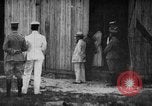
A crowd around a hangar and soldiers push the Wright Flyer aircraft out of the hangar for testing at Fort Myer, Virginia.
Orville Wright and U.S. Army aviator Frank Purdy Lahm, the first army passenger, test the "Wright Flyer" at Fort Myer, Virginia. A small group stands at the door of a hangar. A crowd gathers around the hangar. The doors of the hangar are opened. Dignitaries greet each other. Notable dignitaries present include U.S. President William Howard Taft and Mrs. Taft, U.S. Army Major General George O. Squier, U.S. Army Major Charles McKinley Saltzman. U.S. Army soldiers open the doors from the hangar. They push the Wright Flyer sideways out of the hangar.
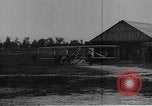
U.S. Army soldiers turn the Wright Flyer and pull it to a field during its testing at Fort Myer in Virginia.
Orville Wright and U.S. Army aviator Frank Purdy Lahm, the first army passenger, test the "Wright Flyer" at Fort Myer, Virginia. U.S. Army soldiers turn the Wright Flyer. They pull the aircraft to a field. A headquarters building in the background.
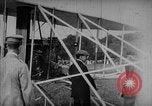
Frank Lahm and Orville Wright prepare for a take off, take seats and take off in Wright flyer during a test at Fort Myer.
Orville Wright and U.S. Army aviator Frank Purdy Lahm, the first army passenger, test the "Wright Flyer" at Fort Myer, Virginia. Preparations for the take off of the aircraft. Frank Purdy Lahm sits at the controls with Wright standing in the front and releasing the ropes. Lahm and Orville Wright take seats in the aircraft. Men standing beside a catapult in front of buildings. Good views of Fort Myer buildings of the era. They adjust the position of the catapult. The catapult as seen from the front of the aircraft. View of catapult from behind the aircraft. The Wright Flyer takes off. The aircraft in flight. It circles over a field and buildings. Headquarters building in the background. The aircraft in flight over the field. (This footage is a mix of July 1909 footage where the aircraft shows two half-rounds of canvas in the front elevator, and September 1908 footage, from the rear taking off, where the aircraft has a single half-round of canvas in the front elevator.)
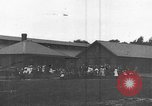
Army personnel group around the Wright Flyer as it lands after its testing at Fort Myer, Virginia.
Orville Wright and U.S. Army aviator Frank Purdy Lahm, the first army passenger, test the "Wright Flyer" trials at Fort Myer, Virginia. The aircraft in flight. Headquarters building in the background. Men stand in front of the buildings. They watch the Wright Flyer flying. The aircraft circles over a field and buildings. The aircraft in flight. It lands on the field. The aircraft is moved on the field. Army personnel group around the Wright aircraft. Oliver Wright gets off the aircraft.
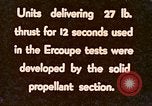
Solid propellant sections leave thrust for Ercoupe airplane flight tests at March Field in California.
Flight tests of Ercoupe airplane without and with an auxiliary jet propulsion at March Field in California. Check posts made of aluminium sheets at an airfield. A sign on a check post: 'Explosives'. Solid propellant sections leave thrust to be used in Ercoupe airplane flight tests at the airfield.
CRITICALPAST.COM: About Us | Contact Us | FAQs - How to Order | License Agreement | My Account | My Lightboxes | Shopping Cart | Advanced Search | Featured Collections | Website Terms & Conditions | Privacy Policy ©2026 CriticalPast LLC.
License Agreement |
Terms & Conditions |
Privacy Policy
©2026 CriticalPast LLC.