


 Francais
 Deutsch
 Italiano
Refine Your Search
New Mexico United States 1946 stock footage and images
- Showing 29437 to 29442 of 30775 results more
more Hide
Hide
Damaged vehicles and trees get uprooted due to a hurricane on the Atlantic Coast.
Damage due to a hurricane on the Atlantic Coast. The storm, dubbed the "Long Island Express" is seen creating huge waves on the coast. A man on a bridge retreats as water from the ocean pounds him. Water on the roads. Cars move in the flooded area. Trees uprooted because of the hurricane. Damaged boats and vehicles. A car hangs on a pole due to the hurricane.

Cowboys ride bucking horses and bulls in a rodeo event at Cheyenne, Wyoming.
A rodeo event in Cheyenne, Wyoming. Men ride horses on a street. Cowboys ride bucking horses and bull. Spectators in stands watch the rodeo event. The cowboys fall from bucking bulls.
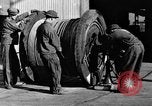
Members of 12th Coast Artillery Mine Planter Battery prepare to plant mines from a vessel, during World War II
Film on the Employment and Operation of a Submarine Mine Battery.Members of 12th U.S. Army Coast Artillery Mine Planter Battery prepare for mine planting. They unroll steel cable from a large roll and cut it into lengths of from 500 to 1600 feet, to be fastened, from their respective mines, to a distribution box. The cut cables are each coiled on a rack in a figure eight, with both ends free for connecting. A length of 135 feet is free on each cable for use on the mine planter vessel. Ends of each cable are tagged to identify their respective mines. Coast Artillerymen load the racks on the aft deck of the vessel, along with mine buoys and other equipment. They then thread the free 135 foot length of each cable segment along the sides of the planter vessel from stern to foredeck, where they will be fastened to their respective mines. As the planter vessel pulls away from the wharf, and heads for the mine fields, the mines can be seen lined along her railings. The name of the mine planter vessel, "General J.M. Schofield," is clearly visible.
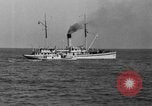
12th Coast Artillery Mine Planter Battery members demonstrate mine planting techniques
A training film about marine mine planting, created before World War 2. Group of mine planting vessels consisting of a planter (The "General J.M. Schofield"), a DB (Distribution Box) boat and three motor boats, are seen underway in Delaware Bay. Members of 12th Coast Artillery Mine Planter Battery, on the planter vessel, attach cable to a loading wire and then connect the cable to the bale of the number 10 mine with a galvanized wire. Mine and anchor lowered over the edge of the planter. Mooring rope attaches the mine with the anchor. End of the cable attached to the DB boat. Men look over the edge of the planter as the mine is lowered into the water. Cable loosened over the stern of the planter. An animation shows the correct way of releasing of coil from a figure of eight.
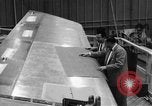
Construction of first Boeing Model 717 (KC-135) U.S. Air Force military jet tanker, at Renton, Washington. USA
The first U.S. Air Force jet tanker prototype being assembled in the Boeing Renton plant in Washington, USA. Like the Boeing 707, Its design is based on the Boeing Model 367-80 ("Dash 80"). But it is smaller, overall, than the 707, has a narrower, windowless fuselage, different cockpit window configuration, etc. Engineers are seen looking at design drawings placed on a wing. A worker climbs partway out of cockpit window.. A woman works on an engine nacelle. Several views of the plant interior with all activity concentrated on construction of this single aircraft.

Spun rayon fabric is manufactured at the Burlington Mills in North Carolina; 1950s family fashions in USA
Manufacture of spun rayon fabric at the Burlington Mills in North Carolina. A worker loads cotton-looking, rayon fiber in to a machine. Rolls of fiber are loaded into a carding machine. Fluffy strands are combined into a single uniform strand. Exteriors of the plant. View of manufactured garment. Shows people wearing latest fashion clothes made up of Burlington Mill's fabric . Man and woman on a balcony with woman in a dress and man in a grey suit. Vintage 1950s suburban American family scene with family members together in a living room, including husband, wife, boy, girl, and a separate scene with a teenage girl wearing a scarf in her hair. Woman in the rain holding an umbrella.
CRITICALPAST.COM: About Us | Contact Us | FAQs - How to Order | License Agreement | My Account | My Lightboxes | Shopping Cart | Advanced Search | Featured Collections | Website Terms & Conditions | Privacy Policy ©2026 CriticalPast LLC.
License Agreement |
Terms & Conditions |
Privacy Policy
©2026 CriticalPast LLC.