


 Francais
 Deutsch
 Italiano
Refine Your Search
New Mexico United States 1946 stock footage and images
- Showing 30187 to 30192 of 30776 results more
more Hide
Hide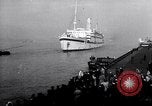
Hospital Ship, Atlantis, carrying exchange wounded Allied Prisoners of War back to England In World War II
In the first exchange of Allied and Axis wounded prisoners of war, the British Hospital Ship, Atlantis, with number 33 painted on her side, steams into port, at Leith, Scotland, (and then on to Liverpool, England) during World War 2. She is returning Allied wounded from Germany, by way of Goeteborg, Sweden. British soldiers are carried off ship on stretchers. Several ambulatory American soldiers leave ship on foot. Railroad train seen right at the port.
Russian air-cadets get trained in England, during World War I.
Russian air-cadets being trained at the Royal Flying Corps' No 1 School of Military Aeronautics, at Coley Park Aerodrome, Reading, Berkshire, England, during World War 1. Cadets march with their officer to a tarpaulin covered hangar. Next they are seen inside the hangar, removing a double wing from a bi-wing aircraft. . They sit, wearing earphones, at a table outdoors, learning wireless telegraphy. They examine the parts of a Clerget 9B nine-cylinder rotary aircraft engine, and sit for a lecture about inline engines. The instructor holds up a bearing and connecting rods from the inline engine. They look at an aeronautical chart and take notes. Cadets climb aboard a canvas-covered army truck and stand in it. They wave as it drives away.
British Soldiers demonstrate use of Allenbury gas mask in World War I.
Allenbury patent protects British soldiers from Asphyxiating Gases. Soldiers hide behind wood logs lying on a field. Soldiers wear the Allenbury gas masks. Gas cloud covers the area. After it passes, they rise up and perform a (mock) attack. View of a soldier modeling the mask in England during World War 1
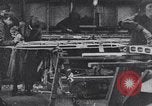
Prince of Wales visits women working in aircraft factory during World War I
British women at work in an airplane factory during World War 1. They are seen working with the framework of wings and other flying surfaces. Young Edward, Prince of Wales (later Edward VIII) in military uniform, examines parts in the factory during a visit with officials. He speaks briefly with a woman at her machine. The next scene shows women making adjustments on a Sopwith Camel aircraft. One tightens bracing on a left wing. Others rotate a propeller showing the movement of the airplane's rotary engine as its cylinders move with the propeller. Several women hold down the tail, as propwash from the running engine blows over them. Various tent-like structures are seen in the background. The number 6003 is seen on the aircraft vertical stabilizer. (WWI; WW1)
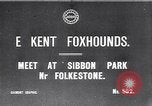
English equestrians preparing to ride to the hounds at Sibbon Park, near Folkestone, Kent, England, in world War I
Equestrians riding in Sibbon Park,near Folkestone, East Kent, England,during World War 1. A group gathering along a path in the background. In the foreground, several horse riders in traditional foxhunting attire, proceed along a park path behind a large group of fox hounds. Following behind them is a youth on a pony, and behind him the rest of the riders, including: a mix of military officers in uniform, men in traditional attire and women riding habit. Scene shifts to dirt roadway near farm fields, where riders and hounds assemble.
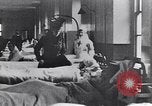
Queen Mary of Great Britain visits wounded soldiers during World War I
Queen Mary of Great Britain, is seen visiting wounded British soldiers at a hospital during World War 1. Change of scene shows her greeting British army officers at a railroad train station during World War I.
CRITICALPAST.COM: About Us | Contact Us | FAQs - How to Order | License Agreement | My Account | My Lightboxes | Shopping Cart | Advanced Search | Featured Collections | Website Terms & Conditions | Privacy Policy ©2026 CriticalPast LLC.
License Agreement |
Terms & Conditions |
Privacy Policy
©2026 CriticalPast LLC.