


 Francais
 Deutsch
 Italiano
Refine Your Search
New Mexico United States 1946 stock footage and images
- Showing 30601 to 30606 of 30776 results more
more Hide
Hide
Welsh Guards parade and a crowd gathers to celebrate Victory in Europe Day London, England.
Victory in Europe Day celebrated in London, England towards the end of World War II. Welsh Guards, an infantry regiment of the British Army, parade in front of Buckingham Palace. A band of musicians also parade along with the Welsh Guards. People move around the Mall. People cheer and applaud as they move.
Buildings wrecked by V-2 flying bombs and British civilians digging up ruins in London, England.
Ruins of buildings in London, England towards the end of World War II. British civilians move around the ruins. The civilians dig in the ruins. Buildings all around wrecked by German V-2 flying bombs. Soldiers clear the ruins of wrecked buildings. A portrait of Queen Victoria hangs on a wall of a wrecked Building.
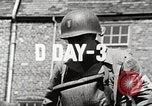
U.S. troops are ferried from Weymouth England, to transport ships in preparation for Normandy invasion in World War II
U.S. army troops board LCVPs (Landing Craft, Vehicle, Personnel) at pier in Weymouth, England, to be ferried out to transport ships anchored offshore, in preparation for the D-Day invasion of Normandy, France, during World War 2. Several large Landing Craft Infantry are seen tied up at the docks, including LCI(L) numbers 84 and 49. Views of Higgins Boats (LCVPs) heading out. Markings on one identify it as belonging to the Attack Transport ship USS Charles Carroll (APA-28). The Higgins Boats come alongside the USS Charles Carroll and troops of the U.S. 29th Infantry Division board her.
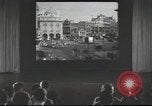
Two U.S. Airmen sightseeing in London
Two U.S. Airmen stroll in Piccadilly Circus, London, England. British people crowd the streets during commuter rush hour. A British overseas Airways Company (BOAC) office displaying a sign about flying to the Commonwealth and all 6 Continents.
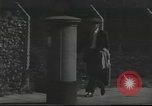
Typical workman's day in Britain. U.S. Airmen in pub.
British steel worker walks to work on Bashley Road, North Acton, London. Views of steel mills in Midlands. A ship under construction in Glasgow, Scotland. Wide, elevated view of city streets and buildings of Edinburgh, Scotland. Steel worker visits a Pub after the day's work. Men in the Mother Shipton Pub (possibly 1 Malden Road, Kentish Town, London NW5). Patrons drink beer and play darts. Bartender pours a cask ale from a tap. U.S. Air Force Non-Commissioned Officers seated at a table in the pub. One of them asks dart players if he can try. They assent and he throws several darts fairly skillfully, meeting with their approval. These scenes are followed by an Instructive narrative about the British political system accompanied by illustrated diagrams. Scenes include the floor of the House of Commons during session.
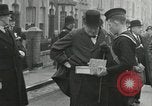
Prime Minister Churchill visits Bristol England and presides over academic ceremony at the University
Prime Minister Winston Churchill, accompanied by Lady Churchill and several officials, visits Bristol, April,12, 1941, the day after the so-called "Good Friday bombing raid." Churchill pauses to contribute to a charity being represented by a uniformed sailor. He takes a small token of his contribution from the sailor's box and pins it to his coat collar. He speaks with some women lining the sidewalk, and pats the head of a small child held up to him by one of the women. Next, Winston, and Lady Clementine Churchill, speak with a woman, standing near some rubble, as a British officer takes a snapshot. The Churchills, and other members of their party, make their way through some rubble, past several bombed buildings. Several citizens take photographs. Scene shifts the University of Bristol's Wills Memorial Building on Park Street. University officials and faculty in academic robes inside the building. At the center of the ceremonial activities, is Winston Churchill, Chancellor of the University, who presides over the awarding of Honorary degrees to American Ambassador, John Gilbert Winant, and Australian Prime Minister, Robert Gordon Menzies. Churchill is later seen leaving the Memorial Building, flanked by the honors recipients, Winant and Menzies. (World War II period).
CRITICALPAST.COM: About Us | Contact Us | FAQs - How to Order | License Agreement | My Account | My Lightboxes | Shopping Cart | Advanced Search | Featured Collections | Website Terms & Conditions | Privacy Policy ©2026 CriticalPast LLC.
License Agreement |
Terms & Conditions |
Privacy Policy
©2026 CriticalPast LLC.