


 Francais
 Deutsch
 Italiano
Refine Your Search
New Mexico United States 1946 stock footage and images
- Showing 4075 to 4080 of 30775 results more
more Hide
Hide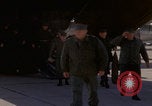
United States Marine Corps officer greets officials and boards staff car in Nevada
United States Marine Corps officer and trainees exit fuselage of a military transport aircraft in Nevada, United States. The officer salutes to USMC officials. The officer talks to the officials and shake hands with one of them. They head towards the staff cars parked in the airfield. Officials board the United States Navy staff cars. (During Vietnam War period.)
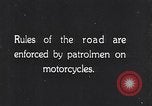
Motorcycle patrolman patrols on highways, unsnarls traffic jams; Snow removal from highways in winters, in the United States.
Maryland State Police motorcycle patrolmen at their post, with sign "Maryland State Police - Substation A". A police patrolman notices a moving violation by a motorist and gets on his motorcycle to pursue. The police officer pulls over the motorist and is seen writing a ticket for the woman driver in the car. A police officer on foot stands at a busy intersection and gives hand commands to control traffic at a bend on highway. Winter time views show a a big snow plow as it removes snow from highways during winters. Many 1920's and 1930's automobiles, including cars, trucks, and buses are seen on American roads and highways. A car passes on a bridge. Cars drive on a four lane. Next scene shows the Statue of Liberty as seen up close from an approaching boat. Final scene shows Bandmaster and United States Marine Corps band as they play. The conductor turns and takes a bow.

Governor of California Ronald Reagan talks about Richard Nixon in United States.
During the 1968 Richard Nixon-Spiro Agnew election campaign for the Presidency in United States. Governor of California Ronald Reagan talks to an interviewer about Richard Nixon. They sit in an office. Reagan favors Richard Nixon for the Presidential election. Ronald Reagan states that people should not waste a vote by voting for a 3rd party or splinter party candidate, but that they should vote for the Republican Party candidate Richard Nixon in the U.S. Presidential elections. Reagain states that the Republican Party "is where the action is."
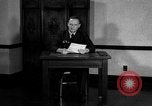
Charles A. Lindbergh speaks against United States participation in European Wars early in World War 2.
Charles A. Lindbergh delivers an anti-war speech early during the outbreak of World War II in Europe. Lindbergh speaks in a studio of the Mutual Broadcasting System. He speaks against American involvement in wars in foreign lands. He states that the Americans should not be asked to fight in foreign countries, but to focus on defense of the United States. Among other things, Lindbergh says: "The doctrine that we must enter the wars of Europe, in order to defend America, will be fatal to our Nation, if we follow it. When men are called upon to fight, and to die, for their country, there must not be even the remotest question of foreign influence involved." He states that Americans have no confidence in decisions of their leaders. He talks about the high number of aircraft and war materiel manufactured to fight in European countries. He talks about the affect on the National debt of the current spending for armaments and war production. He speaks out against the current American leadership (democratic party under Franklin Roosevelt) and how it did not do the right things to see what was coming in Europe and take steps to prevent it. He says that Americans are not confident in their leaders. Lindbergh speaks out against building of untold thousands of military aircraft, but he speaks in favor of a defense-focused American Air Corps.
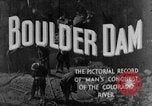
Initial processes in the construction of Boulder Dam in the Black Canyon of the Colorado River in the United States.
The beginning of the construction of Boulder Dam (later the Hoover Dam) on the Colorado River in the United States. Rocks on the side of the river. A boat in the river. A map shows the course of the Colorado River through different states of the country. The river causes floods in towns and farming districts of California. The dam site in the Black Canyon, where the river forms a boundary between Nevada and Arizona. A map shows the dam site. Materials at the dam site. Trains bring supplies. Power lines to the dam site. Men assemble materials for construction work. Men at a survey. Workmen come to the dam site in trucks from other states.
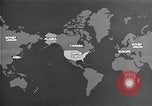
Air Defense warning systems of the United States extend far abroad during the Cold War
Animated map of world highlights the continental United States, Alaska, the Soviet Union and Europe. Circumferential rings illustrate the scope of radar coverage by America's various air defense installations in the world. A radar installation in a desert. Camouflaged radar installation at a remote airfield where U.S. aircraft are parked. An army camp ow tents and sandbags, containing a large radar array. Views of several radar antennas rotating in various places as narrator explains function of radar systems. View of "Radio Jim Creek," Naval Radio Station very low frequency (VLF) radio antennas at Jim Creek near Oso, Washington State. . The transmitter, itself, is located at Arlington,Washington State. Views inside the transmitter facility, where sailor technicians monitor various instruments and are seen at various work stations. (Note: this army production fails to mention that this Naval Radio Station's primary mission it to communicate with submerged U.S. submarines.)
CRITICALPAST.COM: About Us | Contact Us | FAQs - How to Order | License Agreement | My Account | My Lightboxes | Shopping Cart | Advanced Search | Featured Collections | Website Terms & Conditions | Privacy Policy ©2026 CriticalPast LLC.
License Agreement |
Terms & Conditions |
Privacy Policy
©2026 CriticalPast LLC.