


 Francais
 Deutsch
 Italiano
Refine Your Search
Norway 1941 stock footage and images
- Showing 127 to 132 of 1737 results more
more Hide
Hide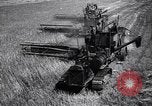
Farmers in Ukraine save crops from invading German forces in World War II Civilians prepare fortifications and defenses
Three Soviet harvesting machines in formation cut wheat in Ukraine before arrival of invading German forces during Operation Barbarossa, in World War 2. Several varying closeups of the harvesting operations and the farmers as they work. Tractor pulls a harvesting machine. Closeup of farmer teaching his wife how to operate the machinery. View of her at the wheel. People (mostly women and children) gleaning grain from the fields after the machinery has finished. Soviet soldiers carrying long handled scythes walk past the wing of an aircraft parked in a field, to join those in the harvesting. A windmill is seen in the far background. Civilians and soldiers work together with hand held tools to cut wheat. Closeup of woman twisting stalks to form a rope to bind the wheat sheaves. Views of soldiers carrying sheaves of wheat. People gathered around and atop a threshing machine. Workers,using pitch forks, toss wheat sheaves up to the threshers, who push them into the threshing machine. A tractor pulls a many wagons filled with flour, from a mill. Complete change of scene shows civilians hard at work building fortifications. Several ensuing scenes show civilians sandbagging and strengthening fortifications in other Allied countries, such as France, Czechoslovakia, Poland, Norway, Holland, Belgium, Spain, and China. Soviet men with shovels digging deep antitank defenses. Many hundreds of Soviet women at work with shovels building defenses along a hillside. A cadre of Soviet women, in uniform, march under command of a military officer, at a square in Moscow. Some appear to be carrying rolled up stretchers or litters over their shoulders, reflecting their role as nurses or medics. Red Cross nurses train for an emergency. One practices bandaging the arm of another. Several Red Cross nurses line up in a formation to march
United States 501st Parachute Battalion, boarding and jumping at Fort Benning (WW2)
Shows 501st Parachute Battalion, boarding C-47 aircraft and jumping at Fort Benning in Georgia during World War II. Views of German parachutists descending on Norway from Junkers 52 aircraft. Aircraft C-47s taking off and dropping heavy equipment parachutists as Curtiss A-12S lay smoke trails below. Troops advancing through smoke in fields.
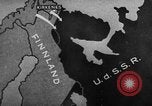
German forces assist Finland combating Soviet forces in World War II
Gernan involvement in Russo-Finnish war ("Winter War") overlapping with World War II. Opening scene shows map with arrows indicating movement of German forces from Norway, into Finland to help them defend against the Soviets. A sign wreathed in greenery, at the border, reads "Finnland" (in German) and "Suomi" (in Finnish). (Narrator says Finland is no more alone.) Next, a German soldier moves a barrier at the border and German troops on motorcycles, led by a staff car, begin crossing into Finland. They cross a bridge over water. A long line of German trucks, cars and motorcycles moves along a country road. One motorcycle, with sidecar, stops and the two German soldier occupants examine a sign marking the Arctic Circle. A steam locomotive pulling a train leaves a Finnish railroad station. Views from aboard the train as local Finns wave at German soldiers who look out the train windows. Change of scene shows German infantry wading through some snow, (Other places are dry.) They are moving forward and taking up firing positions. Closeup of a German soldier firing his rifle. German gun crew firing a a 7.92mm MG37(t) machine gun. Closeup of the gun firing. German soldiers firing a mortar and the shell exploding in the distance. Closeup of another German gun crew firing an MG37 machine gun. (They are probably from the 6th SS Mountain Division Nord.) Shells exploding as German infantry run forward through light brush. Another 3-man German machine gun crew viewed from behind as they fire their weapon at Soviet positions.

1941 Cotton Bowl Classic between Texas A&M Aggies and Fordam Rams, played in Cotton Bowl Stadium, Dallas, Texas on January 1, 1941
Film opens showing fans filling the Cotton Bowl Stadium in Dallas, Texas. Next. opposing college football teams are lined up on the line of scrimmage. A running play gains some yardage before ball carrier is tackled. Referees mark the location and the teams set up on another line of scrimmage. Closeup of a Texas fan wearing a beat up cowboy hat and ill-fitting eye glasses. More views of play on the field. Final view shows crowd (of 45,507) in the stands. The game was a cliffhanger, with final score: Texas 13 and Fordham 12
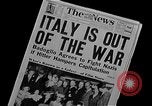
Allied pre-invasion base and activities in Scotland,1941. Allies in Algeria preparing for invasion of Sicily,1943
Activities of the Seabees in Scotland in 1941 and in Algeria in 1943, during World War II. News headlines in 1943 read : ' Italy is out of war' and '17 more Italian towns taken'. An animated map. The Clyde valley in Scotland showing a base built by the U.S. Navy Seabees, in 1941. Numerous quonset huts and vehicles are seen. View of the River Clyde, where 2400 feet of oceangoing dock are being assembled. A ship anchored at a harbor displaying U.S. flag. Allied troops board a landing ship with their belongings. An animated map tracing travel of Allied invasion forces from Scotland to Oran, Algeria, where Seabees are seen testing a floating causway that would be used for invasion of Sicily. Scuttled axis ships and other obstacles and damage that Seabees must repair in occupied ports. Allied ships and troops proceeding for invasion of Sicily. Allied warships bombarding Sicilian coast.

The Philippines gains independence from the United States on July 4, 1946; also scenes from 1941 Japanese invasion WW2
The Philippines are established as an independent nation. Crowds of Filipinos gathered at Rizal Park (Luneta Park) in Manila on the July 4, 1946. View of Independence Grandstand (a temporary structure built in front of the Rizal Monument) with American flag and Philippine flags on tall flag poles.. View looking down on General Douglas MacArthur at a podium, speaking into microphones. Camera pans over various segments of the audience. A map shows the Philippine Islands in context of its neighbors in the Pacific Ocean. Camera pans closeup across faces of many Filipinos gathered at the independence event. View of the Jones Bridge over the Pasig River in downtown Manila. Heacock’s Department Store on the Escolta. The Legislative Building. (later the National Museum of the Philippines). Ocean going ships in a harbor. Cargo being offloaded from a ship onto smaller boat. An industrial complex with eight tall smoke stacks emitting smoke. Steel and petroleum plants. Filipino workers in an assembly plant. The Legislative building with people coming and going. Air raid sirens sounding and people running in streets of Manila at onset of Japanese invasion of the Philippines in December, 1941, at start of World War 2, in the Pacific. People running across the Jones Bridge, seeking shelter. Others boarding a bus. Smoke rising from Japanese bombing. Glimpse of Japanese tanks entering Manila during attack and invasion. Japanese infantry climbing a hill. Bodies of persons killed during the Japanese invasion. Glimpse of Japanese troops occupying Corregidor. U.S. General Wainwright negotiating the surrender of Corregidor with Japanese General Homma. View of an American warship firing during the U.S. campaign to defeat the Japanese on islands in the Pacific. An American landing ship carrying U.S. troops who storm ashore. General Douglas MacArthur striding ashore with a retinue of officers, at Leyte, Philippines, on October 20, 1944. as he keeps his promise to return to the Philippines. Views, back again, to MacArthur speaking at the Independence Day ceremony in Manila on July 4, 1946. Also seen at the ceremony are: U.S. Senator Millard Tydings, (co-sponsor of the 1934 Tydings–McDuffie Act, which provided independence to the Philippines after a 10-year transition under a limited autonomy), and Paul V. McNutt, U.S. High Commissioner of the Philippines, who read President Truman's proclamation of Philippine Independence to the assembly. Camera pans over the gathering which includes many U.S. Service personnel in uniform. The oath of office is administered to the elected President of the Philippines, Manuel Roxas. At the conclusion, the American flag is lowered by Paul McNutt, as President Roxas raises that of the Republic of the Philippines. A celebratory parade in Manila includes a float with signs reading: "Let's Produce and Rebuild," among other things. Other floats represent "Mountain Province," and "The City of Manila," "The University of the Philippines," and "The Division of City Schools." One float, sponsored by the Chamber of Commerce, contains a huge replica machine gear, and models of an aircraft and a ship. It's message is about turning the gear that helps make the nation great. American and Filipino soldiers march, carrying their respective national flags. A white-helmeted military band plays for the marchers. Final scene shows large loose formation of military aircraft in flight very high above the Independence Grandstand, at Rizal Park.