


 Francais
 Deutsch
 Italiano
Refine Your Search
Ohio-State-football stock footage and images
- Showing 6955 to 6960 of 24493 results more
more Hide
Hide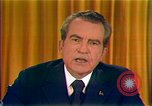
U.S. President Nixon speaks urging action from the Congress to fight inflation in the United States.
Speech by U.S. President Richard Nixon from the Oval Office of the White House in Washington DC, United States about inflation in the country. President Nixon speaks about battle against inflation. He states that the Congress can only hold down cost of living by holding down cost of the government. He says he would continue to veto spending bills which the country cannot afford. President Nixon urges the Congress to reduce tariffs and increase the supply of scarce goods. The President says the Congress should give him authority to move ahead with the Alaska Pipeline for oil to meet the shortage of oil and gas during energy crisis. He urges high production for farm industries. President Nixon speaks about peace in Vietnam and that all American prisoners have returned back. He talks about his summit meeting with General Secretary of the Communist Party of the Soviet Union Leonid Brezhnev which would take place a week later in Washington. President Nixon talks about achieving full prosperity without war and inflation. (Vietnam War period).
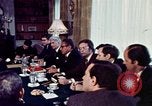
U.S. Secretary of State Kissinger and counterpart, Le Duc tho, of North Vietnam, lead delegations in Paris Peace Talks
During the Vietnam War, representatives from the United States, South Vietnam and North Vietnam meet, in Paris, France, to finalize the Paris Peace Accords ending Vietnam hostilities. Principal negotiators to end the war are U.S. Secretary of State Henry Kissinger, and North Vietnamese counterpart , Le Duc Tho. The delegates are seated at a large rectangular table, with Henry Kissinger at center of one side and Le Duc tho, at center of opposite side. Other delegates occupy seats adjacent to their respective principals. (Location: Majestic Hotel?) Photographers try to take photographs without being obtrusive. The mood of the meeting appears restrained but pleasant.
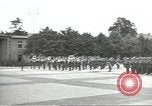
Soviet Union officially transfers control of the American sector of Berlin, to the United States, in a ceremony after end of World War II in Europe
Ceremony in Berlin, Germany, marking official transfer of American Sector of Berlin to U.S. Authorities, following end of World War 2, in Europe. Troops of the U.S. 41st Infantry Regiment, 2nd Armored Division, stand in formation as a U.S Army band plays the American National Anthem (Star Spangled Banner) on the esplanade of the Adolf Hitler Barracks, in Berlin. This is followed by a 48-gun salute fired by "RC" battery of the U.S. 78th Field Artillery Battalion, as all troops assembled render hand salute. Scene shifts to U.S. General Omar Bradley, Commanding General, Twelfth United States Army Group, standing at a microphone. He states that "this ceremony marks the meeting of the United Nations, here, in Berlin and a complete defeat of Germany." He continues with other remarks. Among allied senior officers seen with him are: U.S. Major General Floyd Parks, Commander of the U.S. Sector in Berlin; French Major General Duschesne, Commanding General of French troops in Berlin; and Soviet Major General Nicholei Nicholeiovitch Barinov, Deputy Commander of the Soviet troops in Berlin. Following Bradley's remarks, he, Parks, Duschesne, and Barinov, walk side-by-side across the esplanade, followed by the other military leaders as the Army band plays. Scene shifts to a formation of soldiers from the Soviet 5th Army. Following commands heard, The formation executes a right face,left shoulder arms, and marches off as the band plays.s.
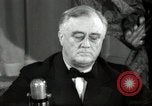
President of United States Franklin Roosevelt delivers a fireside chat in Washington D.C. to the nation.
U.S. President Franklin Roosevelt delivers Fireside Chat speech to the nation on 29th December, 1940 in Washington D.C. during World War II. In portions from his "Great Arsenal of Democracy" speech, Roosevelt talks about lower chances of the United States getting into war by supporting the nations that are defending themselves against attack by the Axis Powers. Roosevelt speaks about supplying equipment required by the nations defending against Axis Powers. He denies any demand for sending an American Expeditionary Force outside the United States. He says that any talk of sending armies to Europe is untrue. He talks about cooperation between the Government, industry and labor. Roosevelt also speaks about immediate expansion of industries essential to defend the nation. He lays stress on aiding Great Britain through lend lease and similar programs, and Roosevelt expresses his belief that the Axis Powers will not win World War II. He says that "we must be the great arsenal of democracy."
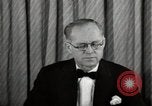
Joseph Kennedy says that opposing ideas should be tolerated in the United States.
U.S. Ambassador to UK Joseph Kennedy records a speech in Washington D.C., United States during World War II. He espresses concern about the "habit of smearing an opponent" because one disagrees with what he stands for. He asks, how can we maintain national unity when the motives of patriotic men are indiscriminately assailed. He says that if intolerance of contrary opinions flourishes, at this point of time, then future of theUnited States is dark.
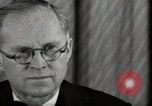
Former Ambassador to the UK, Joseph Kennedy, opposes the entry of United States into World War II in a speech in Washington D.C.
Former U.S. Ambassador to UK, Joseph Kennedy, records a speech in Washington D.C., United States during World War II. He opposes entry of United States into World War II.
CRITICALPAST.COM: About Us | Contact Us | FAQs - How to Order | License Agreement | My Account | My Lightboxes | Shopping Cart | Advanced Search | Featured Collections | Website Terms & Conditions | Privacy Policy ©2026 CriticalPast LLC.
License Agreement |
Terms & Conditions |
Privacy Policy
©2026 CriticalPast LLC.