


 Francais
 Deutsch
 Italiano
Refine Your Search
Ohio-State-football stock footage and images
- Showing 9367 to 9372 of 24492 results more
more Hide
Hide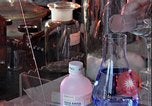
Body of Stalin lying in State. Soviet citizens in Red Square. Body of Stalin carried into Lenin's Tomb; earlier scenes of Stalin visiting Lenin tomb
Embalming laboratory in Moscow, Russia. A technician works with chemicals. Scene changes to funeral of General Secretary of the Communist Party of the Soviet Union, Joseph Stalin in Moscow, Russia, Soviet Union. Embalmed body of Joseph Stalin, Lying in State. Mourners gathered to pay homage to Joseph Stalin. Women weep. A large crowd of civilians gathered at Red Square. Men carry Stalin's body in a coffin to Lenin's Tomb, where it lies, next to the body of Chairman of the Council of People's Commissars Vladimir Llyich Lenin, preserved in the tomb. Views from years prior of Joseph Stalin descending stairs and leaving after visiting tomb of Vladimir Lenin. Brief scenes of a Soviet chemical laboratory with many vials, flask, and beakers, and a scientist or chemist at work in the lab. Scenes of Soviet citizens waiting in line to file into the tombs of Lenin and Stalin.
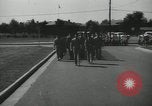
Company E, 1st Training Regiment troops march during the graduation day parade at Fort Dix in New Jersey, United States.
The Basic Training Graduation Day parade of Company E, 1st Training Regiment at Fort Dix in New Jersey, United States. Company E, 1st Training Regiment troops march through streets during the parade. They gather in a field for the graduation day ceremony.
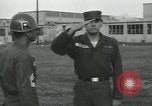
A Company E,1st Training Regiment officer plays a guitar and sings in his room at Fort Dix in New Jersey, United States.
Trainees of Company E, 1st Training Regiment at Fort Dix in New Jersey, United States. The trainees relax in their rooms at night. They look out of a window. A soldier plays a guitar and sings in his room. Two soldiers seated at a table play chess. Other soldier plays a mouth organ.
Kremlin leaders review a massive military parade in Moscow. U.S. Army recruiting and training soldiers in the United States.
Opening scene shows massive military parades in Red Square, Moscow, Russia, Soviet Union. Huge formations of Sailors and soldiers pass in review before Soviet leaders watching from a Kremlin reviewing stand. Among those seen are Party Chairman, and leader, Nikita Khrushchev, in light suit and hat and at his right side, Defense Minister Georgy Zhukov (in General's uniform). Next a formation of Tupolev Tu-16 (Badger) bombers flies over St. Basil's Cathedral and the square. View from high in Kremlin of towed artillery pieces. Closeup of Russian soldiers standing in the open back of a large artillery tractor pulling a large field piece. Other field pieces in tow. Scene shifts to the United States. Glimpse of an American Army recruiting poster and views of U.S. army recruits. U.S. soldiers on parade and in field training live fire exercises. Soldiers firing rifles in prone position, and then advancing across a field. Army gun crew with an 8-inch howitzer. M75 Armored Personnel Carriers driving across a field. Soldiers on maneuvers wearing personal camouflage and firing heavy weapons from a tree line.
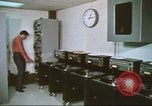
Personnel edit recordings at the American Forces Radio and Television Station in Washington DC, United States.
American Forces Radio and Television Station facility in Washington DC, United States. A man checks recordings of news, sports and special events at a station. The recordings are edited to remove commercial messages. Officials read program details at a operating schedule board. Men work at a station and feed the programs to a American Forces Radio and Television Station by short wave transmitters.
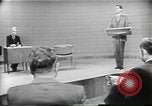
During a presidential election debate in Chicago, Illinois Nixon states that he hopes to control the House and get a majority.
The first Kennedy-Nixon Presidential Debate in Chicago, Illinois. Bob Fleming from ABC News asks Republican candidate U.S. Vice President Richard M. Nixon whether he could work better with Democratic majorities in the House and Senate than Senator Kennedy. Nixon answers and says that he hopes to control the House and to get a majority in the House in the elections. He states that the President cannot control the Senate and the President needs the support of the country and people to get his programs accomplished. He says that whenever a majority of the people are in favor of a program, the House and the Senate respond to it and it does not matter if the House and the Senate in the next session is Democratic or Republican. He disagrees with the reason of a presidential veto by Kennedy. Democratic candidate Senator John F Kennedy presents his views. Kennedy talks about the bill for minimum hourly wage system against which the Republicans voted. He then talks about the federal aid to education bill which failed because the Republicans did not vote for it. He talks about the third bill of medical care for the aged which is tied to Social Security, which is financed out of Social Security funds and it does not put a deficit on the Treasury. Kennedy concludes that these are three programs which are quite moderate and not extreme.
CRITICALPAST.COM: About Us | Contact Us | FAQs - How to Order | License Agreement | My Account | My Lightboxes | Shopping Cart | Advanced Search | Featured Collections | Website Terms & Conditions | Privacy Policy ©2026 CriticalPast LLC.
License Agreement |
Terms & Conditions |
Privacy Policy
©2026 CriticalPast LLC.