


 Francais
 Deutsch
 Italiano
Refine Your Search
Ohio-State-football stock footage and images
- Showing 943 to 948 of 24494 results more
more Hide
Hide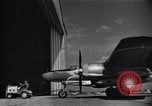
Use of artificial lightning equipment in Project Thunderstorm, and radar operations supporting project and its aircraft
Tug tows Northrop F-15 Reporter into hangar in Minneapolis, Minnesota to be instrumented for Project Thunderstorm. Various scenes of electrical equipment used in making man-made lightning, including a generator made up of hundreds of transformers, and a connected massive generator for producing high voltage. A large oscillograph is shown along with a smaller oscillograph designed for airborne use. A scientist is seen inside the giant generator. Artificial lightning tests are made on canopy of the F-15 occupied by a scientist, and the canopy remains intact following lightning strike. Lightning rods are attached to lightning-vulnerable nose, tail fin, and wing tip locations of the Project Thunderstorm aircraft. Pilot climbs into canopy of F-15. Airborne F-15 project aircraft seen in flight headed toward area of dark clouds. In Ohio at Clinton County Army Air Field, a project officer (AAF Captain) describes how search procedures of the pilot, weather observer, and radar observer are coordinated and key locations of radar and cooperating facilities at Jamestown and the Clinton County Army Airfield. Large radar antenna revolving on top of large tower, scanning for signs of thunderstorms. Radar antenna scanning vertically, near Quonset huts. Command center inside a quonset hut with project personnel at radar scopes and thunderstorm and aircraft positions plotted on large plexiglass screens. Technician adjust motion picture camera that photographs radar scopes every four seconds. Operator at vertical measuring instrument, showing reflected returns from targets, on July 18, 1947. View of operator at plan position indicator radar scope showing weather returns on June 6, 1947. Ground Control Approach (GCA) truck located near end of airfield to guide landings of Thunderstorm aircraft. Radio operators sitting at radar scopes inside the GCA unit. P-61 makes GCA approach and landing in good weather, to maintain skills needed when weather is bad. Briefing officer at blackboard cites radio channels to be used for various purposes. View of AAF aircrews in audience.

A civilian reporter and astronauts on a zero gravity test flight
Astronauts trained in Ohio. A civilian reporter and spacemen on a zero gravity test flight. Clouds seen below. They float in mid air. The men suspend their bodies in air.
Workers in the rubber heel manufacturing unit in Windsor Vermont in United States.
Manufacturing of rubber heels for the soles of U.S. soldiers' boots at a Goodyear plant in Windsor, Vermont. Men and women emerge from rubber heel manufacturing facility in Windsor Vermont. Workers wash uncured rubber heels and keep them to dry so as to prevent them from sticking. Man puts rubber heels in molds for nailing. Each nailed heel passes through vulcanization machines. Woman checks the vulcanized rubber heels and puts them together. Women pass completed heels through an X-ray machine and check for defects. In Akron, Ohio, a U.S. Army soldier stands in front of the statue of Charles Goodyear, the founder of Goodyear rubber company, and the discoverer of vulcanization. (World War II period).
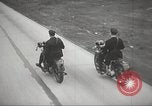
Federal officials declare war on criminals and gangsters during great depression era in the United States
Two police motorcycles escort a black truck carrying Martin Insull, following his deportation from Canada. The truck displays "Atlas Bro Co" across its top. (Martin is brother of the famous fugitive, Samuel Insull who fled the country following the collapse of his various utility company holding companies, most notably Middle Western Utilities.) Martin Insull is being brought to the Cook County Courthouse in Chicago, to answer charges about his involvement in the matter. Scene shifts to Cook County Courthouse where Martin Insull is escorted by various officials. A group of men and women stand in the area. Some exhibit signs of distress. View from above of the Cook County jail. Smoke from stacks obscuring it somewhat. Change of scene shows heavily armed FBI agents escorting handcuffed and chained gangster George Francis Barnes aka “Machine Gun Kelly" at an American Airlines facility in Memphis, Tennessee, in 1933. They escort him past a parked airplane. Closeup of the "Lima News" of Lima, Ohio, with headline reflecting a national federal campaign against gangsters and criminals in the U.S. View of crowded courtroom. View of Alcatraz prison on its rock island in San Francisco Bay, California. Interior view of cell blocks in Alcatraz. Federal officials escorting arrested men in handcuffs who hide their faces as they approach the camera.
Commercial passengers fly Stout Airlines from Detroit Michigan to Cleveland.Ohio
Opening slate refers to developing scope of commercial air operations in late 1920s. A bus parks at the Detroit office of Stout Airlines at Ford Airport, Detroit, Michigan. Passengers leave the bus and enter the office to obtain tickets for a flight to Cleveland. They are nicely dressed in the fashion of the day, men in suites and ties and women in Cloche hats.. Many spectators stand behind a fence at the airport to watch the activities. Passengers leave the office and head toward a parked Ford Tri-motor passenger plane parked on the ramp. One woman is accompanied by three small boys. Next, a man is seen passing the passengers' luggage through the plane's entrance door to a male steward inside. Scene shifts to the uniformed steward loading the baggage into large overhead bins in the roof of the passenger compartment. He closes and secures the storage bins and then heads outside the plane where he assists passengers in boarding. He climbs aboard. The aircraft is then seen taxiing toward the runway for takeoff. As it passes the camera, a sign painted on its side is visible reading: "Stout Airlines, Detroit-Cleveland" (and Chicago added below). (Note: they did not operate to Chicago until 1929) The aircraft takes off heading close to the camera, near its lift off point, and heads off into the sky.Scene shifts to inside the passenger cabin where the passengers (unrestricted by seat belts) chat with one another as the cabin steward watches over them from the front of the cabin. View of ground from passenger cabin window. View of the Ford Trimotor from another aircraft flying nearby. More views inside the passenger cabin with people looking out the windows. View of what may be a suspension bridge under construction across the Cuyahoga River in Cleveland. More views of passengers enjoying the views through their cabin windows. Aerial view of trimotor descending toward destination over cityscape. The aircraft taxis into the Cleveland Hopkins airport ramp and parks. Passengers are seen departing, from inside their cabin and then stepping onto the airport ramp.

Bessie Pastor and husband Michael Berliney create synthetic ice in Toledo.
Bessie Pastor and husband Michael Berliney create synthetic ice in their Toledo, Ohio home lab. The substance is poured into molds and blocks of synthetic ice are manufactured. Masons join blocks and smoothen them out to build skating floor. Children,men and women wearing skates take a test run on the synthetic ice flooring. April 1938.
CRITICALPAST.COM: About Us | Contact Us | FAQs - How to Order | License Agreement | My Account | My Lightboxes | Shopping Cart | Advanced Search | Featured Collections | Website Terms & Conditions | Privacy Policy ©2026 CriticalPast LLC.
License Agreement |
Terms & Conditions |
Privacy Policy
©2026 CriticalPast LLC.