


 Francais
 Deutsch
 Italiano
Refine Your Search
Ohio-State-football stock footage and images
- Showing 10315 to 10320 of 24492 results more
more Hide
Hide
High Line Method and Burtoning Method of replenishing cargo from one ship to another described in the United States.
A U.S. Navy training film about replenishing in sea. The film is titled 'Fueling and Replenishing at Sea'. Two ship in sea transfer ammunition, cargo, fuel and personnels from one to another. Provision ships and cargo ships in the sea. Boom head cranes and winches at ship. Two types of transfer methods are described using pointers High Line Method and Burtoning Method. To transfer high load wire winches are used. An operator at wire handing winch. Forward loading area at ship described. Type of hooks, their functioning on both the delivery ship and the receiving ship is explained. Work of winch-men on both ships discussed. Horizontal lift of provisions. Use of slings in transfer demonstrated. A cargo is unloaded on a ship and sailors move it on a conveyor belt. Ammunitions handled with extra care during transfer. The distance between two ships is maintained at 70 feet. Sailors talk on communication line between both ships. High Line Method of transfer described in detail. Arrangements of haul line described.
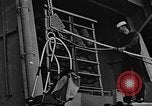
Personnel transfer from one ship to another using High Line Method described in the United States.
A U.S. Navy training film about replenishing in sea. The transfer of personnel described. A one carrier Pipe frame chair is used for transferring personnel. High line method is used for this purpose. In Haul line and Back Haul line described. Back haul line is always supported. In haul line is supported by sailors at the time of personnel transfer. Special chairs used to transfer disabled persons. High lines are kept elevated and lowered by men power when required.
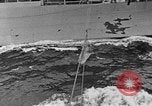
Transfer process of cargo and personnels from one ship to another described in the United States.
A training film of U.S. Navy about replenishing in sea. Petty officer signals winch man when to strain or lift. During lifting workers work at In Haul Line. When cargo reaches the receiving ship it is lowered at landing place. Exchange of movie rolls, provisions and mail. Personnels are delivered only by high line and heavy cargo is delivered by Burtoning method.
United States Army troops communicate with field telephones in the front (WW2)
'Your Job in the Signal Corps' discusses the importance of communication lines in the army during World War II. A sign on the door of the office of a Major General. U.S. Major General H. G. Ingles, Chief Signal Officer speaks about the U.S. Army Signal Corps and their role in all the three divisions of army. Major General Ingles speaks from his office. A soldier on top of a moving tank. Tanks in a field. Mechanized units in a field during a war. The troops communicate from the field. U.S. Army Air Force aircraft in flight and view of pilot and copilot in cockpit. Bomb bay door opens. Soldier on aircraft operates bomb sight device. Bombs fall from bombers and hit the ground. Artillery is fired. A U.S. soldier reads a map and talks over a field phone. Gun crew fires artillery. Railway gun firing. U.S. Nayg guns firing from ship. A boat lands on a beach head. Troops walk in a jungle. A soldier blows a whistle. Allied soldiers fire a bazooka on a moving German armored vehicle. Soldier sends a morse code transmission using a telegraph machine. A soldier calls with a telephone. Another soldier uses the radio for communication. Carrier Pigeons and rockets are also used to stay in touch. A hand fires a signal rocket. A messenger hand delivers a message. Officers making calls from their desks, field telephones and telephones on trees.
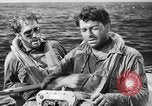
Different communication equipment used by units of the United States Army Signal Corps.
Communication means and equipment maintained and used by the U.S. Army Signal Corps during World War 2. Soldiers in a life boat use a hand cranked radio and an aircraft comes to rescue them. They wave at the aircraft. View of machines used for processing and printing V-Mail letters that are typed by machines and then delivered to soldiers. View of a soldier opening a small V-mail envelope and reading the note inside. Men and women work at various jobs in America in support of war production and war materiel. Men and women war production workers assembling various pieces of electronic equipment and radio devices. Men and women in large, busy clerical and administrative offices supporting typing and communications for the U.S. Army and military. Engineers work in a laboratory. A man loads a tube into a pneumatic message delivery system. Close up views of woman's hands on typewriter typing telegrams, letters, and messages. Women file clerks sort files. Technicians work on a telegraph machine. U.S. Army soldiers on a pole stringing communication wires. A soldier ties a wire on a tree. (World War II period).
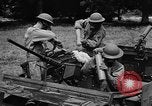
The procedure of decontamination after a gas attack on open vehicles and tanks in the United States (WW2)
A U.S. Army training film about decontamination procedures during World War II. Soldiers decontaminate an open vehicle like a half truck. They hand spray on the vehicle and rub it with a swab. They clean it on up wind side then turn it around and clean. Tanks are brought to a safer area and are turned facing the wind. A soldier opens a hatch and rubs the entrance with decontamination saturated rag. He then uses one o one half quarter sprayer. Then the soldiers clean the surface of the tank. They clean all the other parts of the tank especially openings air ways. A three gallon apparatus filled with non coronation and chlorinated lime is applied on the tank.
CRITICALPAST.COM: About Us | Contact Us | FAQs - How to Order | License Agreement | My Account | My Lightboxes | Shopping Cart | Advanced Search | Featured Collections | Website Terms & Conditions | Privacy Policy ©2026 CriticalPast LLC.
License Agreement |
Terms & Conditions |
Privacy Policy
©2026 CriticalPast LLC.