


 Francais
 Deutsch
 Italiano
Refine Your Search
Ohio-State-football stock footage and images
- Showing 10657 to 10662 of 24492 results more
more Hide
Hide
Waterfall,Rocky slopes and mountain peak in Yosemite Valley of California, United States.
View of the waterfall in Yosemite Valley National Park. View of Rocky slopes. Rocky mountain peak seen through trees. Pack horses are loaded with gear move along a mountain road. Man on horse back brings up the rear. View of waterfall in Yosemite Valley from a distance.
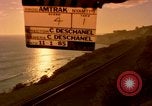
Train passes by the Pacific Ocean on the west coast of the United States at sunset.
Sunset over the Pacific ocean. Train passes by along a ridge above the Pacific Ocean on the West Coast of the U.S. Scene of sun set. An airplane in the sky over the train.

Train passing through arid terrain with low mountains in the United States
High altitude view of train passing through a dry area with low mountains in the U.S. The train passes a field. A river beside the track.

Launching of NATIV missile under Project MX770 in California United States.
A scientist makes a presentation of Project MX770 showing coverage of model and various phases of missile development from 1946-1951. Development of NATIV (NORTH AMERICAN TEST INSTRUMENTATION VEHICLE) missile is between 1946-47 while NAVAHO is developed between 1948-49.The presentation shows the pulling of test vehicle under launching tower and its vertical position. A technician ties guide wires near the top of the missile.The missile is fired. Graphical presentation shows the parabolic pathway of missile showing altitude of 400mt and speed of mach8 (2722.32m/s). The firing range of Navaho is 3000mt from surface to surface.The missile uses Ramjet engines. Models of three missiles are also shown.

Animation of radar guidance to RTV-A-5 under missile project MX770 in Santa Susana Field Laboratory,California, United States
Animation of radar guidance to RTV-A-5 from a radar-disc mounted van under missile project MX770 is given. Large test equipment of the guidance system are seen. Auto-navigator present in the anterior part of the missile is shown in the animation. Large van trailers are prepared to install Telemetering equipment present in the laboratory. Two technicians telecommunicate with each other.

Various aspects of position control system studied during flight under missile Project MX770 in California United States
Position control system of a missile during flight under missile Project MX770 are explained. An auto pilot controls the flight through Reads Electronic Analog Computer or REAC. Disturbances like wind, dust or engine failure are evaluated from flight equation. The auto pilot control the path of the flight through hydraulic server. Generally the movable control system is mounted on hinges of a plane as shown in the TL-238. The rotatory equator moves the control system and positions the flight correctly.
CRITICALPAST.COM: About Us | Contact Us | FAQs - How to Order | License Agreement | My Account | My Lightboxes | Shopping Cart | Advanced Search | Featured Collections | Website Terms & Conditions | Privacy Policy ©2026 CriticalPast LLC.
License Agreement |
Terms & Conditions |
Privacy Policy
©2026 CriticalPast LLC.