


 Francais
 Deutsch
 Italiano
Refine Your Search
Ohio-State-football stock footage and images
- Showing 11365 to 11370 of 24492 results more
more Hide
Hide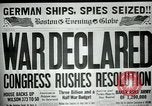
United States declares war on Germany and troops march ahead in European Theater
Events during World War I. A newspaper headline reads ' U.S. declares war' American soldiers embark onto a ship and wave as they leave for the war front. In the European Theater soldiers disembark from the ship and march forward with their weapons. Soldiers march ahead as people cheer them. A cavalry units marches ahead with wrecked houses in the background.
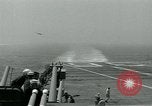
British Royal Navy aircraft operating aboard the United States aircraft carrier Antietam in Atlantic Ocean.
British Royal Navy de Havilland Vampire jet aircraft makes an arrested landing on the American Aircraft Carrier, USS Antietam (CVA-36). Sailors clear the arresting gear and surround the aircraft momentarily. Next, the aircraft is seen ready for takeoff. The aircraft tilts forward as the pilot applies power, holding the brakes. Upon signal from Carrier Yellow Shirt crew member, the pilot releases his brakes and commences his takeoff roll. Brief view of British Naval officers conversing on the deck of the USS Antietam.
First Director of Peace Corps, Sargent Shriver interviewed in Washington DC, United States.
A Television series 'Your man in Washington'. Reporters Len O' Connor and Art Barriault interview the First Director of Peace Corps, Robert Sargent Shriver. During the interview Shriver explains how the idea for Peace Corps was put forward by President Kennedy during his election campaign. He says that Peace Corps consists of 1000 people and it serves in 13 countries across the globe. He also expresses hope that Congress will sanction a bigger chunk of money for the expansion of the Peace Corps.
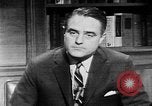
Robert Sargent Shriver interviewed in Washington DC, United States.
Len O' Connor of WNBQ interviews the First Director of Peace Corps, Robert Sargent Shriver. On being asked does he think there are too many Kennedy's in the public office, he disagrees. Shriver instead says that there is a dearth of qualified people capable of holding public offices and if people are qualified enough their surnames should not be an issue.
Soldiers of United States 46th Armor 4th Battalion patrol the streets after the riots in Chicago, Illinois.
After the riots in Chicago, Illinois. Soldiers of 4th Battalion, 46th Armor patrol the streets. Soldiers move on the road as they carry rifles. African American girls on the street. Soldiers and policemen on guard in streets following the assassination of Civil Rights leader Martin Luther King Jr.
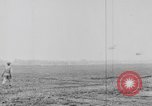
President Coolidge welcomes the U.S. Army Air Service round-the-world fliers in Washington DC, United States.
Two Douglas World Cruiser airplanes land at Bolling Field, Washington, DC, to be welcomed by U.S. President Calvin Coolidge, in recognition of their round-the-world flight completed on September 28, 1924, at Seattle, Washington. Major General Mason M. Patrick, Chief of the Army Air Service, signals with his arm to guide them to a parking place, as they taxi in after landing. The two aircraft park next to one another. Next, a welcoming committee is seen standing, with the President (dressed in a rain slicker). Secretary of War, John W. Weeks stands to the President's left. To Coolidge's right, are 1st Lieutenant Leigh P. Wade (pilot);1st Lieutenant Leslie P. Arnold (co-pilot); 1st Lieutenant Lowell H. Smith (pilot, and flight commander); and SSgt. Henry H. Ogden (flight mechanic). Closeup of President Coolidge with Lieutenant Smith in front of one of the aircraft. Scene shifts back again to the larger group, with Lieutenant Wade and Coolidge shaking hands with the four flyers, starting with Lieutenant Wade. Secretary Weeks shakes hands with General Patrick, who has donned a flying coverall. Then Weeks shakes the hands of the flyers and they proceed away from the gathering. Change of scene shows Lieutenant Smith perched on the wing of his aircraft, the "Chicago,"conversing with the President and Secretary Weeks. He gets down and continues his conversation with Coolidge, who touches a propeller blade at one point. Final scene shows a two seater DH-4 airplane taking off from Bolling field.
CRITICALPAST.COM: About Us | Contact Us | FAQs - How to Order | License Agreement | My Account | My Lightboxes | Shopping Cart | Advanced Search | Featured Collections | Website Terms & Conditions | Privacy Policy ©2026 CriticalPast LLC.
License Agreement |
Terms & Conditions |
Privacy Policy
©2026 CriticalPast LLC.