


 Francais
 Deutsch
 Italiano
Refine Your Search
Ohio-State-football stock footage and images
- Showing 11911 to 11916 of 24492 results more
more Hide
Hide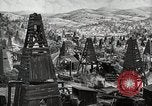
Contribution of African American soldiers during the Spanish American War and World War I.
A film about the role of African American soldiers during various wars in the United States. A dramatization shows a black soldier during the Spanish American War. He also talks about his role in Cuba and the construction of the Panama Canal. Footage of the Panama Canal being constructed and ships underway in the canal. United States Army forces including black soldiers boarding troop transport ships bound for Europe during World War 1. A railroad train carries African American soldiers to France during World War I. African American soldier units under General Pershing march in formation with an Army band in France during World War 1. African American soldiers work and fight against the Germans, including the 813th Pioneer Regiment near Marseilles, the 332nd Labor Battalion, and the 808th Pioneer Regiment near Verdun. African American soldiers racing for front lines including the soldiers with the 8th Illinois and the 372nd regiment and the 371st, and the 369th Infantry Regiment (sometimes called the "Harlem Hellfighters") in the Argonne. View from behind soldier as he fires a machine gun, and United States Army infantry firing artillery. African American soldiers of the 369th regiment "Harlem Hellfighters" being decorated and receiving the French Croix de Guerre for their heroic actions in World War I. The African American soldiers march at a parade in New York City following World War I and are greeted by throngs of enthusiastic African American civilians attending the parade. View of Henry Johnson being congratulated by civilians after he and Needham Roberts performed with exceptional heroism and received the Croix de Guerre. Close up view of the Croix de Guerre medal on a uniform. Graves of African American soldiers who lost their lives during World War I at Arlington National Cemetery in Virginia. View of the All-Wars Memorial to Colored Soldiers and Sailors in Logan Square in Philadelphia (Logan Square, SE corner 20th Street & Benjamin Franklin Parkway, Philadelphia, Pennsylvania). View of a stone memorial erected in the Meuse-Argonne region, north of Sechault, as a tribute to the efforts of the African American soldiers of the 371st Infantry Regiment who fought and died there on April 21, 1918 during World War 1.
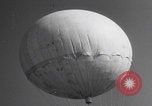
Parts of a Japanese Fu-Go paper balloon bomb (WW2)
A video explaining the components of a Japanese Fu-Go paper balloon bomb- a weapon launched by Japan to drop bombs on the United States during World War 2. A United States Navy personnel inspects the Fu-Go paper balloon on its ballast. Paper bags and sandbags tied to the ballast of the Fu-Go balloon bomb. Payload comprises of incendiaries and anti-personnel bombs. Inflated “Type B” Fu-Go balloon made of 5 ply “washi” rice paper. United States Navy personnel lets go of holding the ballast of balloon bomb. Man unfolds a piece of rice paper. Man ripping a piece of rice paper, demonstrating the durability of the material. Fu-Go bomb inflated with hydrogen gas. Man holding the escape valve of the Fu-Go balloon bomb. Escape valve is shown as made of pressed steel and has a rubber gasket. Pressure is exerted by the rubber ring the escape valve. Spider bracket of escape valve.
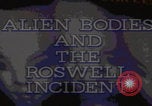
Roswell Incident summary from USAF.
The Roswell incident according to the United States Air Force. Slate reads “Alien bodies and the Roswell Incident”. The next slide mentions about the claims of alien bodies found in Roswell only sprouted in later decades from secondary and tertiary sources. Books by American Ufologist Kevin D. Randle such as “The Truth About the UFO Crash at Roswell with Donald R. Schmitt”, “UFO Crash at Roswell”, “A History of UFO Crashes”, “Roswell Ufo Crash Update: Exposing the Military Cover-Up of the Century” and “A History of UFO Crashes” by Kevin D. Randle and “The Roswell Incident” by Charles Berlitz. A book titled “The Roswell report: fact versus fiction in the New Mexico desert” by James McAndrew. Staff working inside the United States Air Force (USAF) Archives. Documents scrolling into the screen. Cover of a book “Roswell report: case closed” by James McAndrew. Men in white suit unravels a long red plastic-like fabric from a spool of a truck. Truck drives away. An Air Force pilot with oxygen mask is being assisted into a vehicle during an Air Force experiment. Pallbearers carry a coffin draped with the United States flag during a full honors funeral.
USAF video questions Roswell Incident claims.
The Roswell incident according to the United States Air Force. View of books titled “The Roswell report: fact versus fiction in the New Mexico desert” and “The Roswell Report: Case Closed” by James McAndrew. A test dummy is released from a high altitude. An experimental balloon device is launched. Narrator indicates that misidentification of such events leads to UFO claims. A scientist holds a radar target tied to a weather balloon. Men in white suits unravels a long red plastic-like fabric from a spool of a truck. A large high-altitude balloon is inflated and ascends. Two dummies attached to a balloon are hanging from a crane. The crane lets go of two dummies. White, transparent balloon climbs upwards. An early aircraft flyer utilized by the United States Air Force. Two pilots on flyer. Photographs of Brigadier General Billy Mitchell, General Henry H. “Hap” Arnold, Lieutenant General Jimmy Doolittle, Dr. Theodore von Karman and General Bernard A. Schriever. A Lockheed F-117 Nighthawk aircraft takes off from an airfield. Lockheed F-117 Nighthawk in flight both day and night. A target shoots a flying aircraft. A United States missile launching. A group of fighters flying.

Industrial machines manufacture various consumer and packaged goods and products; Marina City in Chicago USA
Industrial factory production in the late 1960s United States. Factory machine prints sheets of can labels. Canned goods emerge from a large machine. Glass bottles and toilet paper rolls move along conveyor belt inside a factory. A machine producing and releasing a newly created yellow plastic bottle into a pile of yellow plastic bottles. Packaged food machine manufactures crust and pies for packs of Sara Lee frozen pies. View of the Marina City building (300 N State St, Chicago, IL 60654, United States) in downtown Chicago, Illinois USA.
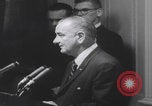
Lyndon B. Johnson speech on Vietnam War; scenes from World War II and Korean War
United States President Lyndon B. Johnson delivers a speech at a news conference in July 28, 1965 during the Vietnam War. President Johnson quotes a letter from a woman in the Midwest, "Dear Mr. President: In my humble way I am writing to you about the crisis in Vietnam. I have a son who is now in Vietnam. My husband served in World War II. Our country was at war, but now, this time, it's just something that I don’t understand. Why?”. United States Army soldiers in a Vietnamese jungle. A crying Vietnamese child. A man sits in front of a fire in the middle of a ruined house. Fascist leaders Adolf Hitler and Benito Mussolini during a parade in Munich, Germany. Flags of Nazi Germany and the United Kingdom. British Prime Minister Neville Chamberlain disembarks from in Munich for the Munich agreement. Nazi German guards turn their heads in unison. Adolf Hitler and Neville Chamberlain walk together. Crowd civilians perform the Nazi salute. Hitler and Mussolini in balcony. Neville Chamberlain reads the “Peace For Our Time” speech. “We regard the agreement signed last night and the Anglo-German Naval Agreement as symbolic of the desire of our two peoples never to go to war with one another again” Chamberlain said before smiling. Ruins of a bombarded city in Europe during World War II. Mussolini gesturing strongly during a speech. Cavalry soldiers on horseback in Ethiopia. Royal Italian Army fighting in Ethiopia during the Second Italo-Ethiopian War. Italian soldiers firing with a Fiat-Revelli M14 machine gun and advancing in field. Emperor Haile Selassie I of Ethiopia protests Italian aggression in the League of Nations. A stylized Nazi eagle statue in Austria. Austrian soldiers during the German Anschluss of 1938. Hitler and Austrian politicians perform the Nazi salute in Vienna. Explosions from night bombardment during the Korean War. Communist Chinese People's Liberation Army troops firing with Chinese Type 24 Maxim Water-Cooled Machine Gun and rifles in Korea. Soldiers’ feet climb and jump up uneven terrain in the battlefield. United States Army M46 Patton tanks pointing upwards and firing at enemy positions. An M46 Patton tank and trucks of the United Nations Forces crossing the 38th parallel line in Korea. Sign denotes the 38th parallel line. President Johnson continues his speech at the White House. “Why must young Americans, born into a land exultant with hope and with golden promise, toil and suffer and sometimes die in such a remote and distant place? The answer, like the war itself, is not an easy one, but it echoes clearly from the painful lessons of half a century. Three times in my lifetime, in two World Wars and in Korea, Americans have gone to far lands to fight for freedom. We have learned at a terrible and a brutal cost that retreat does not bring safety and weakness does not bring peace. It is this lesson that has brought us to Vietnam.” President Johnson said.
CRITICALPAST.COM: About Us | Contact Us | FAQs - How to Order | License Agreement | My Account | My Lightboxes | Shopping Cart | Advanced Search | Featured Collections | Website Terms & Conditions | Privacy Policy ©2026 CriticalPast LLC.
License Agreement |
Terms & Conditions |
Privacy Policy
©2026 CriticalPast LLC.