


 Francais
 Deutsch
 Italiano
Refine Your Search
Ohio-State-football stock footage and images
- Showing 12277 to 12282 of 24492 results more
more Hide
Hide
U.S. Army Quartermaster Corps overseas supply from port of debarkations to division distributing points in the U.S.
United States Army Quartermaster Corps overseas supply procedure in the United States. A pictorial representation of Quartermaster Corps overseas supplies reaching a port of debarkation. Quartermaster Corps unload supplies from a ship. A crane carrying loads of supplies at the port. A pictorial representation of Quartermaster Corps running the system of supply through communication zone to combat zone. Quartermaster Corps in a combat zone. The corps in a line beside a truck. The U.S. Army soldiers line up to take a shower. A train moving on a track. Trucks moving on a road. Boxes of supplies waiting to be picked up. The corps standing beside the boxes. Representation of a base depot near a port of debarkation where more perishable items are stored. Meat hung in the depot. An open air depot where less perishable items are stored. Stacks of materials in the depot. A truck moving away from the area. A pictorial representation of supplies being taken by rail, truck or boat from base depots to advance depots. Dummy depots to confuse enemy aircraft. Pictorial representation of supplies being taken from advance depots to regulating stations to maintain the regularity of supplies to combat divisions. Rail cars moving on a rail track and people in view. Representation of supplies being moved to a rail head. The supplies are moved from the rail head to the combat zone and by trucks to division distributing points. (World War II period).
Reconnaissance photographs showing Russian Beagle bombers and missiles in Cuba during the Cuban Missile Crisis of 1962.
Events held in the United States during the Cuban Missile Crisis of October 1962 when the United States and the Soviet Union confronted each other with nuclear destruction. A sign reads 'Shooter'. Seattle fair closes. A poster regarding the sale of elephants. A girl walks with a baby elephant. U.S. President John F. Kennedy resumes pre-election touring. He boards an aircraft. President Kennedy and Soviet Foreign Minister Andrei Gromyko talk to each other. President Kennedy in the back of a limousine with advisors. Reconnaissance photographs showing Russian Beagle bombers and missiles in Cuba. A map depicts the range of Russian missiles.
Fallout shelters are set up and supermarket shelves are stripped by people in the U.S. during the Cuban Missile Crisis of 1962.
Events in the United States during the Cuban Missile Crisis of October 16, 1962 when the United States and the Soviet Union confronted each other with nuclear destruction over Soviet missile positions in Cuba. A sign reads 'Fallout Shelter'. Supermarket food store shelves stripped by people eager to stock rations in case of nuclear war. Queues and lines at grocery checkouts as shoppers stock up.
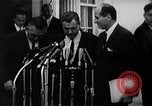
Governor Rockefeller addresses people in the U.S. and says that they should follow instructions in civil defense bulletin.
Events held in the United States during the Cuban Missile Crisis of October 1962 when the United States and the Soviet Union confronted each other with nuclear destruction. Governor of New York Nelson Rockefeller speaks into a microphone. Governor of Washington Albert Rosellini stands near Rockerfeller. Rockerfeller says that people should follow all instructions in civil defense bulletin available at civil defense offices throughout the nation.
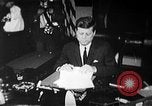
In the US, President Kennedy receives a message from Soviet Premier Khrushchev about dismantling of missiles in Cuba.
Events in the United States during the Cuban Missile Crisis of October 1962 when the United States and the Soviet Union confronted each other with nuclear destruction. U.S. President John Kennedy signs a quarantine order. U.S. Air Force B-52 Stratofortress bombers take off. U.S. Air Force interceptors and fighters take off from U.S. aircraft carriers at sea. Radar dishes moving. A U.S. battleship underway at sea. A U.S. aircraft intercepts a Soviet tanker and allows it to proceed. U.S. reconnaissance aircraft over Cuba. U.S. Air Force SAC (Strategic Air Command) bombers are prepared for a take off. U.S. missiles are prepared. Head Quarters of American Air Defense Command shows interiors of a control room. People wait for news. Exteriors of the White House in Washington DC. Exterior of the Kremlin in Moscow, Soviet Union. A press announcement about a message that President Kennedy has received from Soviet Premier Khrushchev saying that he will dismantle missiles in Cuba.
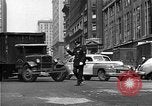
Views of U.S. city centers and industrial manufacturing facilities that are potential targets in the event of war
A police officer directing traffic on crowded street in New York City. Pedestrians and shoppers crowd sidewalks at a corner of 5th Avenue. City of Chicago. View of Michigan Avenue, at the Art Institute of Chicago. Busy area with trolley cars, traffic, and pedestrians at West Madison and State streets. Pedestrians crossing Madison Street. A newsstand at the corner. Elevated rail train in the Loop area of Chicago. Foot of a bridge with center lanes and turnaround reserved for trolley cars. At a level below, several World War II era airplanes are on display. Fiery displays created by molten steel being poured in a steel plant. An overhead crane moves a heavy glowing ingot of steel. Steel fabrication operations in a manufacturing plant. Views of various manufacturing operations in the United States. Men and women workers in manufacturing and production assembly lines. These scenes represent potential targets in the event of war, during the cold war.
CRITICALPAST.COM: About Us | Contact Us | FAQs - How to Order | License Agreement | My Account | My Lightboxes | Shopping Cart | Advanced Search | Featured Collections | Website Terms & Conditions | Privacy Policy ©2026 CriticalPast LLC.
License Agreement |
Terms & Conditions |
Privacy Policy
©2026 CriticalPast LLC.