


 Francais
 Deutsch
 Italiano
Refine Your Search
Ohio-State-football stock footage and images
- Showing 12529 to 12534 of 24492 results more
more Hide
Hide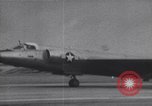
The Cuban Missile Crisis. The Limited Nuclear Test Ban Treaty.
October, 1962, U.S. Air Force U-2 reconnaissance aircraft, tail number 56-6707, of the Strategic Air Command (SAC) 4080th Strategic Reconnaissance Wing, lands at Laughlin Air Force Base, Texas. View of Photographic evidence, brought back by the U-2, showing Soviet missiles being set up in Cuba. President John F. kennedy broadcasts to the nation about the crisis on October 22, 1962, announcing measures being taken by the USA to address the situation. A B-58 Hustler bomber landing. Airmen removing camera from nose of a reconnaissance aircraft. Air Force Sergeant, photo interpreter, reading wet film in a base laboratory. U.S. Naval officers and sailors in Command Center viewing large wall map of the world. U.S. Air Force SAC B-52 bombers taking off. View of United Nations Headquarters building in New York City. On October 25, 1962, U.S. Ambassador to the UN, Adlai Stevenson, confronts Soviet Ambassador Valerian Alexandrovich Zorin about missiles in Cuba.He looks at Zorin, and says,"Don't wait for the translation, yes, or no." Zorin smiles as the room fills with laughter. He then responds. View of a Soviet ship bound for Cuba being monitored by a U.S. aircraft overhead. Pilot in cockpit of the aircraft. View from U.S. aircraft flying low past a Soviet ship. Crew in cockpit of the aircraft. Soviet ships turning away. Helicopter flying over sandy beach area of Hyannis Port, Massachusetts. The helicopter parked and Undersecretary of State, Averell Harriman, steps from the helicopter and is later seen with President Kennedy, and Secretary of State, Dean Rusk, at the President's Weekend White House. Harriman reports on the successful negotiation of a limited nuclear test ban treaty. Glimpse of Moscow. U.S. Secretary of State, Dean Rusk, Soviet Foreign Minister,Andrei Gromyko, and British Foreign secretary, Alexander Douglas-Home, are seen signing the document for their respective nations, August 5, 1963.
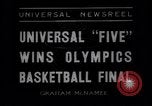
Universal Pictures beats McPherson Globe Refiners in basketball to win Olympics final in New York City
A newsreel titled "Universal five wins Olympics basketball final" shows a game between the company team from Universal Pictures and the McPherson Globe Refiners from Globe Oil and Refining Co. of McPherson, Kansas. The McPherson team is sometimes also referred to as the Oilers, or the Refiners. The teams are seen playing in the Olympics Qualifying basketball final in New York's Madison Square Garden. People cheer the two teams. Universal defeats the McPherson Globe Refiners to win the Olympics final. The win entitled the Universal Pictures team to name 7 players to the Olympic basketball team representing the United States in the 1936 Olympics held in Berlin Germany, and McPherson Globe Refiners was able to name 6 players to the team. These two teams beat out five U.S. college teams to earn the spots in the final and determine the makeup of the U.S. Olympic Basketball team. Players in the game in this video clip include Globe Refiners forward Francis Johnson, Centers Willard Schmidt and Joe Fortenberry, and Universal forward Carl Knowles. Universal beat the Globe Refiners by a score of 44 to 43. According to a Time Magazine article of April 13, 1936, the Globe Oil & Refining team, "...have perfected a technique called dunking with which they score by jumping up above the basket, dropping the ball into it." This may be one of the earliest references to dunking, now a staple technique in basketball. The same Time article further stated of the Oilers, "On the defense, they prevent opponents from scoring by batting the ball out of the basket." Again, the Globe Refiners were demonstrating play that later became standard in modern basketball. The idea for the Globe Refiners was a company promotion scheme, thought up in 1934 by Gene Johnson, the Sales Manager of Globe Oil who had several years experience coaching basketball. The Olympic team also included Washington State Huskey player Ralph Bishop. The USA went on to win the gold, defeating Canada 19-8.

Soviet Union mobilizes to defend against German invasion in June, 1941, World War II
A film titled ' Our Russian front. It shows Soviet Russia's state of preparedness and national mobilization at the time of the German invasion (Operation Barbarossa) in 1941, during World War 2. Soviet troops on parade in Red Square, Moscow, carrying Tokarev SVT-40 semi-automatic assault rifles, with curved magazines and fixed bayonets. Glimpse of a Soviet heavy gun (possibly 152mm howitzer). A Soviet Navy gunboat speeding toward the camera. A formation of Polikarpov I-16 aircraft inflight overhead. Several views of soviet forces, including units composed entirely of women; Closeups of troops, some holding Russian RPD 7.62 cal m44 light machine guns. A Soviet T-26 speeding in Red Square with flag flying, during a parade. View from the rear of a line of Soviet Zvezda BT-7 light tanks being deployed along a dirt road. Russian civilians, most of them women, work digging hillside fortifications. Closeup of woman with small boy in her arms. Views of destroyed buildings and dead civilians in a Russian town Aerial view of bombs bursting on Russian city. Smoke rising from resulting fires. Several views of light flashes from artillery firing at night. American envoy, W. Averell Harriman, participant in the U.S.-British military mission to Moscow, broadcasts about Soviet determination to defend against the Nazi invasion, at all costs. He refers to Soviet mechanics assembling American aircraft (Provided under "Lend Lease"). Narrator identifies Harriman as Chairman of the Board of Union Pacific Railroad. View of Russian airplanes in formation, flying high above the State Museum building in Red Square, Moscow. An American Government aircraft (C-47 /DC-3) aircraft lands at Moscow Airport. View of the aircraft parked and surrounded by a large crowd of military and diplomatic attendees. Harriman steps from the plane. Next he is seen with British Lord Beaverbrook and Soviet diplomat, Andrey Yanuaryevich Vyshinsky. Another view of Russian aircraft flying over the State museum in Red Square. U.S. President Franklin D. Roosevelt (unseen) is heard in the background extolling the Russian efforts against the Nazis. Soviet Tupolev SB bombers in formation overhead. Flags waving Aerial view of a formation of Polikarpov I-16 aircraft in flight. A Komintern Artillery Tractor,carrying Soviet soldiers, tows a 152mm field howitzer. A formation of army vehicles carrying Russian troops along paths already formed in the dirt by prior tracked vehicles. Seen are Komintern Artillery Tractors and ordinary army trucks.
President Eisenhower speaks at Press Conference in White House in 1956.
View of newsmen seated and cameramen at a press conference. President Eisenhower enters the conference room. Journalist asks him questions regarding violence resulting from "Segregation Issues" (racial segregation) as schools reopen after the summer in the United States, under desegregation orders. President replies how local governments need to enforce the laws including federal law, and that the United States of America is ready to help. Journalists writing in notepads. Close view of President speaking. President is asked what he would say to young people who are responsible for unrest and tension during desegregation. The President states that it is difficult through law and courts to change the hearts of people. He advises people to explore the issues, and that we need to "bring about a change in spirit, so that extremists on both sides do not defeat what we know to be a reasonable and logical conclusion of this whole affair, which is recognition of the equality of man." He says the south is full of people of good will, but that we only hear from others in the south who are full of prejudice and who resort to violence, and the same way on the other side with people who want to have the whole matter settled today. President Eisenhower says of desegregation, "this is a question of leading, and training, and teaching people and it takes some time."
Jubilation Day as Alaska hails Statehood
Alaska hails approval of its Statehood. Alaska wins approval to become the nation's 49th State. Cars seen on the street in Anchorage. A sign reads 'Anchorage-All-America city'. Newspaper headlines read 'We're in'. Children sit with a banner reading '49th State'. A huge star placed on the U.S. flag by a woman who is helped by a fireman. Young women in a convertible celebrate as they pass by Stolt Electric at 1000 East Forth Avenue as wells as Hub Clothing in Anchorage. A man with a stuffed moose with a sign on it that reads, 'Hey Texas, now I'm the biggest bull.' Crowd gathers to watch a bonfire built by Boy Scouts. Sign reads, 'State of Alaska'
German Operation Barbarossa on the Eastern front in World War II.
View of the city, Pskov, on the Veilakaya river. A steel bridge is seen and city across it with smoke rising. German troops march in loose formation over a bridge in Novogorod. Views of German camouflaged tank (with shrubbery) and other armor and troops entering Soviet cities of Brest-litovsk, Minsk, Mogilev, and Vitebsk. View of German Panzer III tank heading toward the camera as it enters a narrow street in Smolensk. Animated map shows progress of these German advances and highlights German forces under German Field Marshal Gerd Von Runstedt cutting deep into the Ukraine. Headline on Chicago Daily News reads: "Nazis Claim Knock-out Victory" with subtitle line reading,"Moscow line cracks." Other newspapers reflect conviction that Soviet forces face imminent defeat by Germany. Slate shows communique issued by the German High Command, stating: "The issue in the East has already been settled. Smolensk is the last halt on the road to Moscow." More views of marching German troops. A battery of Soviet artillery firing from a snow-covered field. Animated map shows German forces moving close to Moscow. Foreign diplomats are moved from Moscow to the city of Kuibyshev. Hitler speaking on October 3, 1941, saying "This enemy is broken and will never rise again." Animated map depicts 500 thousand square miles of Soviet territory occupied by December, 1941, and compares it to the entire west central United States encompassing the states of : South Dakota, Iowa, Nebraska, Kansas, Missouri, and Oklahoma. Fires raging in agricultural area of the Soviet Union. Destroyed Soviet industrial plants, and huge numbers of Soviet citizens under German occupation. Views of destroyed Soviet armor, aircraft and artillery pieces. As season changes, German forces are seen in rain gear moving slowly through cold rainy weather. Some walk beside horses and other ride on horse-drawn caissons along with artillery pieces. Segments of film show contrast between the German military strategies. The German forces would plunge deep into enemy territory and create an area of conquest. This is illustrated by a slate bearing Adolf Hitler's statement that, "A single blow must destroy the enemy, without regard for losses, a gigantic destroying blow." An animated map illustrates the success of this approach by the Germans in Poland, France, and the Balkans. German Generals seen planning the same "Blitz" strategy against the Soviets. Film shifts to the Soviet strategy, showing their idea of building stronger defense, as they fall back, taking advantage of the great size of their territory. Views of Soviet troops on the move. View of Shells knocking out a German tanks. Panzer III tanks advancing. Panzer VI tanks completely covered by German troops catching rides. Soviet field artillery and machine guns firing in cities, forcing German soldiers to leave their vehicles. Soviet cities bombed out and burning, with debris and obstacles limiting the ability of armor to navigate in them. Montage of battle scenes cities of Rostov, Kharkov, Kiev, Kursk, Smolensk, all thwarting the Nazi blitz into the Soviet Union. Battles being waged in cities. (World War II; WW II; World War 2; World War Two)
CRITICALPAST.COM: About Us | Contact Us | FAQs - How to Order | License Agreement | My Account | My Lightboxes | Shopping Cart | Advanced Search | Featured Collections | Website Terms & Conditions | Privacy Policy ©2026 CriticalPast LLC.
License Agreement |
Terms & Conditions |
Privacy Policy
©2026 CriticalPast LLC.