


 Francais
 Deutsch
 Italiano
Refine Your Search
Ohio-State-football stock footage and images
- Showing 12781 to 12786 of 24492 results more
more Hide
Hide
Tactics of the 3rd Fleet and 7th Fleet in the naval battles and Japanese planes attack over U.S. carriers in Philippine sea.
Naval battle of Philippines between the United States and Japanese Imperial Navy. Animated diagrams show tactics of the 3rd Fleet and 7th Fleet in the naval battles on the Philippine (October 23-24, 29). Southern American unit destroys the battleships. Explains maneuvers employed in the Surigao and San Bernardino Straits. Shows Japanese planes attacking ships and being drowned. The carrier Princeton is damaged and sunk. Large smoke rises from carrier Princeton. American carriers are damaged. Several U.S. planes make crash landings on a carrier. United States Navy ace Commander Captain David S. Mc Campbell lands. He exits the cockpit and is greeted. (World War II period).
U.S. Air Force Colonel Catledge speaks about his routine activities and his combat mission at Bien Hoa Air Base in Vietnam.
United States Air Force Colonel Richard C Catledge speaks about his routine activities at Bien Hoa Air Base in Vietnam. He speaks about his activities and his combat mission in seven days operation. He states that he usually visits the maintenance, supply and alert facility. (Vietnam War period).
Various scenes showing Tokyo streets, Torii gates, festivals and a courtier looking at scroll in Japan
Map of North America and the United States, with a white outline for the United States border. Map of the Empire of Japan, including the Korean peninsula and Taiwan, and its borders in white. View of a lake with Mount Fuji. A train on top of Manseibashi bridge (1-1 Sotokanda, Chiyoda City, Tokyo 101-0021, Japan). Trams, vehicles, and bicycles in downtown Tokyo (likely Ginza or Marunouchi). A white Torii gate inside a Shinto shrine. People visit a Shinto shrine during spring. Japanese performers perform with fans on a Danjiri shrine cart during the Kishiwada Danjiri Festival in Osaka. Smokestacks in an industrial town. A wooden Torii gate. Japanese children flying a kite. A Buddhist monk blows a horn while deer graze in Nara. Spanish conquistadors and Japanese samurais ride horses. 18th century British woodcut showing metal tools and blacksmiths at work. 18th century prints showing European peasants working in a mill and horses in a grinding machine. A Japanese courtier opens and looks at a scroll with illustrations.

Cotton industry and urbanization in Japan
Cotton production, transport, and urbanization in Japan. Shipment of raw cotton from the United States are unloaded from a freighter on a Japanese port. Dock worker pulls lever. The package is offloaded from the ship. Various machines process United States cotton in Japanese factories. OSK Line ship Naruto Maru sailing in New York City. The captain of the Naruto Maru stands beside the Japanese flag. The urbanization of Japanese cities. Overcrowded houses and slum areas because of industrialization in Japan. Vehicles move on the road in a Japanese city.
Allied troops capture Myitkyina, Burma, and Japanese 15th and 33rd Divisions counterattack British Forces at Imphal in India (WW2)
At opening, film shows U.S. Army Air Forces Bell P-39 Bell Air Cobra aircraft dropping bombs on on Japanese held northern airfield of Myitkyina, which was later captured by the 3rd Battalion Merrill's on July 26, 1944. Aerial view from U.S. aircraft bombing the Japanese occupied city of Myitkyina, on the west bank of the Ayeyarwady River, in Burma. Heavy smoke rising from bombs striking targets at the river's edge. (Narrator states, "the siege lasted 78 days.") Next, a regiment of Merrill's Marauders marches unopposed into the city. Animated map shows Japanese forces (15th and 33rd Division troops) attacking British-held town of Imphal, Burma. Ensuing scenes show well entrenched British forces in battle, with British soldiers firing heavy artillery, mortars, and Vickers machine guns. Glimpse of shells striking in hills. Momentary glimpse of Allied aircraft above the hills. (Narrator states the British "chewed up a couple of Jap divisions"," and the Allied rear lines of communication remained secure.) Animated map shows Chinese forces attacking Japanese forces west of the Salween River. View from a high position above the river bank. Rubber rafts line the shore and troops are assembling on the land. Next, troops are seen wading neck deep crossing the river with supplies floating along with them. Some paddle a jeep across the river on a makeshift raft. A truck at the edge of the river. Soldiers pulling together on a long rope line. Others crossing with hands on a line to support them as they wade in the water. Trucks bogging down in deep mud are helped by tow lines to others, ahead. Troops in a village where the road is inundated by rain waters flowing across it as a jeep goes past. Vehicles of all kinds sidelined by flooding waters. Jeeps speeding through water in some places and moving very slowly in the center of a muddy road where troops make their way on either side. Chinese soldiers scaling the stone wall of a fortress using ladders they made for the purpose. Troops firing a small artillery field piece and then charging towards battle-damaged buildings. Several are seen using flame throwers, that set building afire. More views of Chinese soldiers firing artillery and heavy machine guns. (World War II period)
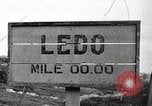
Construction and completion of the Ledo Road from India to China during World War II
Film opens showing road sign reading: "LEDO Mile 00.00." Scene shifts to rail lines at terminus of the Assam-Bengal railroad in the Indian Province of Assam. Surveyors are seen working in jungles. Engineers use machetes and construction machinery, like caterpillar tractors, to cut through the dense growth. Others saw and chop down trees and use explosives to clear the land. Explosives are seen detonating and tractors clearing the debris. Earth moving equipment and jack hammers being used to form a roadbed. View of two engineers setting and detonating a charge in a rock. A steam shovel loads earth into a dump truck. Road scrapers work in parallel to smooth the dirt roadbed. View of road after monsoon rains reduced one roadbed to a sea of mud and another inundated by water. To avoid these problems, rebuilding efforts begin by construction of causeways and bridges. Teams of workers lay planks for this. Closeup of worker tightening a clamp on a pontoon bridge under construction. Work gangs rolling and placing heavy logs as part of a bridge. Workers use a crane to lift segment onto a steel bridge under construction. Men bulding wooden and steel truss bridges. Aerial views from an airplane flying over various sections of the finished Ledo Road. A truck covered by a painted canvas reading: First Convoy over the Ledo Road, Pick's Pike Lifeline from India to China." Brigadier General Lewis A. Pick, Chief Engineer for the project, is seen, next, shaking hands with Lieutenant General Daniel Isom Sultan, Commander India-Burma theater, as he prepares to lead the convoy. View of the convoy starting out, led by the decorated truck. (Narrator states the road was now called, "The Stillwell Road." Views of the trucks proceeding and crossing causeways and bridges. Aerial view of the road twisting and turning across the high mountains. The convoy arriving in Kunming China greeted by Chinese troops and flags. Later, the convoy drives through the city streets of Kunming, with General Pick standing in a jeep, leading the way, and crowds of Chinese people cheering from the sidelines. In final scene, General Sultan states that the next project is a pipeline along the road.
CRITICALPAST.COM: About Us | Contact Us | FAQs - How to Order | License Agreement | My Account | My Lightboxes | Shopping Cart | Advanced Search | Featured Collections | Website Terms & Conditions | Privacy Policy ©2026 CriticalPast LLC.
License Agreement |
Terms & Conditions |
Privacy Policy
©2026 CriticalPast LLC.