


 Francais
 Deutsch
 Italiano
Refine Your Search
Ohio-State-football stock footage and images
- Showing 12835 to 12840 of 24492 results more
more Hide
Hide
1951 Ford sedan being tested by machines, on test track, driving in the desert, and driven by mother with children.
Commercial advertisement for the new 1951 Ford Sedan automobile. Setting is a suburban neighborhood post-war. Front yard and suburban house. Woman leaves a house with her children. They all get into their 1951 Ford Custom Fordor sedan automobile. The children bounce on the car seat. View of Ford car seat springs tested by an automatic machine at Dearborn test facility. A car door hooked up to motor which continuously slams and opens the door. Car on the Dearborn Michigan test track, replica of Independence Hall in the background. Test car goes over steep hill, and cobble stones. The 1951 Ford is then seen in the Southwest United States, on a mountain road and a desert road. Label on side of car reads, 'Ford Test Car' View of speedometer. The new car arrives at an amusement park. Children get out of the car and run towards a merry-go-round. Ford emblem on front of car. Narrator stating "You can pay more, but you can't buy better."
View of banks, church, public park, Belle Isle, busy streets and Bob-Lo steamship SS Columbia leaving dock in Detroit, Michigan
In Detroit Financial District, people in front of First State Bank Building at 751 Griswold at Lafayette in Detroit, Michigan. (The building was designed by Albert Kahn and Corrado Parducci, and later housed the Olde Discount Corporation). Interior of First State Bank Building, Detroit. Street view of First National Building under construction at 660 Woodward Avenue in Detroit (for First National Bank and other tenants). Automobile traffic on streets of Detroit. People leave Sweetest Heart of Mary, Roman Catholic Church, located on Russell Street at the corner of East Canfield avenue, in a historic Polish parish. (The neighborhood at the time was predominantely Polish.) In the distance is another Polish parish and Saint Josaphat Church located on East Canfield at the corner of Hastings Street (which is now the I 75 freeway). Heavy traffic on a main boulevard. Children play in playground on swings and slides. People and pigeons in a park. Heavy traffic on a street. Large crowd on shore and others in canoes in water at Belle Isle. Crowd streams through gate at dock to board the steamship ferry "Columbia" of the Detroit, Belle Isle and Windsor Ferry Company, with sign "Bob-Lo Route" on the side. Boblo Steamship SS Columbia (designed by Frank Kirby) filled with passengers underway on the Detroit River bound for Bob-Lo Island in Ontario Canada.
Allied troops take over Algiers in Algeria, North Africa during Operation Torch, in World War 2.
World War II Allied naval convoy underway in harbor under protection of barrage balloons in Algeria, North Africa. Allied troops disembark a troop's transport ship at a dock. Troops and equipment are unloaded at the dock and British and American forces take over Algeria with little resistance. Allied bombers take off from an airfield. Bombs seen detaching from open bomb bay doors of Allied aircraft in flight, and bombs away view as bombs are dropped from a high Altitude. B-25 aircraft in formation bomb Nazi German General Rommel's Afrika Korps in Libya. British artillery guns fired and Eighth Army moves forward pursuing German enemy. Heavy smoke rises from shell hits. British infantry leave trench protection and run forward on battlefield to engage German enemy. Dramatic scene as large explosion causes the British soldiers to drop to the ground while advancing. British tanks and infantrymen advance past wreckage and burning German aircraft and armor. British General Field Marshal Bernard Montgomery seen with his advancing forces. Italian Army prisoners surrender under British protection. In city of Algiers, captured German officers and members of German Armistice Commission taken away by U.S. soldiers and Italian and German visitors and members of Axis Spain Fifth Column are rounded up in the city for internment. U.S. troops march on city streets. French and Algerian natives cheer for the United States and British allied troops that have taken over. United States troops decorated by General Mark Clark. Scene changes to aerial view of Italy. Cloud cover over the city. Bombs dropped over Italian targets by British and American bomber aircraft. View of explosions on ground and smoke.
U.S. Army operations in Vietnam which is at war with Buddhist majority and Viet Cong communists.
Vietnamese government faces Vietnam war on two fronts from Buddhist majority and Viet Cong communists. The war is joined by a large number of students who take to the streets. The capital Saigon tuned into an armed camp. Barricades on roads as the army keeps a vigil among the public. A military tank in the city. A mass meeting called by President Diem's regime on the roads of Saigon. Numerous students and supporters gathered in the streets. Banners and posters in support of President Diem. The President makes a rare and brief appearance at the meeting. He inspects the Honor Guard. Madam Nhu and her husband, head of the secret police seen standing with children. Madam Nhu gives marathon interviews stating her views against the United States and President John F Kennedy. Ton That Dinh, Military Governer of Saigon at a press conference blaming foreign interventionists for the riots in Vietnam. Henry Cabot Lodge takes over as U.S. Ambassador to Vietnam. Ambassador gives a statement to the media. He demands the ousting of President Diem's brother Nhu in order to continue American aid to Vietnam. U.S. soldiers known as advisors stand beside a U.S. Army helicopter as they plan their strategy. U.S. Army helicopters in a marshy swamp. Soldiers board the helicopters as they take off. The helicopters with U.S. and South Vietnam troops approach the Ca Mau Peninsula. A view of the village taken over by the Viet Cong Red Guerilla Band. Damaged houses near the water body. A helicopter down in a rice paddy. U.S. soldiers run to the safety of other helicopters as Communist Vietcong snipers begin shooting. U.S. soldiers take cover behind the crashed helicopter. An American soldier running to safety in the water. A village set on fire by North Vietnamese Communists in the Mekong Delta. View of wiped out villages.
European Relief Council feeds starving children of war effected countries in Europe.
United States' European Relief Council (ERC) along with other American relief organizations feeds starving children in war effected countries of Europe, in the period after World War I. The United States contributes $33,000,000 to meet the needs of 3.5 million war affected children. Volunteers distribute food to children. Men and women watch as boys and girls stand in line and wait for their turn, receiving food aid including hot soup or stew. Children sit around a table as they eat and drink from mugs. View of Herbert Hoover, Program Director of the American Relief Administration (and its predecessor the U.S. Food Administration), working on a document urging the American people to help the children in need.
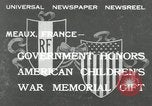
U.S. presents monumental statue, commemorating Battle of the Marne, to people of France.
The scene is on a hill top overlooking the plateau along the Marne River where the Battle of the Marne took place 18 years earlier. The occasion is the presentation, from the people of the United States, of a 130 foot high granite monument, commemorating the heroic defense by French troops in the Battle of the Marne. The monument, designed by Frederick MacMonnies, depicts La Belle France, supporting a wounded French infantryman, and was reportedly underwritten in part, by the contributions of pennies, nickles, and dimes from four million school children in the United States. French and American officials unveil the monument. Numerous spectators stand by to cheer and applaud. Armed soldiers hold national flags and salute in honor. U.S. Ambassador to France, Walter Evans Edge, gives presentation speech, as other dignitaries and people listen. (Note: At the time of this event, this was the largest carved granite monolith monument in the world, and viewed, by many Americans, as a gift of thanks to France for the statue of Liberty.)
CRITICALPAST.COM: About Us | Contact Us | FAQs - How to Order | License Agreement | My Account | My Lightboxes | Shopping Cart | Advanced Search | Featured Collections | Website Terms & Conditions | Privacy Policy ©2026 CriticalPast LLC.
License Agreement |
Terms & Conditions |
Privacy Policy
©2026 CriticalPast LLC.