


 Francais
 Deutsch
 Italiano
Refine Your Search
Ohio-State-football stock footage and images
- Showing 12919 to 12924 of 24492 results more
more Hide
Hide
U.S. Marine Corps, royal family and dignitaries in the burial procession of King Christian X of Denmark in Copenhagen.
Death of King Christian X of Denmark. United States and British warships in Copenhagen harbor with half-mast flags. Danish flags on buildings at half-mast. Burial procession of King leaded by United States Marine Corps. Casket of king in horse drawn carriage, followed by royal family and dignitaries from various countries. Civilians on both sides of roads. Roskilde Cathedral (Domkirkepladsen 3, 4000 Roskilde, Denmark), the location where the burial of King Christian X takes place near his ancestors.
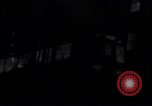
Busy roads with buses and cars, illuminated streets with car lamps and lighting in buildings and shops, in Chicago, Illinois.
Traffic on roads and illuminated buildings in night, in Chicago, Illinois United States. Street cars and buses and cars on roads in downtown area. Buildings and bridges lighted with light poles and illuminated signs. Rain is falling and the streets are wet with rain. People seen gathering in front of the McVickers Theater (25 W Madison St, Chicago, IL 60602, United States). On the theater marquee is advertised the show Man of La Mancha. Shoppers on streets and shop windows with mannequins inside. Illuminated marquee of the historic landmark Balaban and Katz Chicago Theatre.

African Americans Hood and Malone admitted to Univ of Alabama after President Kennedy overrules Governor Wallace's opposition
Newsreel, "African Americans enrolled as Governor Yields." Tight security at the registrar office of the University of Alabama in Tuscaloosa. Governor George Wallace confronts a deputy United States attorney and doesn't allow admission to the University for two African American students- James Hood and Vivian Malone Jones. An officer arrives and talks to Governor Wallace about President Kennedy's integration orders. Governor Wallace bows to Presidential authority and walks out. Students James Hood and Vivian Malone enter the registrar office for registration at the University. United States President John F. Kennedy addresses the nation from White House in Washington DC, regarding civil rights, saying the country is facing moral crisis.
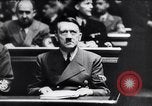
Hitler addresses Reichstag in Berlin, Nazi army advances in Soviet Union, and signing of Atlantic Charter during World War II.
Adolf Hitler addresses the Reichstag in Berlin on December 11, 1941 declaring war operations against the United Kingdom, Soviet Union, and United States. Marshall Hermann Goering, Sharp and other Nazi leaders listen to him. A map shows eastern front with Nazi German Armies advance in Soviet Union. Battle scenes between German and Soviet armies. German soldiers capture a Soviet prisoner of war. German soldiers fire artillery during a battle. View of German tanks advancing and firing on a battlefield. Ruins of a wrecked, smoking Soviet tank. Scene shifts to United States President Franklin Roosevelt and British Prime Minister Sir Winston Churchill at Atlantic Conference aboard ship "Prince of Wales" for signing of Atlantic Charter. The Allied leaders are seen singing "Onward Christian Soldiers" during a service.
Peruvian cadet girls and boys look at radio jeep and C-130A plane of the U.S. Air Force during Andes Airlift in Chiloya, Peru.
C-130A cargo airplanes of the United States Air Force during Andes Airlift of road construction equipment from Chiloya to Bella Vista village in Peru. Peruvian cadet girls gather around a forward control radio jeep watch a CCT serviceman talk operating controls. Cadet girls and boys gathered at the rear of a C-130A plane talk to a United States Air Force flight crewman. Cadets look at the interior of aircraft and girls sit at the pilot and copilot's stations.
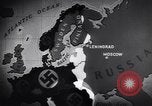
German Operation Barbarossa on the Eastern front in World War II
Animated map shows extent of German controlled areas in Europe following their conquest of the Balkans in World War 2. Norway is under their control and German forces threaten Leningrad and Moscow. A soviet defense line is shown on the map. The German attack is shown to come from 5 directions on June 22, 1941, with the launch of German Operation Barbarossa. A sky filled with German Heinkel He 111 bombers is shown. German Panzer III tanks with 75 mm guns. Army trucks carry German troops into battle. German soldiers on motor cycles and infantry advance under fire. Animated map shows principal German targets as Leningrad, Moscow, and Kiev. It then shows beginning a drive from the North to encircle Leningrad. Arrows show where German Marshal Fedor von Bock's forces drove 480 miles into Soviet territory. Slates identify cities being overrun by German invaders, including: Pskov, Novgorod, Brest-litovsk, Minsk,Mogilev, and Vitebsk. On July 17, 1941, a German tank is seen entering Smolensk, past the Dnieper River threatening Moscow, itself. To the south, German forces, under Marshal Gerd von Rundstedt, cut deep into the Ukraine. Newspapers world-wide consider the Soviet forces close to defeat. Slate shows communique from the German High Command stating: "The issue in the East is already settled. Smolensk is the last halt on the road to Moscow." German infantry marching. Scene shifts to heavy artillery being fired by Soviet forces in a snowy scene clearly later in the year. Animated map shows German forces very close to Moscow on October 15, 1941, forcing the Soviet Government and all foreign missions to move to Kuibyshev, 700 miles to the east. Adolf Hitler, in a speech on October 3, 1941, states that the enemy is broken and will never rise again. Animated map shows 500 thousand square miles of Soviet territory occupied by German forces. Views of fires burning in Russia. Damaged and abandoned Soviet industrial plants. A German guard atop a hill looks down on thousands of Soviet people in the occupied areas of Russia. Damaged and abandoned Soviet T-26 tanks. Glimpse of damaged Soviet aircraft and field artillery. Headline in New York World Telegram newspaper reads: "Berlin Admits Russ War May Last Winter." Another headline reads: "Red Army Holds Push On Moscow." Weary German soldiers traveling in horse-drawn wagons, pulling field artillery. Soviet and German war planners are seen at work. Slate quotes Adolf Hitler saying: "A single blow must destroy the enemy, without regard for losses... A gigantic all-destroying blow." German armor moving along a road. Animated map shows this technique in the German invasions of Poland, France, the Balkans, and Yugoslavia. In contrast, the Soviet planners are seen, as map illustrates how they intend to take advantage of the vast area of their land by holding lines of defense an falling back as necessary to keep engaging the invaders across interior of the Soviet Union. Soviet infantry are seen marching along a road. German troops riding atop their tanks. Soviet troops forcing German invaders into close combat in her cities. Soviet soldiers running in a city and firing heavy machine guns. Bomb damage and rubble inhibit German armor mobility in cities. Cities where this kind of Soviet resistance prevailed were: Rostov, Kharkov, Kiev, Kursk, Smolensk. German troops leaving a city with heavy black smoke rising in the background. More views of cities where Soviet troops are engaged German forces in House-to-house battles, including: Odessa, where the Old Opera Theater building is shown sandbagged and relatively undamaged. The Odessa NI tank, created from an STZ-3 agricultural tractor.
CRITICALPAST.COM: About Us | Contact Us | FAQs - How to Order | License Agreement | My Account | My Lightboxes | Shopping Cart | Advanced Search | Featured Collections | Website Terms & Conditions | Privacy Policy ©2026 CriticalPast LLC.
License Agreement |
Terms & Conditions |
Privacy Policy
©2026 CriticalPast LLC.