


 Francais
 Deutsch
 Italiano
Refine Your Search
Ohio-State-football stock footage and images
- Showing 12967 to 12972 of 24492 results more
more Hide
Hide
Newsreel 'At Gettysburg Ike comments on Khrushchev's visit'
United States President Eisenhower leaves the grounds of Hotel Gettysburg (Gettysburg Hotel, 1 Lincoln Square, Gettysburg, PA 17325, United States). A sign reads 'White House Press Room'. President Eisenhower gets out of the car and enters the Press Room. He talks about Nikita Khrushchev's visit to America. Press men take notes as President Eisenhower speaks. “Now, I would like him to see our great industrial plants and what we are doing. I want him to see a happy people. I want him to see a free people, doing exactly as they choose within the limits of not, that they must not transgress the rights of others” Eisenhower said.
Mrs. Franklin Roosevelt visits bases in South Pacific during World War 2
First lady of United States, Eleanor Roosevelt, visits U.S. Base Hospitals in South Pacific areas including Australia and New Zealand during World War 2. Base hospital's wards are seen including some in thatched huts. Mrs. Roosevelt wearing Red Cross uniform. A soldier seen in a wheel chair. Mrs. Roosevelt waves goodbye to United States soldiers.

Newsreel 'Latest films of war in Italy' shows progress of Allied forces advancing toward Rome in World War 2
United States Army Air Force fighter planes and B-17 bomber aircraft seen in flight, including close-up aerial views looking down on B-17 in flight. Boeing B-17 Flying Fortress “Hustlin Hussy” of the 385th Bomb Group in flight. Views of American bombing on the German supply lines outside of Rome Italy during World War II. U.S. planes bomb railroad marshaling yards near Rome. Allied forces cover the Mediterranean Sea. Explosions seen on ground as filmed from Allied aircraft over head. Fifth United States Army advance from the Anzio beachheads toward Rome. General Mark Clark in aircraft as he inspects the operation via aerial view. Close up views of General Mark Clark after he exits airplane to inspect operations. U.S. 5th Army troops on the ground bombard German positions with mortars and artillery. Explosions seen along German lines. American soldiers seen passing through small bombed-out villages in Italy. The town of Anzio heavily damaged after bombing. Group of Italian refugees greet American troops. German prisoners of war who have surrendered are marched in Italy, including many being marched double time. German prisoners marching, passing by a sign with arrow that reads “Military Police H.Q.”. They are seen being loaded into the same invasion ships that brought the Allied forces to Italy.
The Rise of Japanese militarism in the 20th Century
Film opens showing reenactment of Japanese attack ostensibly against Formosa, in 1894. Japanese troops and artillery are shown. The event is depicted in a critical political cartoon. Next, Japanese Admiral Heihachiro Togo is seen in 1904, standing with other naval officers. Then, Japanese warships are shown, firing barrages of naval gunfire at the Russian fleet in Port Arthur, Manchuria. Huge black clouds arise from burning ships. Scenes of Japanese people celebrating their naval victory. Date shifts to 1910. Cartoon depicts Japanese annexation of Korea. Cartoon illustrates Japanese actions in World War I when, siding with the Allies, Japan acquired the German-held Shandong (Shantung) Peninsula of China, as well as German-held Marianas, Carolines, and Marshalls islands in the Pacific. Japanese representatives are seen participating in Post World War 1 international activities. They signed the so-called Five-Power,Four-Power, and Nine-Power treaties, and participated in the League of Nations. Glimpse of two Japanese officers, followed by cartoon depiction of the Mariana, Caroline, and Marshall Islands, that Japan insisted on keeping. Cartoon shows them being fortified. A Japanese military marching band parades down a city street while being cheered by spectators on the sidewalks. Next, Japanese military General, Baron Tanaka Giichi, is seen in uniform with other officers. Cartoon illustrates the so-called Tanaka Memorial document that Baron Tanaka allegedly presented to the Emperor, in 1927, outlining a strategy to conquer the world. Cartoon then illustrates plan of conquest by acquiring Chinese manpower; Manchurian iron and coal; Siberian timber, coal, wheat, and metals; Tin,oil and rubber from Malaysia and the East Indies. The United States is shown as the last conquest. Views of ordinary farm and factory activities in the U.S. Cars parked in the Ford Motor Company factory lot. Japanese officials and legislators meeting in the Diet (Parliament). Japanese theater patrons and a Japanese woman singing with an American-style band, are shown as examples of activities the Japanese Government sought to discourage. A Japanese female ensemble in traditional dress, playing traditional instruments, is shown as more desirable. Western dancing and western hollywood movies are shown and narrator states they were forbidden by the Japanese government. Japanese movie scene depicts ancient martial arts. A musical production on stage displays German Nazi swastika flag , Japanese rising sun, and symbol of Kingdom of Italy, celebrating the axis alliance. Japanese men are shown playing the ancient game of Chu Shogi, instead of playing Western card games. People are shown in a library, where Western books are replaced by more militaristic tomes, such as: "If we fight" by Admiral Shinsaku Hirata, March 15, 1930 (shown on film slate). Slate goes on to quote about attack on Hawaii as the first battle in war of the Pacific. Film cites another approved Japanese publication: "Arguments Against American Policies" by Kawashima Seichiro, Christmas Day, 1924. It discusses distruction of the American fleet and subsequent landing on the U.S. West Coast.
Thousands of men volunteer for the U.S. Navy in Houston, Texas, after loss of the cruiser, USS Houston, in World War II
Views of the United States Cruiser, USS Houston (CA-30) underway in calm seas. Closeup of her 8-inch guns in triple turrets. A large group of men march at an outdoor ceremony, intended to enlist a thousand men to make up for those lost in the sinking of the USS Houston during the battle of Battle of Sunda Strait, after the battle of Java Sea, in World War 2 (February 1942). A wooden model representing the lost ship is part of the ceremony. It contains words,"Remember the Houston," on its bow. Scene shifts to the Loew's State theater, at 1014 Main Street. A group of U.S. naval officers, in dress whites, stands on a platform in front of the theater marquee. They administer the oath of allegiance to the crowd of volunteers standing in front them, who all raise their right hands as they take the oath. Film closes with view of a Northhampton-class cruiser firing her guns.
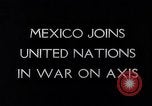
Citizens campaign in Mexico City for Mexico to declare war against the Axis powers in World War II
Thousands of citizens march in Mexico City demonstrating for Mexico to declare war against the Axis powers in World War 2. They converge on the main plaza (Zócalo) where President Manuel Ávila Camacho stands on the balcony of the Presidential Palace, with his wife, Doña Soledad Orozco García de Ávila Camacho, and members of his staff. View from a high point overlooking the plaza, showing thousands massed with the Mexico City Cathedral in the background. Narrator states that citizens protest against axis sinking of unarmed mexican ships. Flags of the United States, and allied flags are displayed. Flags are waved in salute for their dead comrades, by Survors of the SS Potrero del Llano, a Mexican ship torpedoed by the German submarine, U-564, on May 13, 1942. Camera pans over the square filled with people and banners. Next, President Camacho is seen asking the Mexican Chamber of Deputies for a declaration of war. People on the streets (some sitting on street lamps) listen to the broadcast over loudspeakers. Mexican Army soldiers seen in helmets. Uniformed troops line a sidewalk. Deputies applaud after unanimously approving the declaration of war.
CRITICALPAST.COM: About Us | Contact Us | FAQs - How to Order | License Agreement | My Account | My Lightboxes | Shopping Cart | Advanced Search | Featured Collections | Website Terms & Conditions | Privacy Policy ©2026 CriticalPast LLC.
License Agreement |
Terms & Conditions |
Privacy Policy
©2026 CriticalPast LLC.