


 Francais
 Deutsch
 Italiano
Refine Your Search
Ohio-State-football stock footage and images
- Showing 13027 to 13032 of 24492 results more
more Hide
Hide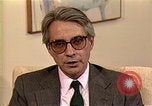
Margret Thatcher, Bettino Craxi, Helmut Kohl and Paul Nitze talk about the Strategic Defense Initiative in Washington DC.
A briefing on the Strategic Defense Initiative in Washington DC. U.S. Assistant Secretary of State European and Canadian Affairs Richard Burt discusses U.S. government policy with regard to the Strategic Defense Initiative. The Prime Minister of the United Kingdom, Margret Thatcher, talks about the SDI ( Strategic Defense Initiative) criteria. The Prime Minister of Italy, Bettino Craxi, talks about the SDI. The Chancellor of West Germany, Helmut Kohl, stands next to U.S. President Ronald Reagan. President Ronald Reagan gives a speech on the Defense Budget. Arms Control Advisor, Paul Nitze, talks about the SDI at a studio. U.S. Secretary of State, George Shultz, talks about the Satellite Weapon System.
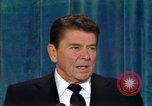
President Ronald Reagan gives a speech on the U.S. Foreign Policy and Arms Reduction Policy in Washington DC.
U.S. President Ronald Reagan's address on U.S. Foreign Policy at the National Press Club in Washington DC. President Reagan proposes mutual United States-Soviet reduction of nuclear weapons in Europe. He also talks about the elimination of the risk of surprise nuclear attacks. The press reporters and the officials listen carefully to the President. The President talks about the Soviet aggression and their ballistic missiles. A chart shows the balance of comparable United States and Soviet Intermediate Range Nuclear Forces. President Ronald Reagan proposes talks with the Soviets on Strategic Arms Reduction Negotiations.
U.S. President Lyndon B. Johnson's receives a warm welcome in Australia during the Manila Summit Conference.
United States President Lyndon B Johnson's visit to Australia during official visit to Asia to attend the SEATO Manila Summit Conference. United States Air Force One presidential aircraft (VC-137C SAM 26000) lands on runway in Australia. Australian Prime Minister Harold Holt welcomes President Johnson and Mrs. Lady Bird Johnson in Melbourne, Australia. Close up of musician blowing an instrument. Honor Guard salutes and band plays. President Johnson waves at the cheering crowd. He places wreath over a grave. Australian soldier with a rifle in hand.
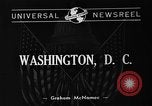
U.S. President Franklin D. Roosevelt addresses the Congress in Washington D.C. on U.S. strategy in war crises.
U.S. President Roosevelt discusses U.S. stance as World War II expands in Europe. U.S. President Franklin D. Roosevelt addresses the Pan American Congress in Washington D.C. He decries the invasion of 3 more independent nations by force of arms: Belgium, Netherlands, Luxembourg. President Roosevelt states that America is shocked by the German attack. State Department and cabinet officials arriving at the White House to discuss U.S. strategy in war crises. Officials converse with each other outside the White House.
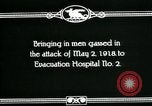
Soldiers affected by a poisonous gas are brought to Evacuation Hospital and advanced field hospital at Vesle Front, France.
A United States Army training film about defense against chemical warfare. U.S. soldiers affected by a poisonous gas in World War I are brought to Evacuation Hospital number 2 after an attack in 1918. United States troops put wounded soldiers on army trucks. Wounded soldiers at the advanced field hospital of the Fourth Division at Vesle Front, France in August 1918. (World War 1. World War I. WWI.)
General Eisenhower greets King George VI at the First Army Headquarters in Verviers, Belgium (WW2)
King George VI of the United Kingdom and United States Army General Dwight D Eisenhower at the First Army Headquarters in Verviers, Belgium during World War II. Lieutenant General C. H. Hodges, General Dwight D. Eisenhower, U.S. Army Lieutenant General Omar N Bradley, and a United States Army Air Force General await the arrival of King George VI. Officers converse with each other and look up at the sky. A sedan drives up to a building. United Kingdom King George VI gets out of the car. He is greeted by General Eisenhower.
CRITICALPAST.COM: About Us | Contact Us | FAQs - How to Order | License Agreement | My Account | My Lightboxes | Shopping Cart | Advanced Search | Featured Collections | Website Terms & Conditions | Privacy Policy ©2026 CriticalPast LLC.
License Agreement |
Terms & Conditions |
Privacy Policy
©2026 CriticalPast LLC.