


 Francais
 Deutsch
 Italiano
Refine Your Search
Ohio-State-football stock footage and images
- Showing 13063 to 13068 of 24492 results more
more Hide
Hide
President Franklin Roosevelt signs Selective Service draft bill of 1940 in Washington DC.
President Franklin Roosevelt in his office in Washington DC. He is seated at his desk and signs the draft bill (Selective Service and Training Act of 1940, or STSA) which was the first peacetime conscription in United States history. Officials and cabinet members standing nearby. Painting on a wall in the background. He reads the conditions of bill. He states that the legislation intended to increase our armed forces becomes law. All men between 21 and 35 must register beginning October 16th, 1940. He says that "the terrible fate of nations whose weakness invited attack is too well known to us all. We must and we will marshal our great potential strength to fend off war from our shores. We must and we will prevent our land from becoming a victim of aggression."
U.S. Senate passes H.R. 1776, Lend Lease Bill. Senate Majority Leader Alben W. Barkley telephones the news to the President.
View of Senate chamber in Washington DC, United States. Senate Majority Leader, Alben W. Barkley, hurries to private phone booth to telephone the news to President Roosevelt. A Senator emerges from the chamber waving newly signed documents passing H.R. 1776 to aid the United States war industry in World War II. Majority Leader, Barkley converses with other Senators. Senator Walter F. George, of Georgia speaking in praise of Lend-Lease, says "We are now ready to forge ahead and to cast the full strength of American industrial power into the struggle against aggression." Non-interventionist Senator Burton K. Wheeler, of Montana, who objects to the Roosevelt administration's lend lease bill, and to direct American involvement in World War 2 in Europe, speaks about continuing the fight to "keep American boys out of the holocaust of Europe's wars."
U.S. President Franklin Roosevelt's "Great Arsenal of Democracy" speech.
President Franklin Roosevelt's address about national security, to the nation from Washington DC. Cameramen set their cameras to broadcast the speech. Roosevelt talks about the prosperity and the security of the nation and that the nation should work together for the preservation of American independence. He states about German intention of invading Europe and then the rest of the world using Europe's resources. He talks about German, Italian and Japanese forces which are engaged in war against other countries. He also states that U.S. fleet is in the Pacific Ocean for the defense of the country.
General MacArthur returns to the Philippines; seen wading ashore.
United States navy fighting the Japanese. Map locates places where General MacArthur has visited. General on the deck of ship accompanied by other officials. He smokes cigar. The Navy bombards Japanese positions on Leyte. Landing craft reach the beaches. General MacArthur and President Osmena wade ashore. United States troops advance on the island. Destroyed buildings in the area due to bombardment. Civilians in tents. U.S. troops along with MacArthur and other officials stand outside a building and the flag hoisting ceremony takes place. (World War II period).
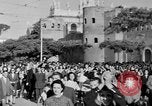
Italians cheer as American soldiers of the 5th Army enter Rome, Italy, during WWII
The United States 5th Army enter Rome, Italy during World War II. Italians fill the streets and cheer for the Americans. Italians gather in front of the Porta San Giovanni (00185 Rome, Metropolitan City of Rome, Italy) near the Archbasilica of Saint John Lateran. Crowds of Italians cheering in front of the Archbasilica of Saint John Lateran. Soldiers on military vehicles, M4 Sherman tanks, trucks and jeeps proceed into the center of Rome, past the Colosseum (Piazza del Colosseo, 1, 00184 Roma RM, Italy) and other ancient structures and landmarks including the Vittoriano and Capidoglio on Capitoline Hill. United States soldiers in truck near the Circus Maximus (Circo Massimo, Via del Circo Massimo, 00186 Roma RM, Italy). Crowds gathered in front of the Altar of the Fatherland (Altare della Patria, Piazza Venezia, 00186 Roma RM, Italy). Men carrying the Italian flag on top of a truck driving in Via del Corso. The American, British and Italian flags hang in front of the Campidoglio. Façade of the Campidoglio (Piazza del Campidoglio, 00186 Roma RM, Italy). Young Italian men and women wave at the camera while marching. Italians hitch a ride with soldiers on a Jeep in front of the Saint Peter’s Basilica (Piazza San Pietro, 00120 Città del Vaticano, Vatican City). Some Italian civilians ride with U.S. soldiers on their trucks. U.S. Lieutenant General Mark Clark consults with two U.S. Major Generals.
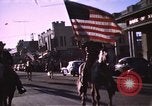
A parade down Fremont Street in Las Vegas Nevada for the crew of the Memphis Belle.
A parade held on the streets of Las Vegas, Nevada, United States. The parade held for the crew of the B-17 "Memphis Belle." Men on horses. A man riding a horse holds a U.S. flag. The crew rides in a jeep in the parade. Landmark buildings in Las Vegas before the "glitter gulch" days are seen, including Bank of Nevada; the Jack Pot Casino with a small amount of neon lighting; the Boulder Club with somewhat more neon lighting; the Apache Lounge, Cafe, and Hotel with its art deco signage at the Corner of Fremont and Second, and the El Portal Theatre at 310 Fremont Street which was the city's first movie theater; a directional arrow sign for the Hotel Sal Sagev (Las Vegas spelled backwards). After the parade on Fremont Street, the crew moves on to Las Vegas Army Airfield (today it is Nellis Air Force Base). They gather on a raised speaker's stand near the nose of the B-17 Memphis Belle. Troops assembled on the airfield, B-17, and crew of the Memphis Belle. The crew is introduced and the Memphis Belle crew members address the gathered soldiers. A United States Army Air Force band plays. A crowd around the Memphis Belle after the ceremonies. (World War II period).
CRITICALPAST.COM: About Us | Contact Us | FAQs - How to Order | License Agreement | My Account | My Lightboxes | Shopping Cart | Advanced Search | Featured Collections | Website Terms & Conditions | Privacy Policy ©2026 CriticalPast LLC.
License Agreement |
Terms & Conditions |
Privacy Policy
©2026 CriticalPast LLC.