


 Francais
 Deutsch
 Italiano
Refine Your Search
Ohio-State-football stock footage and images
- Showing 1423 to 1428 of 24493 results more
more Hide
Hide
Recognition, capabilities and similarities of Japanese Zero fighter plane and United States P-40 Warhawk (WW2)
Recognition and capabilities of Japanese World War II Zero fighter plane. Japanese Mitsubishi A6M Zero in flight. Animated diagram of Zero fighter plane shows its wings, tail and engine. Animated picture of Zero fighter plane and United States P-40 Warhawk. The similarities and differences of both the aircraft is shown. United States P-40 Warhawk in flight. Actor Ronald Reagan dramatizes the experience of mistakenly shooting at a P-40. Officers converse with each other. Pilot looks at pictures of P-40 War Hawk on wall. Airmen discuss the differences and similarities between Japanese Zero fighter plane and the United States P-40 Warhawk. Pilot seated in cockpit of P-40 Warhawk. Airmen ask questions of Ronald Reagan. Pilot Ronald Reagan then takes to the air, correctly identifies a Japanese Zero fighter plane and shoots at it.

United States Army soldiers use sound deception to deceive the German in Film 'Sonic Deception'.
Film 'Sonic Deception' shows the use of sounds to deceive the enemy (sometimes described as the "Ghost Army" in World War 2). Dramatization shows United States troops crossing river in small boats and arriving on beach. They establish beachhead on river bank and defeat German troops located there, having arrived by suprise. Film recounts through actors how a German spy at a German army corps headquarters informs about the presence of United States tanks and trucks. Film demonstrates how sound recordings were used by U.S. soldiers to create false impression of troop activities including bridge building and tank and vehicle movements, in order to serve as a decoy and mislead Germany enemy forces about U.S. Army activities. Dramatization shows German officials consulting and looking at maps. German soldier looks through binoculars and informs officials through phone. Tanks cross a bridge and artillery on field. Actual scenes of front gate of Army Experimental Center station headquarters at Pine Camp in Great Bend, New York (upper New York State). U.S. Army soldiers are shown recording via microphone the sounds of actual bridge construction at the center. The microphone routes to a recording truck where a turntable for pressing recordings is running, creating a phonograph recording of the bridge building decoy sounds. Recording of other sounds is shown, including sound of a bulldozer at work, sounds of men unloading trucks, and sounds of tanks crossing a bridge. Soldier is seen selecting a phonograph record from the Army Experimental Station Library.

United States citizens give isolationist views regarding potential war in Europe; New Deal programs in America in 1930s
The background of World War II. United States citizens state isolationist and anti-war views. They give their views regarding the beginning of war in Europe, and their desire for the United States to stay out of the war. Board reads 'No foreign Entanglements'. View of idle and closed factories during the Great Depression. Ground level, track level view of a railroad train approaching. Elevated view of homeless and unemployed hobo men riding on top of a train car. President Franklin Roosevelt signs Fair Labor Standards Act of 1938 assuring a minimum wage and maximum work week. View of factory workers arriving at a large factory or production plant for a work shift. Newspaper headlines read 'Social Security Laws Go into Effect'. Civilian Conservation Corps (CCC) workers seen hanging telephone lines, digging ditches, and building roads. Aerial view of new highways and clover leaf overpasses.
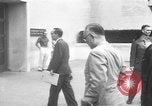
Foreign Minister Shigemitsu Mamoru, of Japan, visits the U.S. State Department, in Washington, DC
Japanese Foreign Minister Shigemitsu Mamoru visits the Department of State in Washington, DC. He enters the State Department Building, walking with a cane, and is greeted. U.S. Secretary of State, John Foster Dulles, meets and converses with him. He also meets with other U.S. officials.
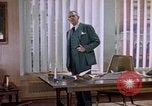
Animated map of Canada and the United States, illustrating North American Air Defense system.
Actor Raymond Massey introducing the subject of North American Air Defense, which is a joint enterprise of Canada and the United States. A map of the United States, Canada and the Arctic. Animation shows radar sites comprising the Dew Line, Mid Canada Line and Pine Tree Line in Canada, as well as coastal and ship borne sites around the United States. Internal U.S. sites tied to the automated SAGE system (Semi Automatic Ground Environment) are shown. SAGE is a computerized control system for tracking and intercepting enemy bombers. The headquarters of NORAD (North American Air Defense) is shown, at Cheyenne Mountain, Colorado. Mr. Massey points out models of new antiaircraft missiles displayed on his desk. Animation shows how these can be fired from the ships at sea.
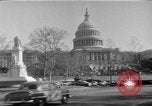
Decline in industry and jobs, and Stock Market crash and start of Great Depression in the United States.
The film 'The Unfinished Revolution' opens by showing people recovering after the Great Depression in the United States. Most scenes circa 1929 - 1931 (but film produced in 1960s). Landmarks in Washington DC: the United States Capitol building with 1940s and 1950s cars and taxi cabs on roads in foreground. View of exterior of Supreme Court building. Closer view of U.S. Capitol and then of the White House in Washington DC. Also the Washington Monument. Scene changes to the American West and a herd of sheep and of cattle grazes on pastures or ranch. Cowboys on horseback herd cattle on a giant field with snow covered mountains in the background. Farmers work in a field picking cotton. Scene changes to New York City with view of Manhattan skyline including Empire State Building, with new skyscrapers in construction in the foreground. View of market area and tenements; push cart vendors lined up on a street in a lower east side New York City neighborhood, and a Ford sedan on the street. Busy New York City streets filled with cars and pedestrians at end of 1920s. Children standing on fire escape in poor downtown area look down over suspended laundry lines between tenement buildings. An officer looks out from small window of a raised booth traffic light as the lights on the booth change color. A Ford automobile assembly line. Engineers work in a factory with minimum wages. A farmer plows a field of potatoes using four horses. A wheat thresher working a field. Trains at a crossing, on a bridge, and coal cars lined up at a coal yard. Busy New York Stock Exchange (NYSE) floor filled with people around time of 1929 stock market crash and start of Great Depression. Frenzied stock market scenes. Board outside a factory reads 'No Men Wanted'. Scenes of silent railroad yards and dormant factories. A man plays an accordian and collects coin donations. Jobless people wait in relief lines, soup kitchen lines, unemployment lines or queues and bread lines. Unemployed and homeless men asleep in public areas.
CRITICALPAST.COM: About Us | Contact Us | FAQs - How to Order | License Agreement | My Account | My Lightboxes | Shopping Cart | Advanced Search | Featured Collections | Website Terms & Conditions | Privacy Policy ©2026 CriticalPast LLC.
License Agreement |
Terms & Conditions |
Privacy Policy
©2026 CriticalPast LLC.