


 Francais
 Deutsch
 Italiano
Refine Your Search
Ohio-State-football stock footage and images
- Showing 14323 to 14328 of 24492 results more
more Hide
Hide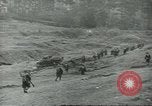
Soldiers fire artillery, advance on a battlefield and take in USO entertainment in World War 2
The United Service Organizations (USO) of the United States during World War 2. Soldiers advance on a battle filed in Europe. Two soldiers fire guns. The soldiers walk on a pier and load supplies in boats. A soldier talks over a field telephone. The soldiers fire field artillery. They walk in a single file. A vehicle moves through a mud pit. The soldiers unload shells from a truck. They carry shells on a snow covered road. Truck moving in deep muddy conditions. The soldiers crawl near a wall. They run on a field. Change of scene to soldiers enjoying USO shows and stage productions. A chrous line group of dancing girls perform. A juggler performs. Three comedians. Soldiers and sailors laugh, applaud, and enjoy the shows.
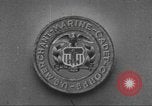
A man applies and receives a courier of his acceptance from the Merchant Marine Cadet Corps in the U.S.
A film titled 'Tomorrow's leaders of the Merchant Marine' shows merchant marine officer candidates in the United States. Sail boats at sea. Seamen operate artillery aboard a ship. The seamen take transfer to another ship. Men aboard a ship. A man applies to the Merchant Marine Academy to become a Merchant Marine Officer. He writes the address of the Merchant Marine Cadet Corps. The man works in his office. His mother receives a courier from the Merchant Marine Cadet Corps. She calls her son. The man reads the news of his acceptance and the order to be present for a physical examination.
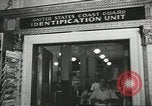
U.S. Coast Guard screens all ships and persons arriving at American ports, docks, and other waterfront installations.
A man seen walking out of doorway marked: "United States Coast Giard Identification Unit." Inside uniformed Coastguardsmen are seen talking with individuals who require access to docks, piers, and other waterfront facilities. Closeup of a Coastguardsman checking the credentials of a man in uniform seeking a pass. Men showing their passes to Coast Guard inspectors as they enter a port. A small work boat tying up to a large ship. Its occupants board the ship and show their passes to uniformed Coastguardsmen. A boat containing a Coast Guard boarding party is seen moving in a harbor. Closeup of officers from U.S. Customs & Immigration; Public Health Service; and Coast Guard , comprising a boatding party.. The officers are seen on the deck of an arriving ship, before she docks. The boarding officer interviews members of the main branches of the crew. (World War II; WW II; World War 2; World War Two)
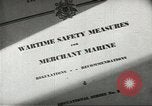
Two U.S. Merchant Marine seamen who survived in life rafts are interviewed by U.S. officials.
Wartime safety measures for United States Merchant seamen. A document reads 'Wartime Safety Measures for Merchant Marine'. Survivors of sinking ships are asked to give suggestions by U.S. officials to improve survival at sea. Two Merchant seamen are interviewed by officials. They share their experience of spending days on a raft after sinking of their ship. Both seamen are shown on a raft floating at sea. They wave to ships passing faraway but ships did not notice them on raft. Officer asks if they had any signaling device on raft. Seaman says they never had any device but they used a tin can as a reflector to signal the ships. An aircraft flies overhead and seaman uses tin can to signal the aircraft and a cutter is sent for rescue. A U.S. Navy officer holds a mirror which is made required equipment on life rafts.
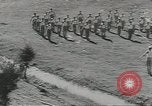
U.S. soldiers exercise and take shower as a troop train stops at a station and prepare to sleep aboard the train in the U.S.
Railroad transportation for military divisions in the United States. Soldiers of the 201st Armored Division exercise in a field as a railroad train stops nearby. They run and take an outdoor shower below an elevated water spout that covers the group. The locomotive train approaches and moves along tracks as seen from low camera position with train approaching. The soldiers play mouth organs. The train moves across a bridge. A man lowers a middle berth. The soldiers prepare to sleep. A soldier gives an order of no smoking. (World War II period).

Material of war being loaded onto vessels and piles of invasion equipment readied in USA and Britain.
War materiel in the United States amassed to serve as D-Day invasion equipment for invasion of France during World War II. At a U.S. port, airplanes are lifted to the decks of ships that are loaded with freight for invasion preparation ports. Materials of war being loaded into vessels. A ship convoy underway at sea. In a British port, piled up material and equipment for invasion armies preparing for war. African American soldiers unload ships. Tires, soap, tobacco, candy and refuse cans. Rolling stock, tanks, gasoline drums, pontoon boats, railroad cars, locomotives, boats, trucks, ambulances, guns and bombs are seen. Rows of gliders, fighter warplanes, and various airplanes are shown parked and ready for shipment. Bomb shells stacked and ready.
CRITICALPAST.COM: About Us | Contact Us | FAQs - How to Order | License Agreement | My Account | My Lightboxes | Shopping Cart | Advanced Search | Featured Collections | Website Terms & Conditions | Privacy Policy ©2026 CriticalPast LLC.
License Agreement |
Terms & Conditions |
Privacy Policy
©2026 CriticalPast LLC.