


 Francais
 Deutsch
 Italiano
Refine Your Search
Ohio-State-football stock footage and images
- Showing 14341 to 14346 of 24492 results more
more Hide
Hide
Firefighters parachute into forests from Ford trimotor airplane. Parachute training in Missoula, Montana
Aerial view of a lookout tower in a forest in United States . A Ford trimotor airplane takes off on a grass field. The airplane in flight and dropping supplies to firefighters, by parachute. Scenes of 1939 experimental tests with firefighters parachuting from a Ford trimotor, near Winthrop, Washington. They can be seen leaving the aircraft, chutes opening, and firefighters descending. Scenes from first operational use of parachuting firefighters, on July 12, 1940, when Smoke Jumpers, Rufus Johnson and Earl Cooley parachuted into the Nez Perce forest , in Idaho, where they successfully extinguished a small fire. Rufus Johnson was the first to jump from the airplane, followed immediately by Earl Cooley. Fire fighters being trained at a parachute training center in Missoula, Montana. Men learn to jump and run over wooden planks. An instructor gives directions to trainees on a loudspeaker. (World War II period).
Various means of bringing water to fight forest fires. Back packs, pumping from streams, truck mounted pumps, and airplanes
Fire fighters using backpack manual pumps to fight forest fire in United States. Water being pumped by gasoline driven pump, from a stream. Water tanks mounted on trucks for use in fighting forest fires. Aerial view looking down on a Douglas O-2 aircraft in flight over forest. 1930s experiments in using aircraft to deliver water to fight a fire. A man carries a 10 gallon water bomb and another one fixes it below the wing of an aircraft.
War veterans being provided employment under the financial rehabilitation benefits provided by the veterans administration, U.S.
United States Veterans Administration's role for the war veterans of World War II. An enactment shows Veterans administrations role in terms of physical and financial rehabilitation of war veterans. A service disabled war veteran being provided technical training to enable him to get a job. War veterans being imparted technical training. A war veteran meets a vocational guidance officer. The officer guides him about the jobs he can take up and puts him through a series of scientific tests. A blind ex- Sargent in his gift shop set up by veterans administrations help under financial rehabilitation measures. A veteran in his home purchased under the financial rehabilitation benefits provided by the veterans administration.
Special U.S. Air Force teams decontaminate crash site of aircraft carrying nuclear weapons.
'Nuclear might ready but safe.' About the safe use of nuclear weapons by the United States Air Force. A nuclear weapon strapped to a trailer, with two armed guards standing nearby. A missile raises up toward launch position. B-52 bombers on a flight line. A B-52 bomber,on ground alert, taxis out for takeoff. B-52 in flight during airborne alert. Remains of a crashed aircraft that carried a nuclear bomb (a "Broken Arrow" event). An Air Force team team looks at the wreckage of the crashed plane in a field as they work to decontaminate the area. The health concerns involve possible local contamination by scattered non-explosive radioactive materials.
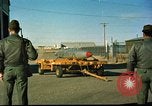
The mechanism of working of a nuclear device and the devices that ensure safety of nuclear weapons in the U.S.
Safe use of nuclear weapons by the United States Air Force. A nuclear bomb on a trailer. a C-119 aircraft takes off in background. An animation shows the nuclear material used in weapons. Fissionable material is surrounded by a layer of high explosives.. Detonators being fired simultaneously at the edges of the high explosives causes implosion that exerts pressure on the fissionable material, causing it to compress into a critical mass that results in nuclear explosion. In an event in which the high explosive, itself, is accidentally ignited, it will burn unevenly, and not provide the uniform circumferential pressure needed to cause the core of nuclear material to compress into a critical mass, even though it may be broken up and scattered.. Various safety features of a nuclear weapon. A battery which provides current, armed switch which controls the flow of current. Thermo fuses which ensure protection against fire. Various mechanical devices like safety pins and wires with seals also ensure safety of nuclear weapons and prevent untimely detonation.
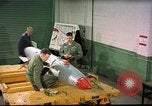
U.S. Air Force personnel handling nuclear weapons.Technicians being examined for reliability
Safe use of nuclear weapons by the United States Air Force. A Sergeant (E4) technician works on a nuclear bomb as a Technical Sergeant (E6) supervisor looks on. A Quality Assurance Evaluator takes notes. The technician reacts angrily after dropping a T304C Continuity Tester and his supervisor corrects him. The technician is then questioned by a doctor to ensure his reliability for a nuclear program. Men around an aircraft as a trailer carries a nuclear bomb near the aircraft. The bomb being attached under the fuselage of the plane. Men work in groups using the two men concept to assure that no individual is ever in a position to arm, launch, or detonate a nuclear weapon.
CRITICALPAST.COM: About Us | Contact Us | FAQs - How to Order | License Agreement | My Account | My Lightboxes | Shopping Cart | Advanced Search | Featured Collections | Website Terms & Conditions | Privacy Policy ©2026 CriticalPast LLC.
License Agreement |
Terms & Conditions |
Privacy Policy
©2026 CriticalPast LLC.