


 Francais
 Deutsch
 Italiano
Refine Your Search
Ohio-State-football stock footage and images
- Showing 1447 to 1452 of 24493 results more
more Hide
Hide
Richard Nixon-Spiro Agnew election campaign stresses reduction of crime in United States.
Richard Nixon-Spiro Agnew election campaign for the office of Presidency in United States. An old woman walks along a wet road at night in United States. She walks alone in the street. She passes by several shops. Lights in the shops. A flower shop on street. A neon sign on a shop reads 'Lido Bello'. She walks in front of buildings with iron gates. Richard Nixon insists on freedom from fear for citizens of United States.
Senator Edward Brooke of Massachusetts talks about Richard Nixon in United States.
Richard Nixon and Spiro Agnew election campaign TV advertisement for the 1968 Presidential campaign in the United States. Senator Edward Brooke of Massachusetts talks to a man about Richard Nixon. They sit in an office. Brooke indicates that he favors Richard Nixon for the Presidential election. Edward Brooke states that Richard Nixon will restore law and order in United States coupled with justice and he will create jobs for the unemployed citizens.
Governor of California Ronald Reagan talks about Richard Nixon in United States.
During the 1968 Richard Nixon-Spiro Agnew election campaign for the Presidency in United States. Governor of California Ronald Reagan talks to an interviewer about Richard Nixon. They sit in an office. Reagan favors Richard Nixon for the Presidential election. Ronald Reagan states that people should not waste a vote by voting for a 3rd party or splinter party candidate, but that they should vote for the Republican Party candidate Richard Nixon in the U.S. Presidential elections. Reagain states that the Republican Party "is where the action is."
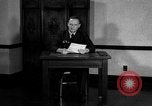
Charles A. Lindbergh speaks against United States participation in European Wars early in World War 2.
Charles A. Lindbergh delivers an anti-war speech early during the outbreak of World War II in Europe. Lindbergh speaks in a studio of the Mutual Broadcasting System. He speaks against American involvement in wars in foreign lands. He states that the Americans should not be asked to fight in foreign countries, but to focus on defense of the United States. Among other things, Lindbergh says: "The doctrine that we must enter the wars of Europe, in order to defend America, will be fatal to our Nation, if we follow it. When men are called upon to fight, and to die, for their country, there must not be even the remotest question of foreign influence involved." He states that Americans have no confidence in decisions of their leaders. He talks about the high number of aircraft and war materiel manufactured to fight in European countries. He talks about the affect on the National debt of the current spending for armaments and war production. He speaks out against the current American leadership (democratic party under Franklin Roosevelt) and how it did not do the right things to see what was coming in Europe and take steps to prevent it. He says that Americans are not confident in their leaders. Lindbergh speaks out against building of untold thousands of military aircraft, but he speaks in favor of a defense-focused American Air Corps.
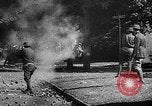
National Guard throw tear gas bombs to scatter the rioters in United States.
Riots and strikes in United States during period of labor unrest in the United States. A huge crowd on the street. Men rush forward and throw stones. National Guardsmen throw tear gas bombs. Buildings on the street. Vehicular traffic on the streets. Smoke rises up. The rioters scatter as the United States soldiers carrying bayoneted rifles give chase. Men stand on the sidewalk. Several men run. Men with cycles walk along the road. Police lead away a protestor.
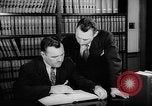
Federal Bureau of Investigation officers discuss German and Japanese agents and their activities in the United States.
The director of the Federal Bureau of Investigation (FBI) John Edgar Hoover talks about enemy agents and spies in the U.S. at the time of World War II. Two officers sit in an office. German and Japanese suspects in the United States. A German agent on a street. A Japanese spy takes photographs from a bridge. Purported Nazi German agents arriving as tourists in the United States. German and Japanese diplomats greeting one another and exchanging a Nazi salute. The conference room of the Federal Bureau of Investigation. Officers discuss the activities of Nazi German secret agents and Imperial Japanese agents operating in South America. Nazi signs on an animated map show the advance of German agents in areas such as Patagonia. Narrator states that Nazi German and Imperial Japanese agents setup radio listening posts in multiple locations in South America to track and report on U.S. shipping in the world's oceans. Animated map shows settlements northward migration through Brazil of "more than 300,000 Japanese colonists". Animation shows expansion of German airline services through South America from Argentina to Colombia.
CRITICALPAST.COM: About Us | Contact Us | FAQs - How to Order | License Agreement | My Account | My Lightboxes | Shopping Cart | Advanced Search | Featured Collections | Website Terms & Conditions | Privacy Policy ©2026 CriticalPast LLC.
License Agreement |
Terms & Conditions |
Privacy Policy
©2026 CriticalPast LLC.