


 Francais
 Deutsch
 Italiano
Refine Your Search
Ohio-State-football stock footage and images
- Showing 14977 to 14982 of 24492 results more
more Hide
Hide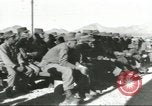
A U.S. Army Captain lectures troops at Camp Desert Rock, about protection against radiation from an atomic explosion
U.S. Army troops seated in an outdoor theater in Camp Desert Rock, Nevada, are briefed by a Captain, about radiation from an airburst atomic explosion. Closeups of some of the soldiers. The Captain standing in front of a blackboard. He writes, "1 mile" on the blackboard, while noting that beyond that, a lethal dose of radiation is unlikely. He writes and describes Alpha, Beta, Gamma, and Neutron emmissions from an atomic explosion, noting that gamma radiation and neutrons are the emissions of most concern to humans, but they can be stopped by shielding, He mentions steel, concrete, and earthen shielding. Animated images illustrate blast effects and narrator states that protection from blast will protect from half of any radiation. He holds up a film badge and explains that a badge or dosimeter will allow radiation protection specialist to determine the amount of any radiation received by its wearer. Closing view of the outdoor theater.
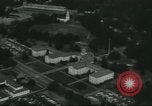
U.S. Army infantrymen learn to fire rifles, repair vehicles and communicate during a training at Fort Benning in Georgia,US.
Training of U.S. Army infantrymen at Fort Benning in Georgia, United States. Aerial view of the U.S. Army Infantry School at Fort Benning. Infantrymen run on a field during their physical training. They are vaccinated. They give measurements for their uniform. An officer instructs them in a classroom. They learn to use rifles and other weapons. They study theory to be applied in field. They learn techniques of communication and vehicle repair. After maneuvers the infantrymen advance in a battlefield and fire artillery.
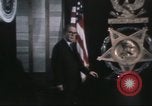
Views of three versions of the Medal of Honor for different branches of the service shown at Hall of Heroes in the Pentagon
John Charles Daly speaks about the recipients of the Medal of Honor in various wars. He stands next to large facsimiles of the medal in the Hall of Heroes at the Pentagon in Arlington, Virginia, United States. He explains the three versions of the Medal of Honor which include first for the U.S. Army, the second for the U.S. Navy , Marine Corps, and Coast Guard, and the third for the U.S. Air Force. Dramatized past scenes show American colonial volunteers advancing on a battlefield and firing artillery against the British, during the Battle of Saratoga in the year 1777.
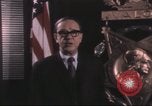
American struggle for recognition as an independent nation, is illustrated by reenactments of battles in the War of 1812
John Charles Daly standing in the Hall of Heroes at the Pentagon in Virginia, United States, speaks of the period prior to the establishment of the U.S. Medal of Honor. Reenacted scenes of the War of 1812 are shown, including British and American naval engagements and Americans fighting British regulars in the Battle of New Orleans in 1815 .
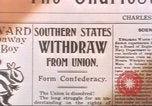
Reenactments of American military in action during the Civil War and Indian Campaigns
John Charles Daly, standing in the Hall of Heroes at the Pentagon in Arlington, Virginia, speaks about recipients of the Medal of Honor during the Civil War and Indian Campaigns. Excerpts from films about those events are then shown. A newspaper headline reads 'Southern States withdraw from Union'. Dramatized scenes: Men fire artillery during the American Civil War in 1861. Soldiers mounted on horseback advance on a battlefield. A montage of current day scenes show battlefield at Gettysburg and various memorial statues commemorating Union soldiers of the Civil War. . Mr. Daly points at names of Civil War Union heroes (1861-1865) and heroes of Native American Indian Campaigns (1861-1898) in the Hall of Heroes at the Pentagon in Virginia.
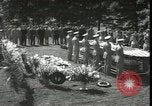
Secretary of Japanese-American Citizens League Masaoka delivers a brief eulogy during Nisei services at Arlington Cemetery.
Nisei services at Arlington National Cemetery in Virginia, United States. Mr. Michael Masaoka National Secretary of the Japanese-American Citizens League Anti-Discrimination Committee, the first volunteer for service in the U.S. 442nd Infantry Regiment, delivers a brief eulogy. Taps are sounded. The flags which were held over the caskets are folded by men. Soldiers parade. Folded flags are presented to the families by U.S. General Jacob Devers.
CRITICALPAST.COM: About Us | Contact Us | FAQs - How to Order | License Agreement | My Account | My Lightboxes | Shopping Cart | Advanced Search | Featured Collections | Website Terms & Conditions | Privacy Policy ©2026 CriticalPast LLC.
License Agreement |
Terms & Conditions |
Privacy Policy
©2026 CriticalPast LLC.