


 Francais
 Deutsch
 Italiano
Refine Your Search
Ohio-State-football stock footage and images
- Showing 16147 to 16152 of 24492 results more
more Hide
Hide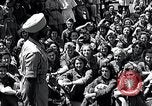
Women's Army Auxiliary Corps (WAAC) training and and contribution to war efforts in different parts of the world (WW2)
The role of Women's Army Auxiliary Corps (WAAC) in the United States Army during World War II. In January 1943, the first posting of WAAC enlisted personnel overseas, was to Algiers. Women disembark a ship. WAAC women walk with orphan children into a convent. A WAAC woman washes utensils; others dry clothes. WAAC women arrive in Scotland and get trained. Women visit India. Women at the Taj Mahal in Agra. Women visit New Delhi. Women on camels in Cairo. Women disembark a ship in Europe. Two women adjust a tent. Woman washes her hair and clothes using her helmet. Women inside a tent. Woman checks injured soldiers. Nurses in hospital as they look after soldiers. Women march. A woman pays homage to the female soldiers who sacrificed their life in war. Soldiers carry another injured soldier on stretcher. Officers check injured women in hospital. Women in uniform march.
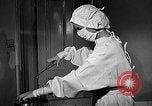
Army nurses treat injured soldiers while doctors perform surgery and women work in the communication department in Korea
The film 'The Big Picture' depicts the role of women in the U.S. Army in Korea. An Army nurse removes a dressing from sterilizer, with tongs, and gives it to surgeon, during operation. A team of doctors perform surgery. Physician works on soldiers. The leg of the soldiers dipped in a water tub. Nurse wipes the legs of soldier using a towel. A nurse teaches physical therapy exercises to recovering soldiers. Nurses treat soldiers in a medical van. Women work in the communication department. Woman works on typewriter. Yokohama, Japan: A quonset hut reads 'WAC Detachment Yokohama command 8064th army unit'. U.S. army women come out of the building. The local women stand. Woman arranges paper on a table. The Eiffel tower. Women work in office. Women eat on snow. A woman with a soldier as she examines a gun. A nurse helps an injured soldier. U.S. Army General Matthew Bunker Ridgway states that he is proud to have women in the army and needs many more to contribute. Captain Carl Zimmerman concludes the program.
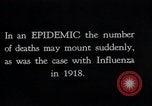
A graph shows a sudden increase in the deaths in New York City due to 1918 influenza pandemic and other diseases.
A graph shows a sudden increase in the deaths due to influenza in New York City during the 1918 Spanish flu epidemic. Spike in the graph is shown for the 1918 influenza outbreak. Slide states "A steady decline of the death rate is shown by communities in which an intelligent public uses the results of scientific knowledge." A strata chart shows the deaths per one thousand people during the period from each of pneumonias, tuberculosis, and cerebro-spinal meningitis, and then deaths from the diseases summed. A chart at the end reads, "What sciences hope to do" and then it reads "Reduce all transmissible diseases to 0 - With the cooperation of an intelligent public."
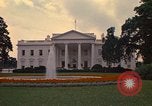
Front entrance of the White House, Washington, DC
Front view of the White House, official office and residence of the president of the United States at 1600 Pennsylvania Avenue N.W. in Washington, DC. Beautiful flowers blooming around fountain on the front lawn. Guard post seen in left distance, with people entering past it. American flag flying from pole on roof of the White House. Flag pole is topped with a gold eagle.
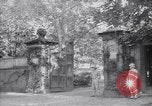
Front of Dumbarton Oaks in Georgetown U.S.
Front gate of Dumbarton Oaks with a car driving inside. A plaque outside inscribed with "Dumbarton Oaks" is there. Front of the building where men with military police walking inside. Exterior of Executive Office Building of State Department. September 1944.
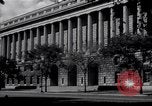
Washington DC scenes. IRS Service Building. Washington Monument. Washington Channel.
Several views of Washington DC. Views of the Internal Revenue Service Building, at 10th Street and Pennsylvania Avenue. The Washington monument can be seen from various viewpoints. The Washington Channel, as viewed from Hain's Point, looking toward Maine Avenue. Boats in the harbor. View of the Washington Monument (2 15th St NW, Washington, DC 20024, United States) as seen from inside the Lincoln Memorial, across the reflecting pool.
CRITICALPAST.COM: About Us | Contact Us | FAQs - How to Order | License Agreement | My Account | My Lightboxes | Shopping Cart | Advanced Search | Featured Collections | Website Terms & Conditions | Privacy Policy ©2026 CriticalPast LLC.
License Agreement |
Terms & Conditions |
Privacy Policy
©2026 CriticalPast LLC.